Quick summary
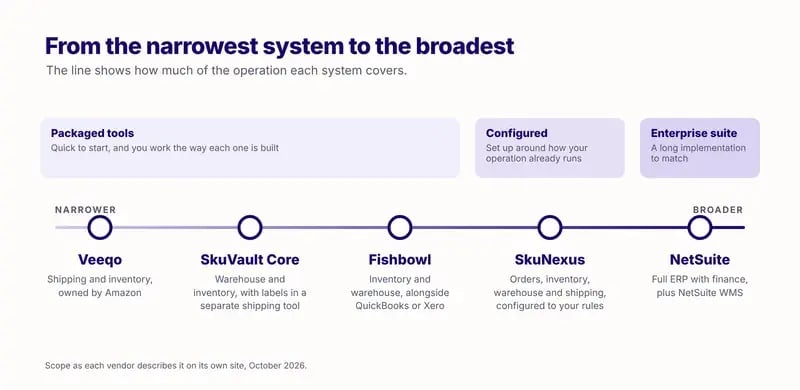
The right ShipHero alternative depends on how much of your operation you want one system to run. For brands that run their own warehouse, SkuNexus is our top pick. The other four run from the narrowest system to the broadest:
- SkuNexus fits brands with several warehouses and routing, split or dropship rules to automate.
- Veeqo fits Amazon-heavy sellers who want shipping and inventory in one tool.
- SkuVault Core fits brands that want barcode control and already ship through ShipStation or ShipWorks.
- Fishbowl fits brands whose books live in QuickBooks or Xero.
- NetSuite fits brands that want finance and the warehouse in one ERP.
First, a quick distinction: this list is for brands, not 3PLs
ShipHero serves two types of businesses: brands that fulfill their own orders and third-party logistics providers (3PLs) that store and ship products for other companies.
There's some overlap in what they need. Both have to track inventory, manage warehouse staff and ship orders accurately.
But a 3PL also needs things like client-specific billing and account management. A brand running its own warehouse is usually more concerned with keeping its storefronts, inventory, fulfillment locations and accounting software working together.
We're focusing on that second group.
If you run your own fulfillment operation, whether from one warehouse or several, these are the alternatives we'd look at.
Why listen to us?
I'm Yitz Lieblich, founder and CEO of SkuNexus.
I've worked in eCommerce for almost two decades. Over the years, I've spent a lot of time inside warehouses, seeing how businesses actually receive stock, process orders and get shipments out the door.
One example is Graeter's Ice Cream.

When we started working together, Graeter's had three warehouses operating with disconnected inventory information. The team also had to work out how much dry ice each shipment needed. We helped bring those warehouses into one system and automate the fulfillment process, including the dry ice calculations. Graeter's now processes its orders automatically from intake through label generation.
That experience shapes how I look at warehouse software. I'm less interested in how many features a platform advertises and more interested in whether it can handle what actually happens in your operation, especially when an order doesn't follow the usual process.
SkuNexus is one of the tools in this guide, so we're not a neutral reviewer. I'll explain where we fit, but I'll also point out situations where another option makes more sense.
What is ShipHero?
ShipHero is a warehouse management system designed for eCommerce brands and 3PLs.
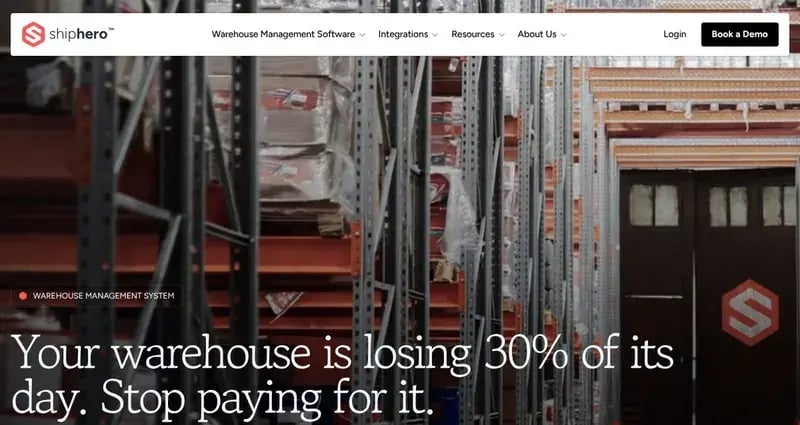
It brings the main warehouse processes into one platform, from receiving stock through picking, packing and shipping customer orders.
Its capabilities include:
- Inventory tracking across warehouse locations.
- Receiving, putaway and replenishment.
- Barcode-based picking and packing.
- Batch picking and other warehouse picking methods.
- Shipping labels and carrier rate comparisons.
- Returns, kits, lot tracking and serial number tracking.
- Labor management through WorkforceHero.
- Multi-warehouse order allocation and automation.
ShipHero also offers hardware-supported workflows, including Pick-to-Light, which uses lights on picking carts to guide warehouse staff.
So there's plenty it can do well.
The question is whether its approach to routing, integrations and warehouse workflows suits your business.
Why do some brands look for ShipHero alternatives?
From what we've seen in customer feedback and ShipHero's documentation, there are a few areas worth looking at carefully before committing.
1. Support when something goes wrong
Support matters with any business software, but particularly with a WMS.
If something goes wrong with a purchase order, inventory count or shipping workflow, your warehouse team may not have the luxury of waiting several days for an answer.
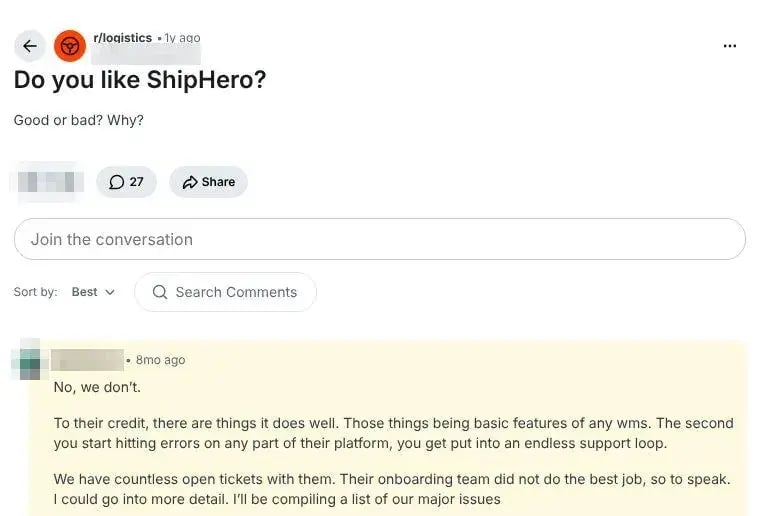
Some ShipHero customers have reported frustrations here.
For example, one user in a Reddit discussion about ShipHero described getting caught in repeated support exchanges when technical problems appeared. Another user reported having multiple unresolved issues.
But the feedback isn't universally negative.
In an October 2026 Shopify App Store review, a brand praised ShipHero's onboarding and ongoing support, even while acknowledging that the software took time to learn.
These are individual experiences, not proof that support is consistently good or bad.
Our advice is to ask how urgent operational issues are handled. Find out what support channels you'll have, how escalations work and who helps when an issue prevents orders from shipping.
2. Keeping stores, locations and the books in sync takes work
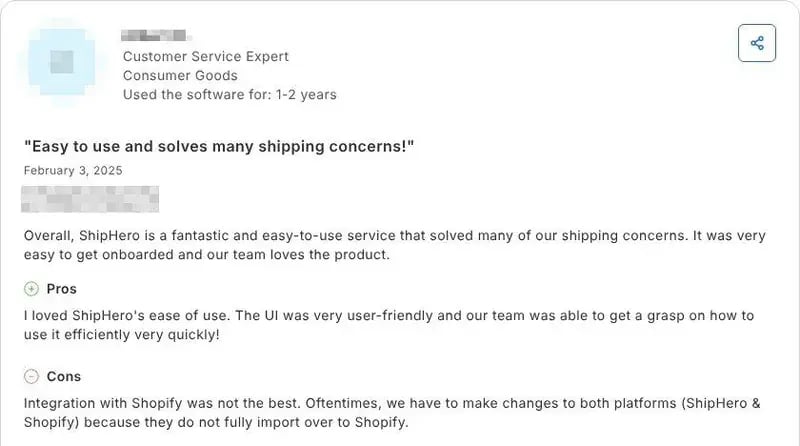
Changes made in ShipHero don't always reach Shopify. One consumer goods company makes its changes in both systems, because they "do not fully import over to Shopify."
If you run several locations, keeping them in sync gets trickier. One UK brand uses a 3PL that runs ShipHero. The brand said the app would "sync ALL orders at ALL locations", even ones its 3PL doesn't ship from. Adjusting an order at one location also changed inventory at every location.
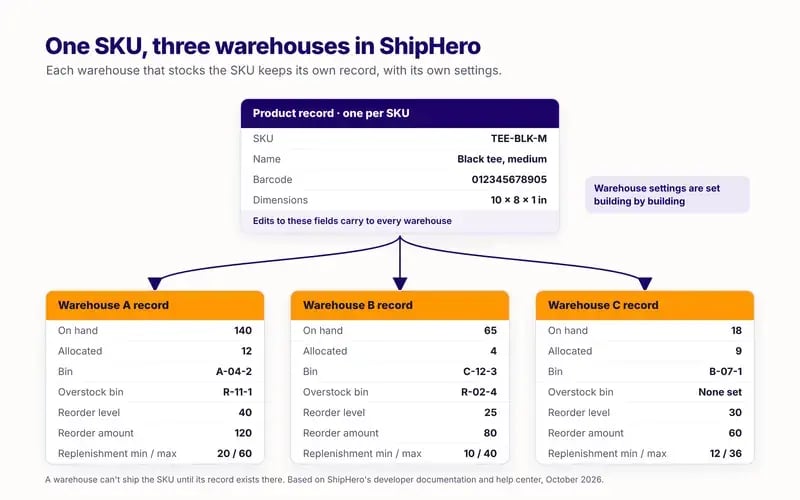
Under the hood, every warehouse that stocks a SKU gets its own warehouse product record. Each one holds that building's on-hand count, bins, reorder point and replenishment levels. So you're setting those up building by building.
On the accounting side, ShipHero's QuickBooks Online integration is only available to 3PL accounts in the US. That matters, since buyers named QuickBooks in 20 of the 78 conversations behind our WMS buying benchmark.
3. Routing and dropshipping workflows
ShipHero supports multi-warehouse fulfillment. Its Multi-Warehouse Allocation rules can assign items based on conditions such as warehouse availability, order information and product attributes.
It can also split orders across warehouses.
Where you need to pay closer attention is how those rules behave when something changes.
When Multi-Warehouse Allocation is enabled, the allocation rules control warehouse assignment. You can't simply override the assigned warehouse on an individual order from the usual order field. To change the allocation, you generally need an appropriate rule and to reprocess the order.
That may be perfectly fine if your fulfillment operation follows established rules.
But if your team frequently makes exceptions, you'll want to test how quickly those changes can be made.
Dropshipping is another useful example. ShipHero's documented dropship process lets you create a supplier shipment and notify the vendor. Once the vendor ships, someone needs to mark the shipment complete and enter its tracking details.
If you work with several suppliers, ask how much of that process can be automated for your particular setup.
4. Reporting and operational visibility
A WMS should help you understand what's happening in your warehouse without spending hours putting reports together.
ShipHero provides reporting and data export capabilities. Still, some customers have raised concerns about the detail and accuracy of particular reports.
In a February 2026 Reddit discussion, a ShipHero customer said they were experiencing reporting errors and difficulties getting an accurate inventory valuation report.
That's one customer's account, not a verified product-wide problem.
But it's a good reason to test reporting before making a decision.
Ask each vendor to show you the reports your team already uses, particularly inventory valuation, stock discrepancies, fulfillment performance and order exceptions.
You want to know whether those reports work out of the box, require configuration or need additional work outside the system.
5 ShipHero alternatives for brands that keep fulfillment in-house
1. SkuNexus
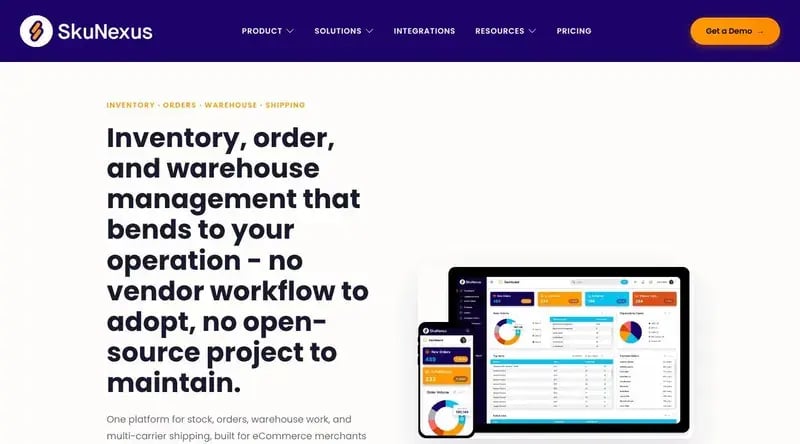
SkuNexus is our inventory, order and warehouse management platform for growing eCommerce businesses.
We built it for merchants whose fulfillment operations have become too complicated to manage through basic settings or disconnected tools.
That might mean shipping from several warehouses, sending orders to different dropship vendors, managing multiple stores or following special packing and shipping requirements.
The main idea behind SkuNexus is that your fulfillment rules should reflect how your business operates.
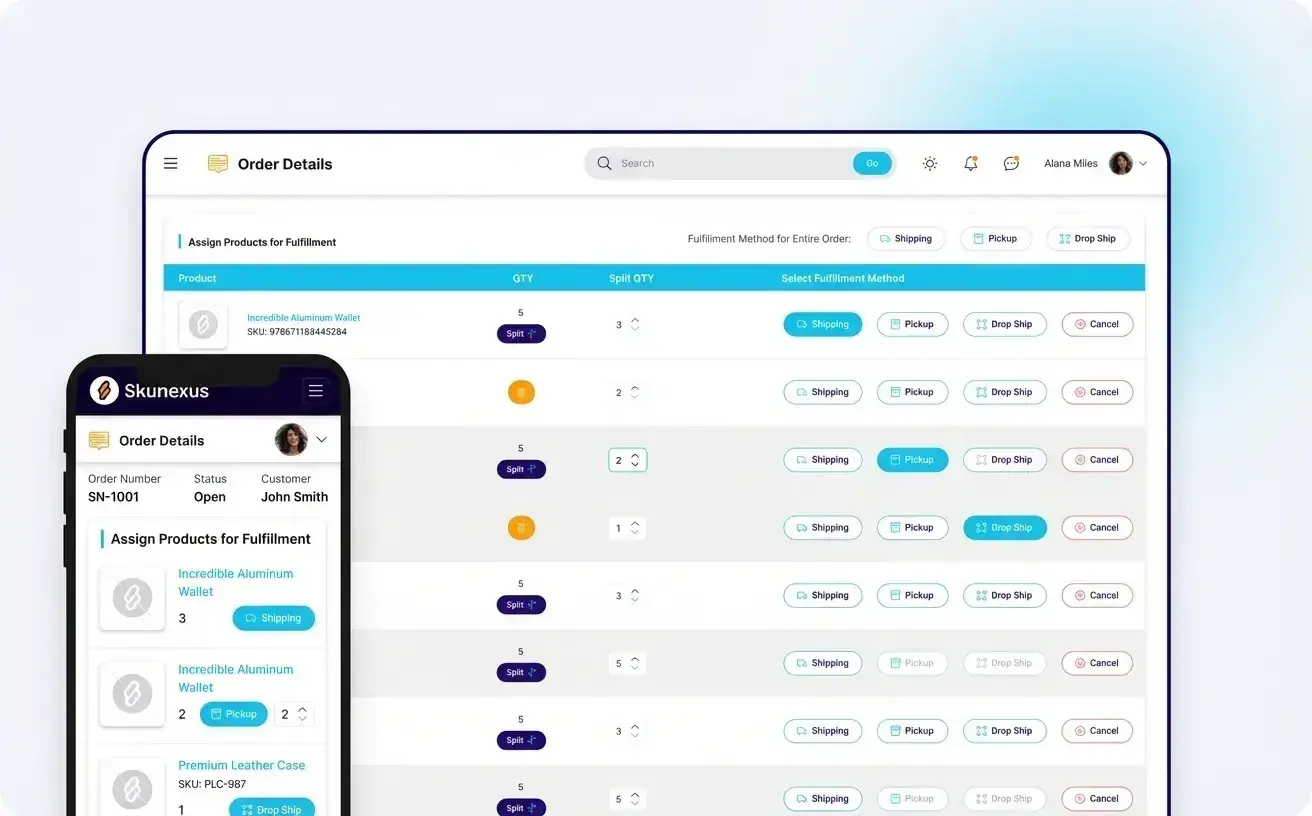
Our Auto-Decision Engine uses configurable IF/THEN rules to decide what happens to an order.
For example, you could route an order to a warehouse based on available stock and delivery location.
If an order contains products that need to come from different sources, SkuNexus can split it. Your warehouse can ship the products it holds while a supplier handles the dropship items.
Those rules are managed inside the platform, so your operations team can make many routine changes without needing a developer.
And when a workflow requires something more specific, we can help configure or develop it.
How that works in practice
Carewell is a good example.
Carewell uses a dropshipping model, with products fulfilled by different vendors rather than shipped from its own stock.
SkuNexus helps route orders to the appropriate vendors and automates purchase order generation. That means the team doesn't have to manually create and send each supplier order as sales come in.
Where it differs from ShipHero
The biggest difference from ShipHero is how stock is tracked across warehouses.
In SkuNexus, each SKU stays a single record, with stock tracked by warehouse and bin underneath it. So when you open a new building, you add its locations to the catalog you already have.
It's also designed for brands rather than 3PLs, so everything in it assumes the stock on your shelves belongs to you.
One lifestyle brand running five Shopify stores evaluated ShipHero before choosing us. The team found ShipHero had what they needed, but for a business their size, it felt over-engineered.
Key features
- Barcode-driven warehouse work: Receive, put away, pick and count by scan, with wave picking and directed putaway.
- Split fulfillment: Ship part of an order from your warehouse while a vendor dropships the rest.
- Rate shopping at the pack station: Compare FedEx, UPS, USPS, DHL and regional carriers on every shipment, with layered carrier rules.
- Priority queues: Send VIP, express or high-value orders to the floor first.
- Working connectors: Connect Shopify, BigCommerce, Magento 2, WooCommerce, Shopware 6, Walmart and QuickBooks Online, with sync direction set per record type.
- ERP-friendly setup: Keep NetSuite, QuickBooks or Xero for the books while SkuNexus runs orders and the warehouse.
- Source code on the enterprise tier: Get the PHP/Laravel codebase when configuration alone won't cover a workflow.
Pros
- Your team can change routine routing rules directly, without opening a support ticket.
- Opening a new warehouse doesn't mean setting up your products again.
- Custom workflows can be configured or developed for you, so you don't wait on a product release.
Cons
- There's no direct Amazon or eBay adapter, so those orders arrive through a storefront feed or SFTP files.
- Channel sync polls every five minutes on Shopify and every sixty minutes elsewhere by default.
- Setup starts with a business analyst mapping your workflows, so plan on a few weeks before go-live.
2. Veeqo
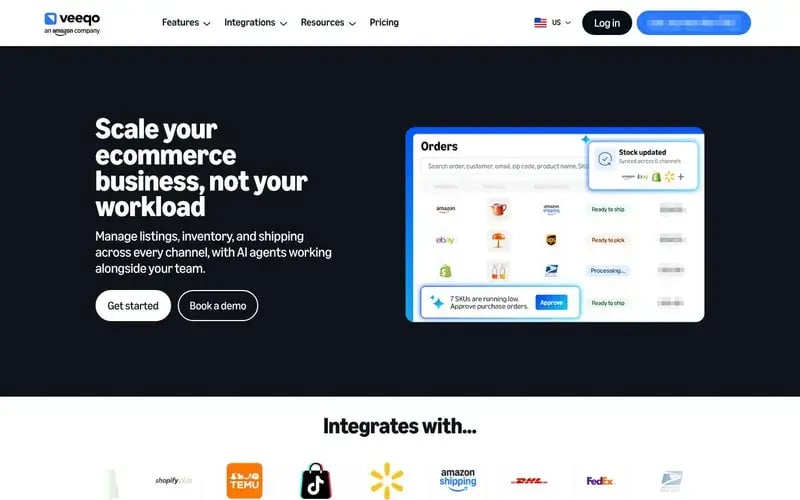
Veeqo is an Amazon-owned shipping and inventory platform for online sellers.
It's particularly worth considering if Amazon is an important sales channel for your business and you fulfill orders from your own warehouse.
Veeqo brings orders from connected stores into one dashboard, lets you compare carrier rates and helps your team generate shipping labels.
One advantage for Amazon sellers is its connection to Amazon Buy Shipping. Eligible labels can carry protections for certain delivery-performance metrics and claims, depending on the service and conditions.
Key features
- Rate shopping: Compare live carrier rates for each package and buy up to 100 labels in one click.
- Digital picking: Pick in batches with the Veeqo Scanner or the mobile app, in bin-location order.
- Warehouse transfers: Track stock by location and move it between warehouses.
- Bundles and kits: Link a bundle listing to its components so stock stays right for each part.
Pros
- Amazon orders ship on protected labels through Buy Shipping.
- Packers can be required to scan every item before an order ships.
- Channels include Amazon, eBay, Etsy, Walmart, Shopify, BigCommerce, WooCommerce and TikTok Shop.
Cons
- Warehouse choice is a priority list or the nearest location, with no rule that assigns one.
- It's only available to sellers in the US and UK.
- QuickBooks Online connects through a third-party app, and Veeqo isn't taking new Xero connections.
3. SkuVault Core
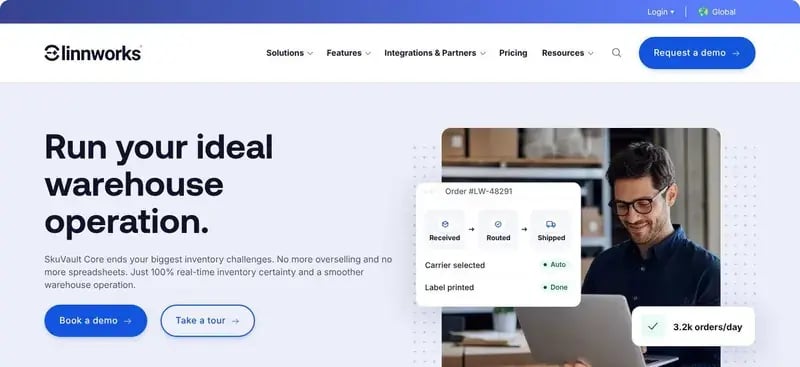
SkuVault Core, formerly SkuVault, is warehouse and inventory software from Linnworks, which bought SkuVault in 2022. It fits a brand whose biggest problems are on the warehouse floor. Linnworks itself calls SkuVault Core "the more focused solution" for that kind of problem. Keep in mind it's only sold in North America.
For shipping, you'll pair it with another tool, like ShipStation or ShipWorks, which handles labels and carrier rates. Linnworks added routing across warehouses in 2024 with a separate module, Order Management for SkuVault. Ask to see it route your own orders before you commit.
Key features
- Scan-checked packing: Catch the wrong item at the pack station with barcode scans and quality control.
- Digital picklists: Send pickers a route the system works out for each list.
- Zones and bins: Map each warehouse into zones and bin types, and track transfers between them.
- Cycle counts: Get an audit report of every discrepancy after a recount.
Pros
- Barcode quality control catches errors before the box ships.
- One account holds several warehouses, with transfers tracked at every stage.
- Kits and bundles track component stock as orders come in.
Cons
- It has no labels or rate shopping of its own.
- Routing between warehouses depends on a separate Linnworks module.
- Brands outside North America can't buy it.
4. Fishbowl
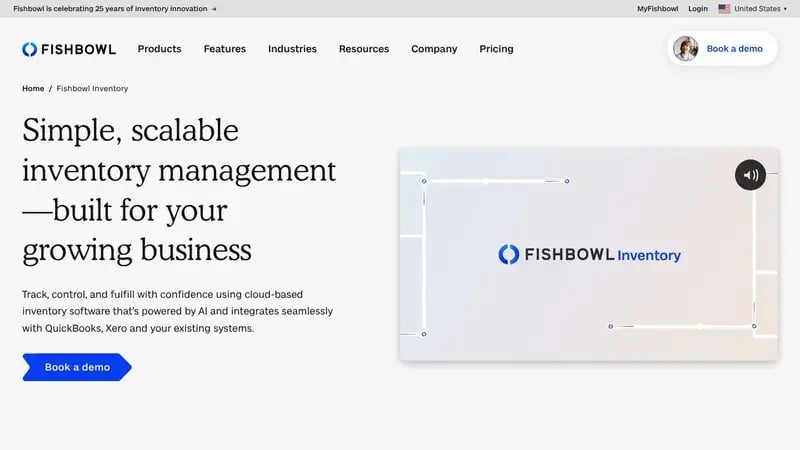
Fishbowl is an inventory management platform with strong accounting integrations.
It's worth considering if you already have your finances organized in QuickBooks or Xero and don't want to replace that system simply to improve how your warehouse operates.
Fishbowl offers different products for different operational needs.
- Fishbowl Inventory is its cloud-based product for businesses that buy, stock and sell finished goods. Depending on the plan, it supports barcode scanning, order fulfillment, multi-location inventory and lot tracking.
- Fishbowl Advanced is aimed at more demanding warehouse, distribution and manufacturing operations. It supports deeper processes such as production management, complex fulfillment and EDI workflows.
Fishbowl offers cloud-hosted deployment for Advanced, with other deployment options available. For shipping, Fishbowl provides integrations with tools such as ShipStation, while Fishbowl Advanced also has ShipExpress capabilities.
If you need sophisticated supplier-based dropshipping, Fishbowl has partners such as Spark Shipping that add supplier routing and automation.
Key features
- Accounting sync: Sync with QuickBooks Online, QuickBooks Desktop (on Fishbowl Advanced) or Xero on a schedule.
- Mobile scanning: Receive, pick and count with Fishbowl's mobile app, including batch picks.
- Lot and expiry tracking: Record lots, serial numbers and expiration dates, and pick the oldest expiration first.
- Built-in shipping: Compare rates and print labels through the ShipExpress plugin, or send orders to ShipStation.
Pros
- QuickBooks or Xero stays the book of record, so your accountant's setup doesn't change.
- Oldest-expiry-first picking suits food and other dated goods.
- Retail EDI runs through partners like SPS Commerce on Fishbowl Advanced.
Cons
- Each channel order goes to one warehouse, and order splitting isn't documented.
- Accounting and channel sync run on a schedule, from daily down to every minute.
- Multi-warehouse operations get steered to a desktop product.
5. NetSuite
NetSuite is Oracle's cloud ERP, covering accounting, orders, inventory, supply chain and warehouse operations in one suite. It fits a brand that wants the books and the warehouse in the same system. You'll also need your own team, or a partner, to implement and run it.
NetSuite WMS directs putaway and picking on mobile RF scanners, and Automatic Location Assignment picks each order line's warehouse. Implementation is the big commitment. NetSuite's own guidance puts moderately complex mid-market projects at four to 11 months.
Key features
- NetSuite WMS: Direct putaway and picking on mobile RF devices, with wave release and FEFO picking.
- Automatic Location Assignment: Assign each order line a warehouse by closest, highest-ranked or workload rules.
- Smart Count: Run cycle counts without freezing transactions across the location.
- Financials on the same records: Keep the general ledger, receivables and payables next to the inventory.
Pros
- Finance and the warehouse share one suite, so there's no integration between the books and the floor.
- Location assignment covers common multi-warehouse rules, like nearest location or a ranked list.
- FEFO picking helps dated stock leave in the right order.
Cons
- NetSuite WMS needs Advanced Inventory Management plus two SuiteApps before it runs.
- Labels and rate shopping go through Ship Central and a ShipStation API account inside NetSuite.
- Ship Central doesn't support LTL freight or pallets.
Selection criteria
How we evaluated these ShipHero alternatives
We focused on software that a brand could use to manage its own inventory and warehouse fulfillment.
That means we left out tools built mainly for outsourced 3PL services and applications that only print shipping labels.
We looked at each vendor's product information and documentation, with particular attention to five questions:
- Inventory: Can you see accurate stock levels across your warehouses and sales channels?
- Order routing: How does the software decide where an order goes, and what happens when it needs to be split?
- Warehouse operations: Can your team receive, pick, pack and count stock without relying on manual workarounds?
- Integrations: How does the system work with your eCommerce platforms, accounting software and shipping providers?
- Implementation: What needs to happen before the system is ready to run your operation?
We also considered publicly available customer feedback. Reviews can highlight issues worth investigating, but they don't establish how frequently a problem occurs or whether it still exists in the latest version.
How to choose the right ShipHero alternative
I'd start with the problem you're actually trying to solve, rather than comparing every feature on a checklist.
- If shipping Amazon orders takes too much time, look at Veeqo. Its Amazon connection and shipping tools may cover much of what you need.
- If warehouse mistakes are your biggest headache, look at SkuVault Core. Its barcode-based workflows and inventory controls are a good place to start.
- If you want stronger inventory management around QuickBooks or Xero, Fishbowl is worth evaluating. Just choose the product that matches your warehouse requirements.
- If your team keeps working around complicated routing or fulfillment rules, SkuNexus is the option we'd put forward. That's where our customization and order automation capabilities become particularly useful.
- If you're replacing several business systems with a broader ERP, NetSuite deserves consideration, especially if finance and warehouse operations need to share the same platform.
And you may not need to leave ShipHero at all.
If your team is happy with picking, packing and shipping, and its allocation rules cover your requirements, there's little reason to take on a software migration simply because another tool offers more customization.
Whichever products make your shortlist, ask the vendor to show you how they'd handle an actual order from your business.
Not a standard order where everything is in stock and ships from one warehouse.
Choose the awkward one. The order that needs two fulfillment locations, requires a supplier, has special packing instructions or regularly ends up on somebody's spreadsheet.
You'll learn much more from that than from another product tour.
Bring your most complicated order to the demo
Before choosing your next WMS, write down a few things about your operation: how many SKUs you manage, where you hold inventory, which sales channels you use and how orders are currently routed.
Then identify one process your team still handles manually.
Maybe it's splitting an order between a warehouse and a supplier. Maybe it's choosing the right fulfillment location, or applying special shipping requirements for certain products.
That's the process I'd ask every vendor on your shortlist to demonstrate.
If SkuNexus looks like a fit, bring that example to a demo. We'll walk through your workflow, discuss how we'd handle it and explain what would need configuring.
And if your requirements are better suited to a simpler tool, we'll tell you.
FAQs
Is ShipHero a good WMS?
Yes. ShipHero is a capable WMS for brands and 3PLs. It covers batch picking, lot and expiration tracking, serial numbers, kitting, returns and labor reporting. Still, check a few limits against how your warehouse runs. Serial numbers don't work with kits, and ShipHero has to switch on multi-warehouse routing for brand accounts.
What is ShipHero fulfillment?
ShipHero Fulfillment was the 3PL network ShipHero launched in 2019, running on its own WMS. ShipHero has since spun it off as a separate company, LVK, a 3PL that runs on ShipHero's software. ShipHero's About page now says "We don't run warehouses. We power them." So today, ShipHero sells software, and LVK runs the outsourced fulfillment.
Who owns ShipHero?
Aaron Rubin founded ShipHero and still runs it as CEO. He started building it in 2013, when he couldn't find warehouse software for his own direct-to-consumer brand. Riverwood Capital led ShipHero's first institutional funding round in 2021, according to ShipHero's newsroom.
Does Amazon use ShipHero?
There's no sign Amazon runs on ShipHero. ShipHero lists Amazon as a sales channel it connects to, through Seller Central and Amazon's Buy Shipping. It imports the orders you fulfill yourself, but it doesn't import Fulfilled by Amazon (FBA) orders. Amazon does own shipping and inventory software for sellers, and that's Veeqo.
Related alternatives guides
Ready to Transform Your Operations?
See how SkuNexus gives you full control over inventory, orders, warehouse, and shipping.
Schedule a Free Demo →
Keep Reading