Quick summary
If you're considering replacing Brightpearl, I'd start by asking what's no longer working in your operation. Is it reporting? Order routing? Warehouse processes? Or do you need a different way to manage accounting alongside fulfillment?
Here are five alternatives worth comparing:
- SkuNexus: Best for merchants keeping their current accounting or ERP system who need more control over order routing, warehouse workflows and shipping.
- NetSuite: Best if you want a full ERP to manage accounting, inventory and operations together.
- Cin7 Omni: Best for retailers and wholesalers that need built-in EDI, point of sale and multichannel inventory management.
- Linnworks: Best for merchants selling across several marketplaces and online stores.
- Extensiv Order Management: Best for brands managing orders across their own warehouses and third-party fulfillment partners.
Looking for a Brightpearl alternative?
Brightpearl is a retail operating system owned by Sage. It brings orders, inventory, purchasing, warehouse management, shipping, CRM and accounting together in one platform.
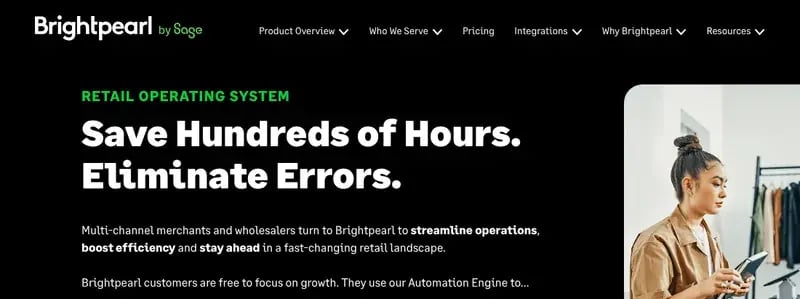
It also connects to platforms such as Shopify, BigCommerce, Amazon and eBay, as well as external accounting software including QuickBooks, Xero and Sage Intacct.
That's a lot of functionality, and for many retailers, it works well.
But you might be spending too much time creating reports, working around fulfillment rules or managing integrations that don't behave quite how you need them to.
The important thing is figuring out which parts of Brightpearl you actually want to replace.
If your accounting setup works, you might want a new inventory and fulfillment platform without changing your books. If you're looking to replace everything, a full ERP might make more sense.
Let's look at both options.
Why listen to us?
I've worked in eCommerce since 2007, and I built SkuNexus in 2018. Our customers run the kind of operations Brightpearl merchants are moving from.
New Look Vision Group is Canada's largest eyewear retailer. It connected SkuNexus to its ERP, POS, Magento 2 store, CMS and Canada Post across 477 locations. The project took nine months from first analysis to go-live, with zero disruption to the business. At Graeter's Ice Cream, packers used to calculate dry ice by hand on every shipment. We built that calculation into their fulfillment workflow across three warehouses.
SkuNexus is one of the five tools below, so I'll be upfront about that. It won't be right for everyone, and each entry says clearly where a tool fits and where it doesn't.
The 5 best Brightpearl alternatives
On our sales calls, prospects tend to sort their options into three groups. There's packaged software you can get running quickly but may outgrow, and there are enterprise suites with long implementations. In between the two, you'll find a customizable operations layer. SkuNexus is first because it's ours, and it's the one I can tell you the most about. The other four follow, from the enterprise suite to the packaged platforms.
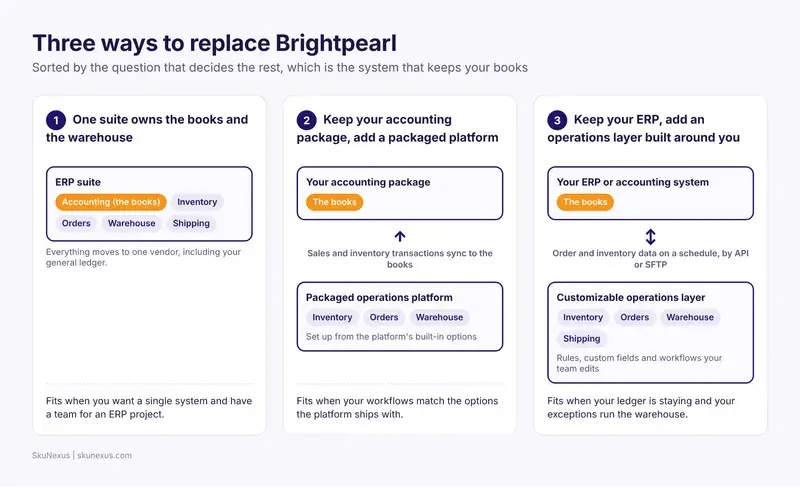
1. SkuNexus
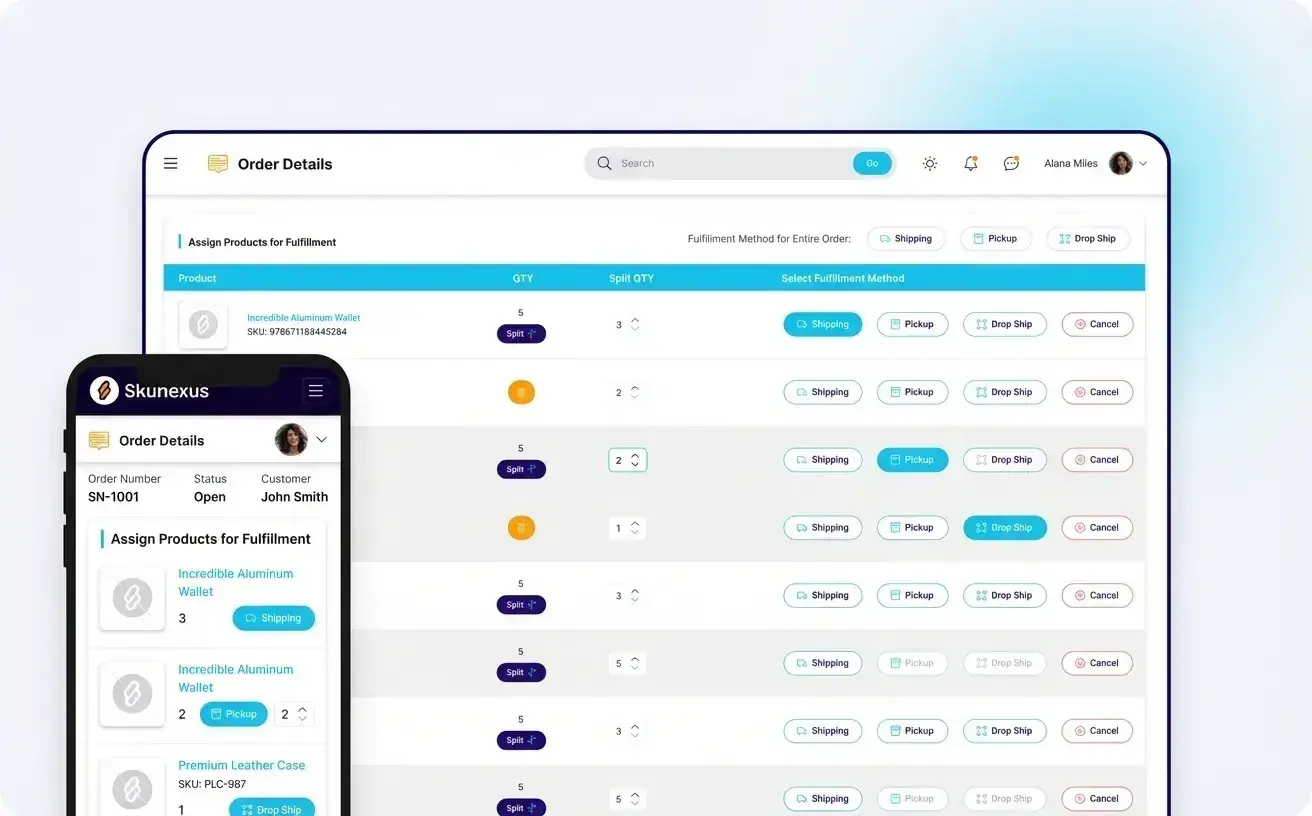
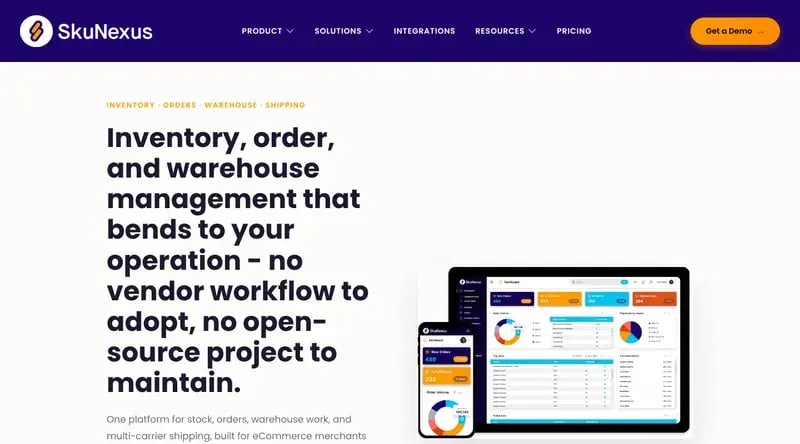
SkuNexus is a fully customizable inventory, order, and warehouse management platform for mid-market eCommerce merchants shipping 50 to 20,000 orders a day. We cover everything between the sale and the delivery, and we leave accounting out on purpose. As our About page puts it, "QuickBooks and Xero do it better."
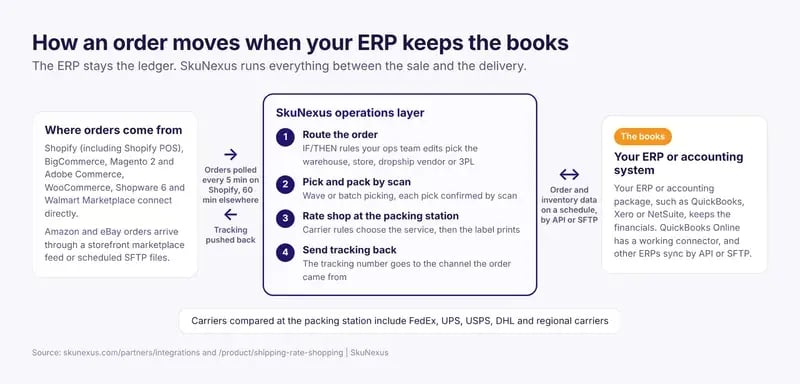
So your ERP keeps the financials, and SkuNexus owns the warehouse and the order lifecycle. Order and inventory data sync between the two on a schedule. That runs through the ERP's API where there is one, and over SFTP where there isn't. On each connector, you set the sync direction separately for orders, products, inventory, customers and fulfillments.
The bigger change from Brightpearl is who writes the warehouse rules. Your own ops team builds and edits them. Most merchants we work with cover 80% of their needs through rules, custom fields and workflow settings. The rest is handled by our development team, or through source code access on the enterprise tier.
Key Features
- Auto-Decision Engine: Route every order through IF/THEN rules to a warehouse, a store, a dropship vendor or a 3PL.
- Configurable workflows: Set up lot and FIFO picking, mixed pallet and parcel orders, or custom steps like Graeter's dry-ice calculation.
- Kitting and bundles: Sell a parent SKU and pick its components, and lower the parent's availability on every channel when a component runs low.
- Scan-driven warehouse: Receive against purchase orders, direct putaway, run cycle counts and confirm every pick by scan.
- Rate shopping: Compare FedEx, UPS, USPS, DHL and regional carriers at the packing station, then send tracking back to the sales channel.
- Connectors and API: Connect Shopify, BigCommerce, Magento 2, WooCommerce and QuickBooks Online, and everything else through the open API or file transfers.
Pros
- Your ERP or accounting system stays the ledger, so there's no second set of books.
- Your ops team can change routing and warehouse rules without waiting on a vendor.
- Exceptions like dry ice, kits that ship in several cartons, and pallets next to parcels can be configured into the workflow.
Cons
- There's no accounting, storefront or POS of its own, so you'll keep those systems.
- There's no direct Amazon or eBay adapter, so those orders come in through a storefront marketplace feed or scheduled SFTP files.
- Orders sync on a polling schedule, every five minutes by default on Shopify and every sixty minutes elsewhere.
2. NetSuite
NetSuite is Oracle's cloud ERP platform. It combines accounting, inventory, purchasing, order management and other business functions. If you're using Brightpearl for both accounting and operations, NetSuite gives you another way to manage those functions together.
It's particularly worth considering if your financial reporting has become more complicated, you're managing multiple business entities or you need broader ERP functionality.
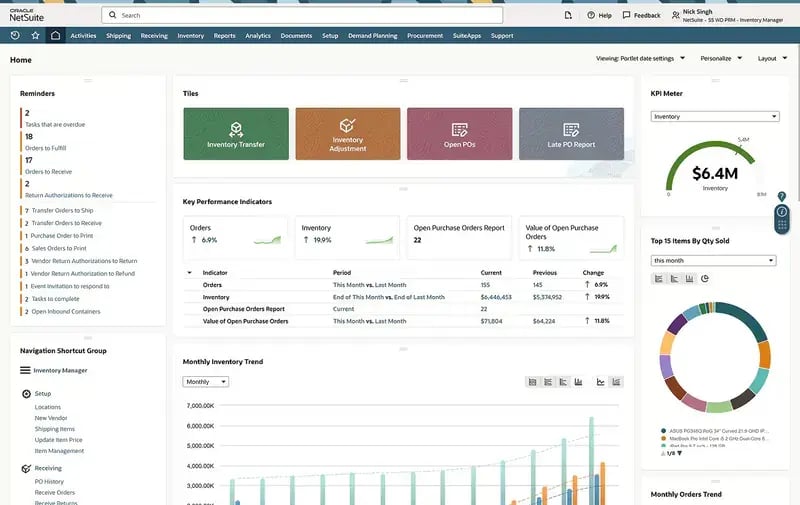
Key Features
- Lot and serial tracing: Trace inventory by lot and serial number.
- Order routing: Send orders to the most economical or closest location, with split shipments and drop ship.
- NetSuite WMS: Run RF barcode scanning, wave release, directed putaway and cycle counts.
- SuiteScript and SuiteFlow: Extend NetSuite in JavaScript, or build point-and-click workflows.
Pros
- Your books, orders and stock live in one system, so there's no sync to manage between them.
- The warehouse side goes deep, from lot and serial tracing to wave picking.
- It runs on Oracle Cloud Infrastructure and uses Oracle's AI services.
Cons
- It replaces your current ERP or accounting package, so it's a poor fit if you're keeping one.
- NetSuite's own implementation guide says a rollout takes as little as three months or longer than six.
- New customers ship through NetSuite Ship Central, which needs a ShipStation API account set up inside NetSuite.
3. Cin7 Omni
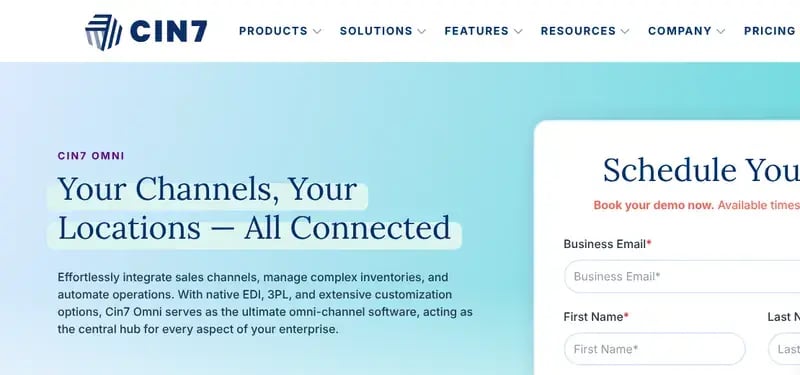
Cin7 Omni is the more customizable of Cin7's two products, and it's aimed at complex operations like multi-entity companies. Of the five, it's the closest match for Brightpearl's mix of stores and wholesale. It syncs with QuickBooks or Xero, and each sync creates a matching transaction in your general ledger. Our Cin7 alternatives guide covers how Omni differs from Cin7 Core.
Key Features
- Built-in EDI: Trade with major retailers through EDI connections that Cin7's engineers build and test for you.
- Multi-entity management: Automate the intercompany transactions between your business entities.
- Point of sale: Sell in stores from a browser-based POS that also works offline.
- 3PL integrations: Sync sales orders, purchase orders and branch transfers with your 3PL.
Pros
- EDI with major retailers is built into the platform.
- Stock control covers FIFO, batch and serial numbers.
- Your books stay in QuickBooks or Xero.
Cons
- It only connects to one Xero organization, because it's designed around a single financial entity.
- There's no dedicated expiry-date function, so food merchants often store expiry in the batch number, which Omni can't filter by.
- Shipping labels run through ShipStation, Shiptheory or Starshipit.
4. Linnworks
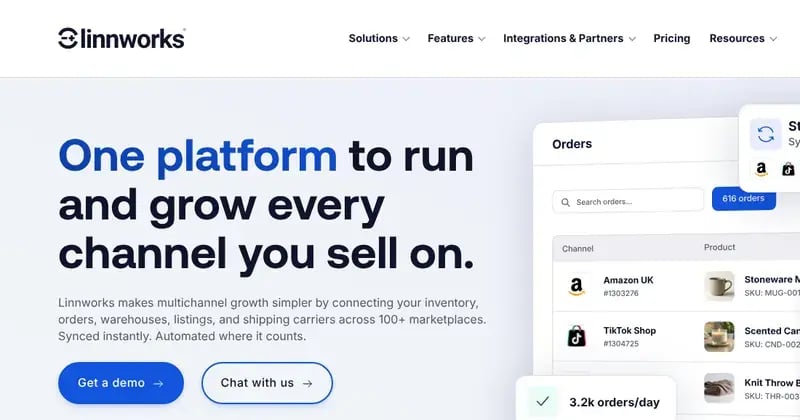
Linnworks is multichannel inventory and order management software. In its own words, it's for "multichannel retailers who are past the point where lightweight tools can keep up." It doesn't include accounting, so you'd connect QuickBooks Online directly, or Xero and Sage through third-party connectors. Our Linnworks alternatives guide goes further on where channel sync stops being enough.
Key Features
- Rules Engine: Process every order before your team sees it, for example by splitting multi-line orders across locations.
- Multichannel stock: Deduct stock across every channel when an order lands, with per-channel buffers that help keep you from overselling.
- Warehouse module: Run barcode-verified picking and packing, wave picking, bins and lot management.
- Carrier connections: Print labels through your own FedEx, UPS, USPS and DHL Express accounts.
Pros
- It's built around channels, so marketplace and webstore sellers get a lot out of the box.
- Barcode-verified picking and wave picking come with every account.
- Labels print through your own carrier accounts, without a separate shipping app.
Cons
- Linnworks itself says it may not fit "businesses that need built-in accounting."
- It only supports one-layer compositions, so a kit can't contain another kit.
- B2B storefront features and EDI come through partners like SparkLayer and SPS Commerce.
5. Extensiv Order Management
Extensiv Order Management, formerly Skubana, is built for brands that sell on several channels and ship from more than one warehouse. It tracks stock across your own warehouses and your 3PL partners in one place. For accounting, it syncs only with the US version of QuickBooks Online, one way from Order Management into QuickBooks.
Key Features
- Order routing: Send each order to the right warehouse with rules based on inventory and location.
- Orderbots: Automate jobs like splitting line items by stock or choosing a shipping type by weight.
- Channel allocation: Set how much of your stock each sales channel can sell.
- Demand planning: Raise purchase orders automatically when stock drops below the limits you set.
Pros
- You get one view of stock across your own warehouses and your 3PL partners.
- Orderbots take routine order decisions off your team's plate.
- Reports cover inventory value, inventory aging and SKU profitability.
Cons
- The accounting sync runs one way, and only with the US version of QuickBooks Online.
- Mobile barcode scanning, lot control and wave picking sit in Extensiv's separate warehouse management product.
- It's a weaker fit if NetSuite, Sage Intacct or Xero is your ledger.
Why seek alternatives to Brightpearl?
We went through Brightpearl's user reviews on Capterra from 2025 and 2026 to see what its own users flag. Plenty of them praise its stability and support, and many have run on it for years. The complaints that keep coming up fall into three areas, and each one is worth testing before you decide.
Reporting takes extra work
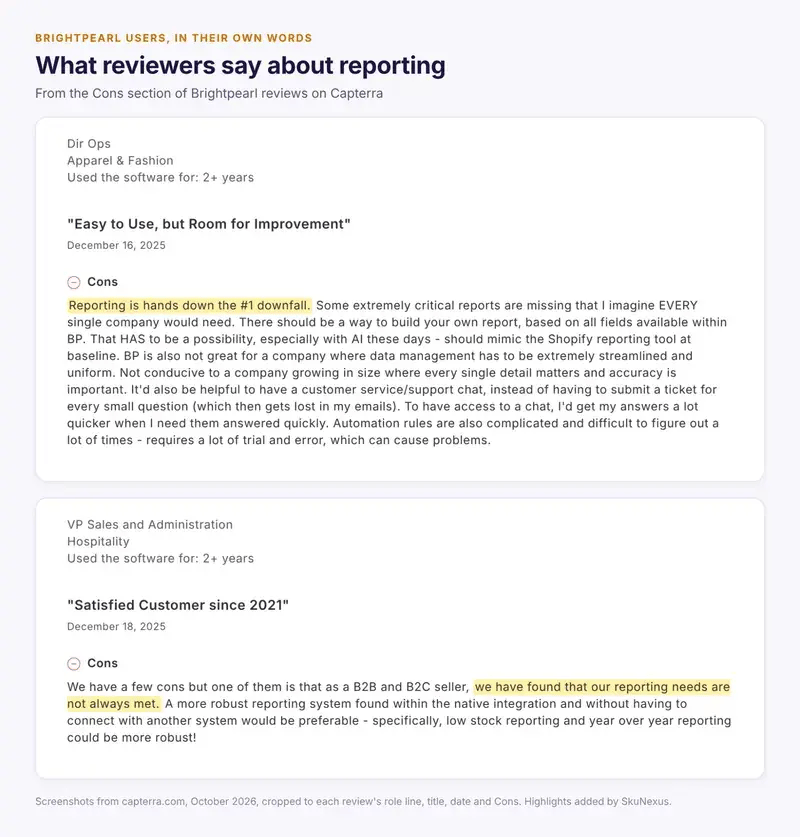
Reporting comes up again and again. A director of operations at an apparel company didn't soften it in a December 2025 review.
"Reporting is hands down the #1 downfall."
They added that some critical reports are missing, and asked for a way to build their own. A retail COO described the workaround in a July 2025 review. "You have to download multiple different reports and manipulate them to get the information required." A VP of sales at a company selling both B2B and B2C wrote that "our reporting needs are not always met."
Some reviewers add that the data itself is good and can be exported, or that a BI tool fills the gap. So bring the three reports your team pulls every week to each demo, and ask to see them built without a spreadsheet.
Changing a workflow can mean waiting on development
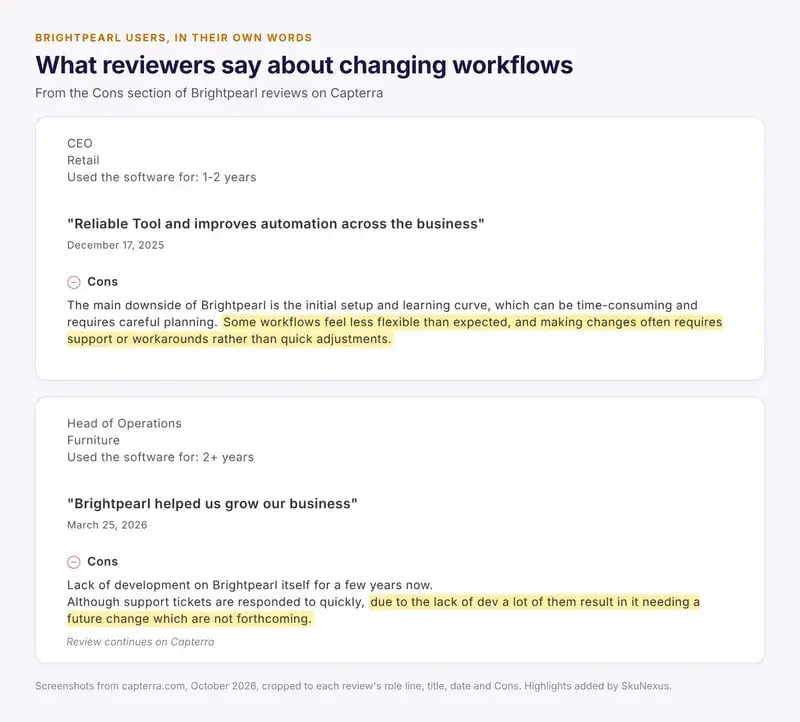
Brightpearl's Automation Engine comes with "commerce-ready automation templates out of the box," for jobs like routing orders to the right warehouse. It also handles FIFO, bundles and multiple warehouses, which covers a lot of standard retail. Reviewers who hit the edges of those templates describe a slower path. A retail CEO wrote this in a December 2025 review.
"Some workflows feel less flexible than expected, and making changes often requires support or workarounds rather than quick adjustments."
A head of operations at a furniture company has used Brightpearl for more than 13 years. In a March 2026 review, they wrote about the pace of development.
"Lack of development on Brightpearl itself for a few years now. Although support tickets are responded to quickly, due to the lack of dev a lot of them result in it needing a future change which are not forthcoming."
Smaller limits show up too. A wholesale creative director flagged "restrictions on product line quantities within individual orders" in December 2025. Brightpearl's help center says it "does not have a dedicated method of handling serial numbers." It also says bills of materials come through App Store apps.
In our benchmark, we summed up what buyers described in one line, "the exceptions are the business." If that sounds like you, ask each vendor who changes a workflow when your process changes, and how long it takes.
Accounting and integrations lean on partners
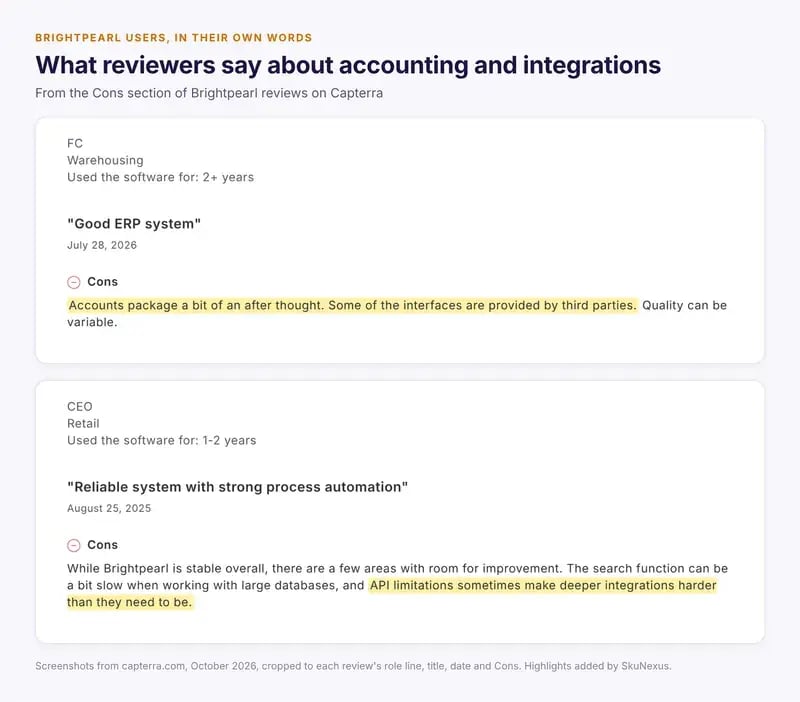
The reviewers who mention Brightpearl's built-in Retail Accounting module are lukewarm. A director at a sports company called it "OK but feels complicated" in an August 2025 review. A reviewer at a multichannel footwear and clothing distributor went further in a July 2026 review.
"Accounts package a bit of an after thought. Some of the interfaces are provided by third parties. Quality can be variable."
Those interfaces matter if your books live somewhere else. Brightpearl connects to Sage Intacct, Xero and QuickBooks Online. Its site says those integrations are "built and maintained by b.solutions, a trusted Brightpearl partner." Carriers work the same way, through what Brightpearl calls "direct plug & play shipping integrations" such as ShipStation, Shiptheory and Parcelhub.
Some reviewers like the partner integrations, and they can work well. A retail CEO still noted in an August 2025 review that "API limitations sometimes make deeper integrations harder than they need to be." Before you sign anything, map which system owns each transaction, which tool holds your carrier accounts, and where your shipping rules live. Our guide to what an ERP and a WMS each own walks you through where to draw that line.
How to choose the right Brightpearl alternative
Before you book any demos, answer these three questions, and you'll know which group you belong in.
- Which system will keep your books? If you want one vendor for both the ledger and the warehouse, look at NetSuite. If you're keeping QuickBooks Online, all four of the others connect to it. And if NetSuite or Sage Intacct is staying, ask each vendor to show the sync running on your own data before you sign.
- Where do your orders come from? If you sell mostly on marketplaces, Linnworks is worth a look, because it's built around channels. If you ship EDI orders to big retailers, look hard at Cin7 Omni. And if you're a brand splitting orders across several 3PL partners, Extensiv Order Management is a good fit.
- What are your exceptions? Write down the five workflows that don't fit any default setting. That might be a dry-ice calculation, a kit that ships in three cartons, or a pallet and a parcel from one dock. Then ask every vendor to run them live.
When staying on Brightpearl is the right call
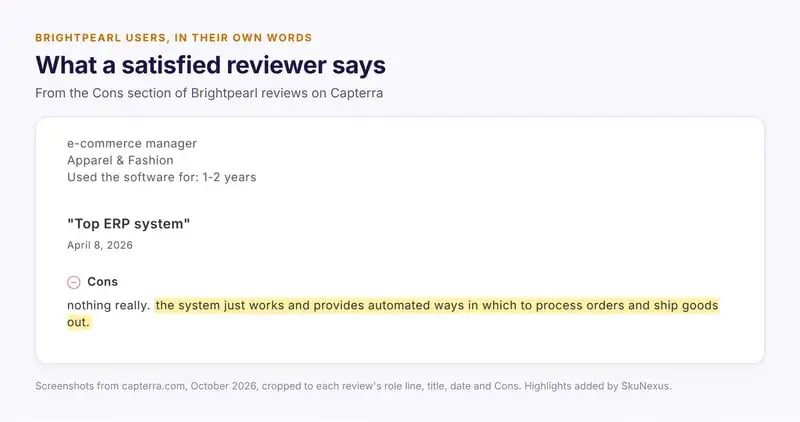
Stay put if you want accounting in the same system as your stock, and your workflows fit Brightpearl's automation templates. The same goes if its integrations already cover your carriers. Plenty of long-time users are in exactly that spot. An e-commerce manager at an apparel company answered the cons question in an April 2026 review with "nothing really." They added that "the system just works and provides automated ways in which to process orders and ship goods out."
Switching systems is a big project, so if what you have works, it's worth keeping.
Decide where the books live, then test your exceptions
Any of these five can run a retail and wholesale operation. So your choice comes down to which system keeps your books, and how much of your warehouse logic you can change yourself.
If you're keeping your ERP or accounting system and your warehouse runs on its own rules, book a demo. It's a 30-minute session on your own data, and we'll show you where SkuNexus fits and where it doesn't.
FAQs about Brightpearl and its competitors
Is Brightpearl an ERP?
Brightpearl calls itself a retail operating system and says it's "not a traditional ERP." In practice, though, it covers the core ERP jobs for a retailer or wholesaler. Inventory, orders, warehouse, CRM and its own retail accounting all run in one platform.
Is Brightpearl a CRM system?
Not on its own. Brightpearl includes a retail CRM module as one part of its wider retail platform. For each customer, the module builds a profile with contact details, order history and interactions, and auto-tags customers by what they buy. It also shows you each customer's outstanding balance and credit limit before you process another sale.
Which is better, Brightpearl or Cin7?
Brightpearl is the better fit if you want accounting inside the same system, because it posts entries as you invoice, ship and receive. Cin7 Omni is the better fit if you're keeping QuickBooks or Xero for your books and need built-in EDI with major retailers. Omni also suits you if you run more than one business entity.
Does Oracle still own NetSuite?
Yes. NetSuite is part of Oracle, and it's branded as Oracle NetSuite. NetSuite's own site says it runs on Oracle Cloud Infrastructure and uses Oracle's AI services.
Related alternatives guides
Ready to Transform Your Operations?
See how SkuNexus gives you full control over inventory, orders, warehouse, and shipping.
Schedule a Free Demo →
Keep Reading