Fishbowl earned its reputation honestly. For a generation of small and midsize businesses, it was the answer to a specific, painful question: how do you run real inventory control when your books live in QuickBooks and QuickBooks alone was never built to track stock, lots, or a warehouse floor? Fishbowl grew up as the inventory and manufacturing layer that sat next to QuickBooks Desktop and filled exactly those gaps. That is a genuine problem well solved, and the businesses it solved it for are not wrong to have chosen it.
So if you are reading a page about Fishbowl alternatives, the useful question is not "what is better than Fishbowl." Fishbowl is not broadly worse than anything. The useful question is narrower and more honest: has your operation moved into a shape that a QuickBooks-and-manufacturing-first inventory tool was not designed to hold? For some readers the answer is no, and the most helpful thing this page can do is tell you to stay put. For others, usually merchants whose center of gravity has shifted from the accounting close to multichannel eCommerce fulfillment, the answer is yes, and the rest of this page is a fair map of where to look.
This is written the way we write every comparison: no scores we cannot defend, no invented pricing, no disparagement of a product that thousands of businesses run well. Where we describe Fishbowl or any alternative, we describe what it is built for, so you can match it against what you actually run.
What Fishbowl is genuinely good at
It is worth being specific about Fishbowl's strengths, because they are the same strengths that make it the wrong thing to walk away from casually.
Fishbowl is an inventory and manufacturing platform aimed at small to midsize businesses, and its defining trait is a deep, accounting-first relationship with QuickBooks and Xero. As of this writing Fishbowl integrates with QuickBooks Desktop, QuickBooks Online, and Xero, syncing inventory movements back into clean cost of goods sold and landed-cost figures so a finance team can close the books quickly. It offers warehouse features, purchasing, kitting, and a manufacturing module that handles work orders and bills of materials, from a simple fabrication shop up to more involved production. Fishbowl markets itself, fairly, as inventory and manufacturing power "without the ERP complexity."
Two facts from Fishbowl's current product are worth putting on the record here, because they correct assumptions buyers often carry from years ago. First, Fishbowl is no longer QuickBooks Desktop only. If your reason for shopping is "we are moving to QuickBooks Online," that alone is not a reason to leave Fishbowl, because Fishbowl now supports QuickBooks Online directly. Second, Fishbowl does connect to eCommerce and shipping tools, including Shopify, ShipStation, and EDI through SPS Commerce, and it markets a commerce suite with cloud-native selling features. So the honest trigger for looking elsewhere is rarely "Fishbowl cannot sync a channel at all." It is almost always about the depth, direction, and scale of what you need next.
If your operation is a QuickBooks-centered product business, if manufacturing or light assembly is core to how you make money, and if your order volume and fulfillment complexity are steady rather than exploding, Fishbowl is a reasonable place to stay. Keep that in mind as you read the rest of this page. The alternatives below matter only if your situation has genuinely outgrown that description.
What our buying data shows about QuickBooks and inventory
We do not have to guess about how central QuickBooks is to this decision, because we measured it. Between February 2025 and May 2026, SkuNexus recorded 76 real sales-demo conversations with mid-market eCommerce merchants who were actively shopping for new inventory, order, and warehouse software, and we published the full analysis in our mid-market WMS buying benchmark. The transcripts run to more than 460,000 words of unscripted conversation about what is broken and what these businesses run today.
QuickBooks turned out to deserve its own line in that report. It came up in 26 of the 76 conversations, roughly a third, and in 17 of them it was part of the prospect's own stated stack, almost always as the accounting system of record that any new platform simply has to integrate with. In several conversations it showed up in a second role too: as the only inventory tool the business currently had. One merchant described using QuickBooks to track inventory and summarized it in four words: "it's not very good." That is the exact gap Fishbowl was built to close, which is why so many QuickBooks-first businesses landed on Fishbowl in the first place.
The benchmark also explains why these merchants were shopping at all. The single most common pain in the dataset was manual, spreadsheet-based process: 47 of the 76 conversations described spreadsheets or manual workflows as a core problem in the operator's own words. More than half of the conversations named a specific tool they were trying to leave behind or wire together, and by a broader count that included incumbent systems and in-house builds, 71 of 76 were starting from something that no longer fit rather than from nothing. Pricing was never a side note either: 66 of 76 conversations carried a substantive budget signal.
Read against that backdrop, the Fishbowl alternatives question is really a QuickBooks-integration question with an eCommerce shape. Whatever you move to, the accounting integration cannot break. What changes as you grow is everything happening upstream of the accounting sync: the number of sales channels, the volume of orders, and how specific your fulfillment logic has become.
The signals that you have outgrown a QuickBooks-first inventory tool
There is no single moment when Fishbowl stops fitting. There is a pattern. When enough of the following are true at once, merchants tend to start evaluating alternatives, and the reason is consistent: the operation's center of gravity has moved from the accounting close to the eCommerce fulfillment floor.
Your channels multiplied and now they fight over the same stock. You started on one or two sales channels and now you are live on a webstore plus two or three marketplaces, each with its own inventory expectations. The pain is not that you cannot connect a channel; it is that keeping available-to-sell accurate across all of them, in near real time, so you stop overselling, has become a daily fire. Overselling shows up in the benchmark as a pain that is visceral when it hits.
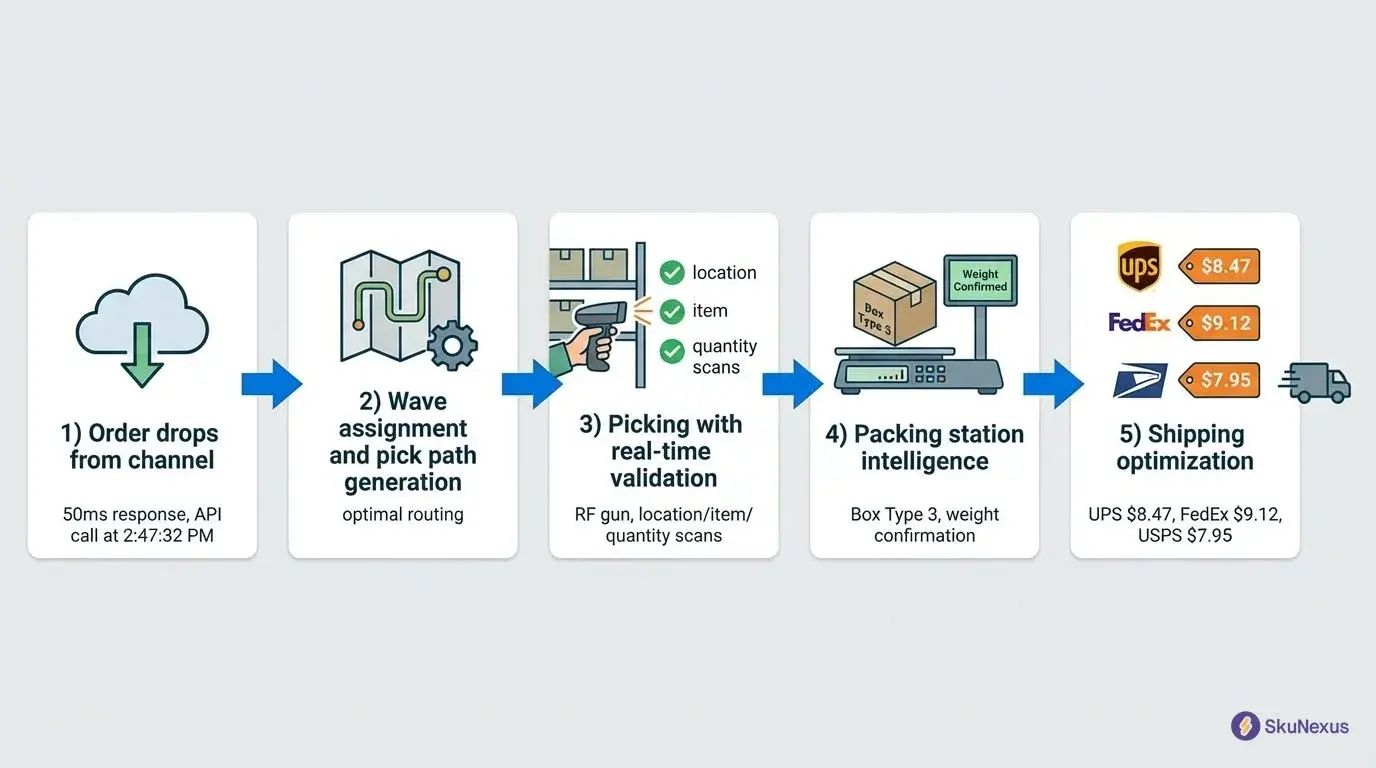
You run your own fulfillment, and the warehouse is where the money is made or lost. When you operate your own warehouse or warehouses and ship at real volume, picking paths, packing rules, and carrier selection stop being details and become the core of the operation. A tool oriented around inventory accuracy and the accounting sync can track what you have; the question becomes whether it can orchestrate how it gets picked, packed, routed, and shipped the way your floor actually works.
Your routing logic has become too specific to approximate. You route orders by location, by carrier, by product type, by service level, or by some combination that is genuinely yours. When that logic has to be modeled rather than approximated, you need a platform that can express it directly instead of one you build spreadsheets and manual steps around.
Your growth plan adds locations, channels, and rules rather than simplifying them. If the next 24 months mean more warehouses, more channels, and more fulfillment complexity, you are choosing a platform for where you are going, not only where you are.
None of these is a knock on Fishbowl. They are simply a different problem than "give my QuickBooks books accurate inventory." If most of these describe you, the alternatives below are worth real evaluation. If only one does, you may be better off extending what you have.
The genuine alternatives, and where each one fits
There is no single Fishbowl replacement, because the businesses leaving Fishbowl are leaving in different directions. A manufacturer wants something very different from a multichannel D2C brand running its own warehouse. Below is a fair read of the real options and the shape of operation each one suits. We describe fit, not rank, and we do not quote prices, because pricing for these systems depends heavily on modules, volume, and configuration, and a made-up number would not help you.
SkuNexus, for merchants running their own multichannel fulfillment at scale
SkuNexus is an inventory, order, and warehouse management platform built for mid-market eCommerce merchants who run their own fulfillment, typically shipping somewhere between 50 and 20,000 orders a day. It brings real-time inventory across locations, multichannel order management, and warehouse operations like picking, packing, and shipping into one system, and it connects to storefronts, marketplaces, ERPs, and carriers through an open API. QuickBooks and other accounting systems sit on the accounting side of that integration, exactly where a merchant needs them to.
The reason a former Fishbowl user would consider SkuNexus is customization at the source-code level, delivered as a managed platform rather than an open source project you host and maintain yourself. Order routing rules, picking strategies, packing instructions, and fulfillment workflows are built to match how your team actually operates. This is the specific answer to the "our routing logic is too specific to approximate" signal above: instead of building manual steps around the software, you model the process inside it.
A concrete example. Graeter's Ice Cream, the Cincinnati craft producer, needed multi-warehouse order management with packing directions specific to a perishable product that cannot be routed or boxed like a shelf-stable good. Rather than force that operation into a generic template, SkuNexus built the custom functionality around those requirements and automated the order flow. You can see the platform's fit for own-warehouse teams on our eCommerce warehouse management page and how routing across sites works on our omnichannel order management page.
The honest boundaries. SkuNexus does not serve third-party logistics (3PL) operators, and it is not the right call for a very small or simple operation shipping low volume from a single location on standard workflows; a packaged tool will cost less and set up faster, and you will not get full value from a customizable platform. Just as importantly for Fishbowl users, SkuNexus does not serve manufacturing or MRP buyers. If bills of materials, work orders, and production planning are central to your business, SkuNexus is not built for that, and the manufacturing-oriented options below or staying on Fishbowl will serve you far better. More on the customization model itself is on our custom inventory management software page.
Cin7 Core, for product businesses that want cloud inventory with strong accounting sync
Cin7 Core, formerly known as DEAR Inventory, is a cloud inventory and order management system aimed at product businesses that sell across multiple channels and want a tight relationship with cloud accounting. It integrates with QuickBooks Online and Xero, connects to eCommerce platforms and marketplaces, and includes purchasing, B2B, and light production features. For a Fishbowl user whose primary motivation is moving off a heavier or more desktop-rooted setup toward a cloud multichannel system, while keeping a clean accounting sync, Cin7 Core is a natural name to evaluate. It tends to fit growing merchants whose complexity is real but who want a configurable off-the-shelf product rather than a platform built to their exact process. Our inventory management system guide covers where cloud inventory systems like this sit in the broader category.
Zoho Inventory, for smaller multichannel sellers already in a connected suite
Zoho Inventory is a lighter-weight, more affordable option aimed at small and growing businesses, and it is part of the wider Zoho ecosystem, which is attractive if you already use Zoho tools or want an inexpensive way to add multichannel order and inventory management. It handles multichannel selling across common webstores and marketplaces, includes shipping integrations, and connects to QuickBooks and Xero for accounting. Notably, Fishbowl's own materials name Zoho alongside Cin7 as a top option for growing QuickBooks and Xero users, which is a fair reflection of where it sits. For a Fishbowl user whose operation is on the smaller and simpler end and whose main need is affordable multichannel basics, Zoho Inventory deserves a look. It is generally not the destination for a high-volume, own-warehouse fulfillment operation.
inFlow, for straightforward wholesale and light warehouse operations
inFlow is an inventory management system built for small businesses with a practical, approachable feel, strong barcode support, and a clean fit for wholesale and B2B workflows. It integrates with QuickBooks Online and covers warehouse basics like receiving, picking, and stock counts without a steep learning curve. For a Fishbowl user whose real need is solid inventory and order control for a wholesale or light-warehouse operation, and who does not require deep manufacturing or highly custom fulfillment routing, inFlow is a reasonable, uncomplicated alternative. As with Zoho, it fits simpler operations better than complex, high-volume, multichannel fulfillment.
Katana, for the manufacturers Fishbowl users often are
This one matters, because a large share of Fishbowl's base is there specifically for manufacturing, and those users need honest guidance rather than a nudge toward a platform that was not built for them. Katana is a cloud manufacturing and inventory platform focused on makers and manufacturers, with real-time production planning, bills of materials, and shop-floor control, and it integrates with QuickBooks Online, Xero, and Shopify. If your reason for leaving Fishbowl is that you want cloud-native manufacturing rather than that you are becoming a fulfillment-heavy eCommerce operation, Katana is very likely a better path than any inventory-and-fulfillment platform, including ours. We say that plainly because SkuNexus does not serve manufacturing or MRP buyers, so for a true production business, Katana or staying on Fishbowl is the right conversation.
Who should stay on Fishbowl
The most helpful section on an alternatives page is often the one that talks a reader out of switching. Several kinds of Fishbowl users are well served by staying, and moving would trade a known, working setup for a change that solves nothing they actually have.
QuickBooks or Xero-centered small and midsize businesses with steady operations. If your books drive the business, your inventory and order complexity are stable, and Fishbowl's accounting sync keeps your close clean, you have a good fit. The fact that Fishbowl now supports QuickBooks Online as well as Desktop and Xero removes what used to be a common reason to leave.
Manufacturing and light-MRP operations. If bills of materials, work orders, and production are core to how you make money, Fishbowl's manufacturing module is a real strength, and you should weigh it seriously against staying. To be explicit about our own limits: SkuNexus does not serve manufacturing or MRP buyers, so if that is you, the right decision is either to keep Fishbowl or, if you specifically want cloud-native manufacturing, to look at a purpose-built manufacturing system like Katana. Do not replace a manufacturing tool with a fulfillment platform.
Single-location, moderate-volume operations without custom routing needs. If you ship from one warehouse at a manageable volume and your fulfillment logic is standard, the extra power of a customizable, own-fulfillment platform is capacity you would pay for and not use. A capable packaged tool, Fishbowl included, is the better economic choice until your process genuinely becomes your own.
If you recognized your business in this section, the honest recommendation is to stop evaluating and go back to work. Alternatives only pay off when the shape of your operation has actually changed.
How to run a fair evaluation
If you have decided the alternatives question is real for you, a few practices keep the evaluation honest and prevent an expensive mismatch.
Start by writing down your non-negotiables, and put the accounting integration at the top. Given how central QuickBooks is to this decision, confirm in a live demo, with your own accounts, that the accounting sync produces the cost of goods sold and landed-cost behavior your finance team needs. A demo that skips the boring accounting sync is hiding the part that matters most.
Bring your real order flow, not a clean sample. The point of a demo is to watch the system meet your actual multichannel volume, your genuine routing rules, and your specific packing steps. If you have built spreadsheets or manual workarounds to make your current tool fit, those workarounds are the exact things to ask each vendor to reproduce natively. Whether a platform can absorb them tells you more than any feature list.
Match the tool to the direction you are heading, not only where you stand today. If your next two years add channels, locations, and rules, weigh how each option handles that growth. If they do not, do not pay for capacity you will not use. And be honest about manufacturing: if production is core, evaluate manufacturing systems, not fulfillment platforms.
For readers whose next step is understanding the small-business end of this category and where budgets land, our guide to inventory management for small business is a useful companion, and our multichannel inventory management guide goes deeper on keeping stock accurate across channels, which is the pain most often driving this switch.
Frequently Asked Questions
Is Fishbowl only for QuickBooks Desktop?
No, not anymore. Fishbowl grew up as the inventory and manufacturing add-on for QuickBooks Desktop, which is where much of its reputation comes from, but it now integrates with QuickBooks Online and Xero as well. If your only reason for shopping was a planned move to QuickBooks Online, that alone is not a reason to leave Fishbowl. The stronger reasons to look at alternatives are about multichannel eCommerce volume, running your own fulfillment at scale, and needing custom order routing.
What is the best Fishbowl alternative for multichannel eCommerce fulfillment?
It depends on how much of your operation is your own warehouse and how specific your fulfillment logic is. For mid-market merchants who run their own fulfillment, ship real daily volume, and need routing, picking, and packing modeled to their exact process, SkuNexus is built for that case. For growing multichannel product businesses that want a configurable cloud inventory system with strong accounting sync, Cin7 Core is a common choice. Smaller sellers who need affordable multichannel basics often look at Zoho Inventory. Match the tool to your volume and the specificity of your fulfillment rules rather than to a feature count.
Should a manufacturer switch away from Fishbowl?
Usually not for manufacturing reasons alone. Fishbowl's manufacturing module, with bills of materials and work orders, is a genuine strength, and replacing it with a fulfillment platform would be a mistake. If you want cloud-native manufacturing specifically, a purpose-built system like Katana is the right kind of alternative. SkuNexus does not serve manufacturing or MRP buyers, so for a true production business the honest options are staying on Fishbowl or choosing a dedicated manufacturing platform.
How central is QuickBooks to choosing inventory software?
Very. In our benchmark of 76 recorded mid-market buying conversations, QuickBooks came up in 26 of them, and in 17 it was part of the prospect's own stated stack, almost always as the accounting system of record that any new platform has to integrate with, and in several cases as the only inventory tool the business had. Whatever you move to, treat the accounting integration as a hard requirement and verify it in a live demo with your own accounts.
Does SkuNexus replace QuickBooks?
No. SkuNexus manages inventory, orders, and warehouse operations and integrates with your accounting system rather than replacing it. QuickBooks or another accounting platform stays your system of record for the books, and SkuNexus keeps the inventory and order data feeding it accurate. The two do different jobs.
Is SkuNexus the right fit for a small business currently on Fishbowl?
Often not, and we would rather say so. If you ship low volume from a single location on standard workflows, a packaged tool, including Fishbowl or lighter alternatives like Zoho Inventory or inFlow, will cost less and set up faster, and you will not use the full value of a customizable platform. SkuNexus fits when you run your own fulfillment, have outgrown packaged tools, and expect to keep adding channels, locations, and rules.
How do I know whether I have actually outgrown Fishbowl?
Look for the pattern rather than a single trigger: multiple sales channels competing over the same stock with near-real-time accuracy demands, your own warehouse where picking and packing drive the economics, routing logic too specific to approximate, and a growth plan that adds complexity rather than reducing it. When most of those are true at once, the alternatives question is real. When only one is, extending your current setup is usually the better call.
See it against your own workflow
The only reliable way to evaluate a Fishbowl alternative is to put it in front of your real order flow, your real channels, and your real warehouse logic, and watch whether it bends to fit. If you run your own fulfillment, have outgrown a QuickBooks-first inventory tool, and expect to keep scaling channels and locations, book a demo and we will walk through exactly how SkuNexus would model the operation you run today, accounting integration included. And if what you actually need is manufacturing or a simpler packaged tool, we will tell you that too.
Primary CTA: Get a Demo
Secondary CTA: Read the mid-market WMS buying benchmark -> https://www.skunexus.com/blog/mid-market-wms-buying-benchmark
Related alternatives guides
Ready to Transform Your Operations?
See how SkuNexus gives you full control over inventory, orders, warehouse, and shipping.
Schedule a Free Demo →
Yitz Lieblich
CEO & Founder, SkuNexus
Yitz Lieblich is the Founder and CEO of SkuNexus. He has spent 19 years in eCommerce, starting in 2007 when he founded Web Solutions NYC, an eCommerce agency he still leads today. His approach to inventory, order, and warehouse management did not come from a whiteboard. It came from the floor. Across nearly two decades, Yitz has worked with merchants of every size, from mom-and-pop startups to Fortune 100 enterprises, across auto parts, food and beverage, apparel, B2B wholesale, and retail/D2C. He has walked through hundreds of warehouses, watching where operations lose time, money, and orders, with one goal: optimize the operation and make it easier for the merchant. That hands-on pattern is what led him to build SkuNexus in 2018 as a full operational platform. The idea was simple. Configurable infrastructure that bends to each merchant workflow, supporting businesses that ship anywhere from 50 to 20,000 orders a day. A custom development background runs through everything he builds. When SkuNexus writes about fulfillment, WMS, or multi-channel inventory, it comes from operations Yitz has seen and solved firsthand. First as an agency partner since 2007, and now as the architect of the platform.
Keep Reading
WooCommerce Warehouse and Inventory Management
September 16, 2026