Inventory Tracking Software

Stock you can trust, everywhere you sell.

One count across your warehouse, your vendors and every store and marketplace. When something sells in one place, it's gone everywhere.

What changed for three merchants

Pleasant Hill Grain: their first real warehouse system

Product locations used to live in staff members' heads. Now every product has a tracked location, and wave picking replaced the spreadsheets.

Read Pleasant Hill Grain's story →

Graeter's Ice Cream: three warehouses, one stock view

Stock used to sit in three separate warehouses with nothing shared between them. Now every order is routed across all three by stock and distance to the customer.

Read Graeter's story →

Carewell: stock from every vendor

Carewell holds no stock of its own. Inventory from every vendor feeds SkuNexus, so each order goes to a vendor that has the item.

Read Carewell's story →

Read all customer stories →

Three stock problems, as the people who raised them put it.

And what we built for each one.

"high customer call volumes due oversells resulting in cancelled orders"Carewell
What we built: stock floors and daily limits, so vendor feeds that only update two or three times a day can't sell what isn't there.
"There were products with e.g. 5 or 6 variants and all of these variants were incorrectly mapped... we are wasting a lot of time cleaning that up manually"Engineer, SkuNexus
What we built: a sync that re-links products when SKUs change in Shopify. One pass found 501 variants that had been silently deleted.
"...if we have to subtract what is shipped to figure out what is actually on hand, it is pretty much a guaranteed mix-up."Ecommerce Executive, Graeter's Ice Cream
What we built: stock now drops the moment a label prints, so the system matches their daily freezer count. Live before their first holiday peak.
2
SKUs off at a kitchen equipment retailer's March 2026 inventory audit, in a warehouse shipping about 100 orders a day
15,264
product variants re-synced for a diesel parts retailer in one pass
18,000
SKUs re-barcoded in one morning, before a trading card retailer's 8 a.m. shift

See every unit, wherever it sits.

On hand, reserved, available and on order, for every product, by warehouse, bin and vendor.

  • Stock floors so you never sell the last one twice
  • Vendor stock feeds counted alongside your own
  • A daily stock report with cost per item
"Fantastic update regarding the Buffer Quantity!"Founder, Carewell
Read Carewell's story →
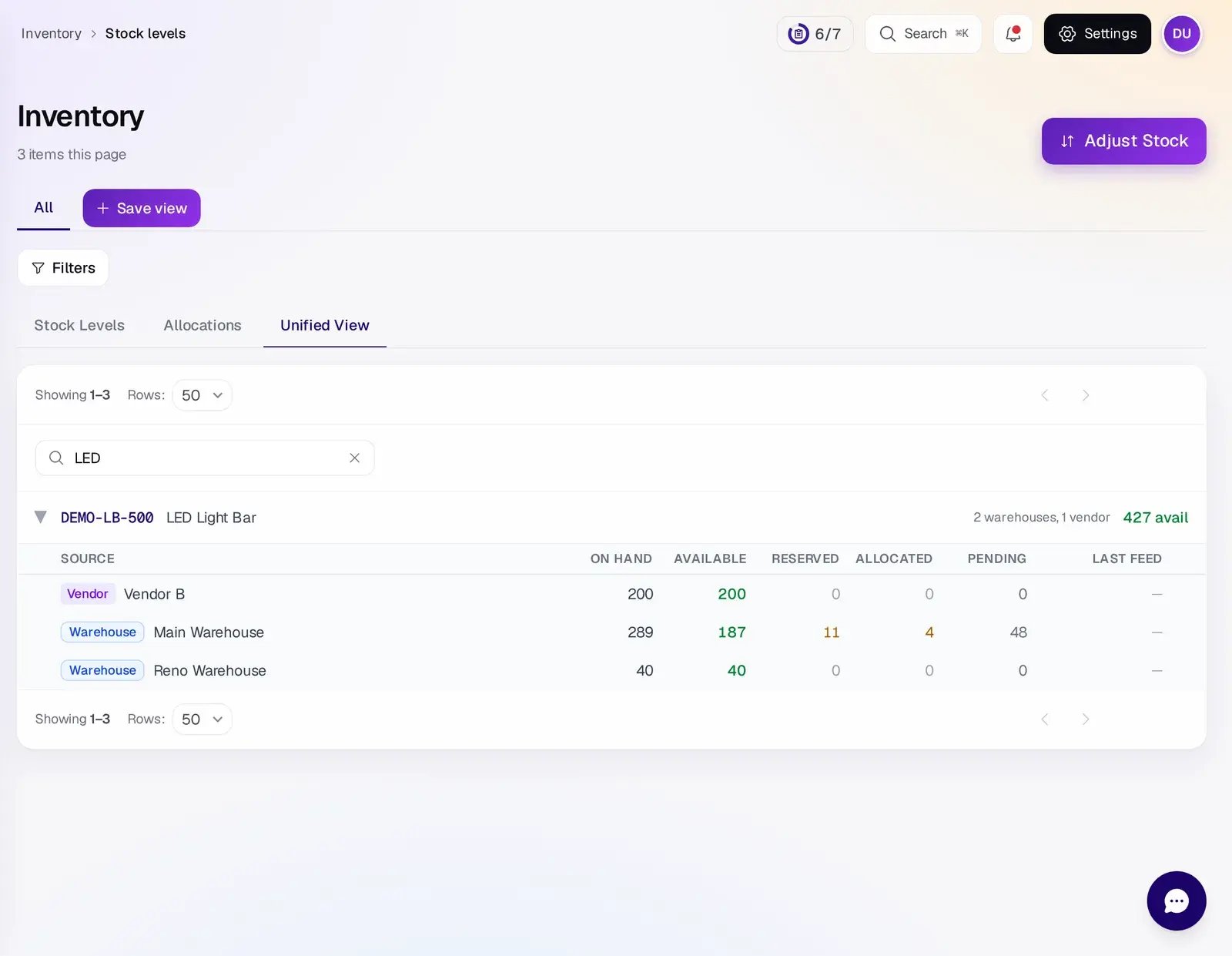
Unified view for one product: stock at a vendor, the main warehouse and the Reno warehouse, with on hand, available, reserved and allocated counts

Your store and your web shop, kept apart.

Each location keeps its own count. In-store sales stay out of the warehouse count, and online stock only updates the locations you choose.

  • Separate counts per location
  • Bin and reserved stock visible inside Shopify
  • Register sales kept out of web stock
A trading card retailer's register was draining the stock their website needed. Now store sales and web stock are counted apart.
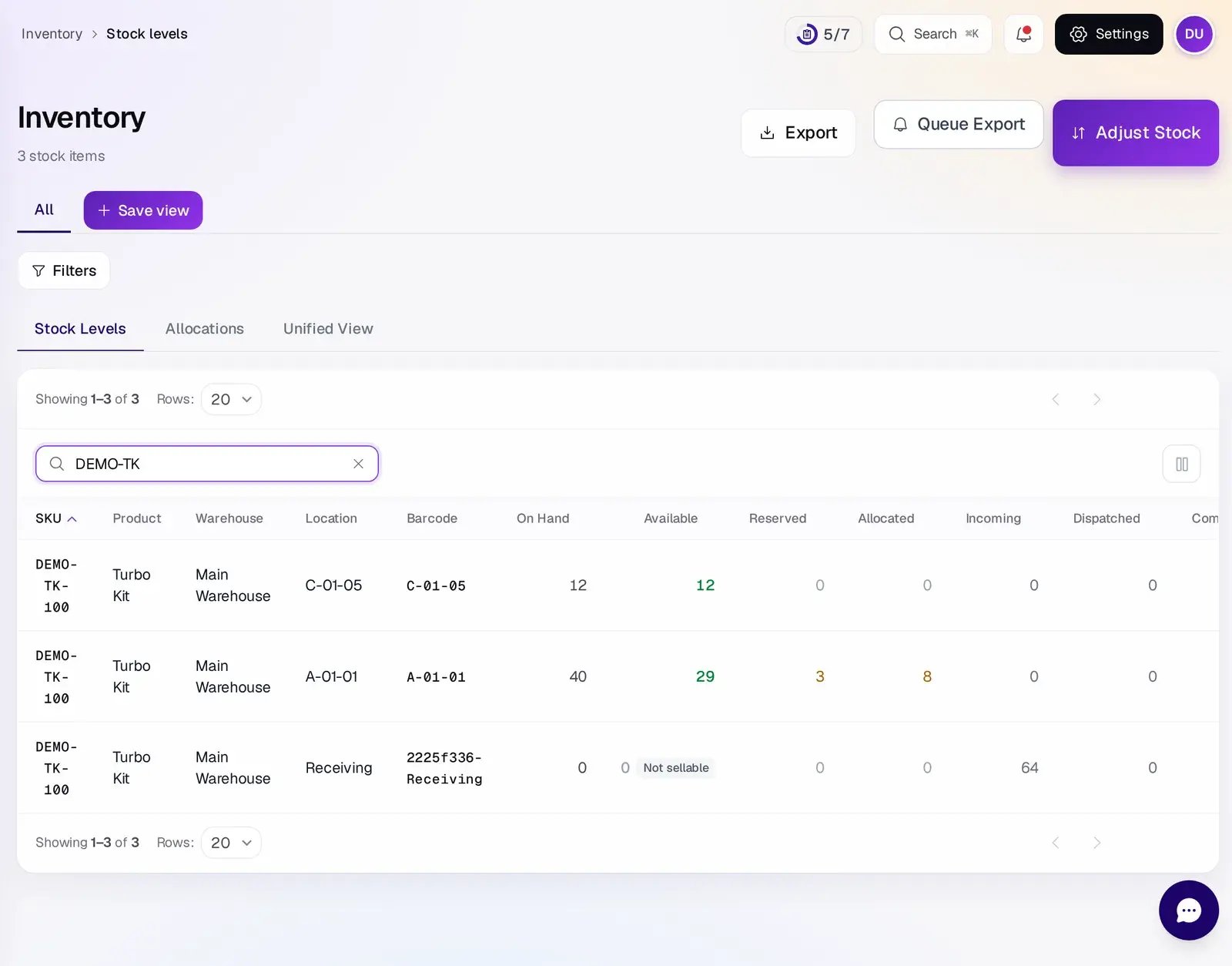
Stock for one product in each bin, with on-hand, available, reserved, allocated and incoming counts

When Shopify has a bad day, your stock still lands.

Any stock, tracking or reserved-quantity update that fails retries on its own, from 30 minutes up to 8 hours, until it goes through.

  • Failed updates retry on their own
  • Every sync logged, so "did we miss one?" has an answer
  • Past orders never rewritten when a SKU changes
When one of Carewell's distributors renamed its stock file without warning, the stalled feed was caught and fixed.
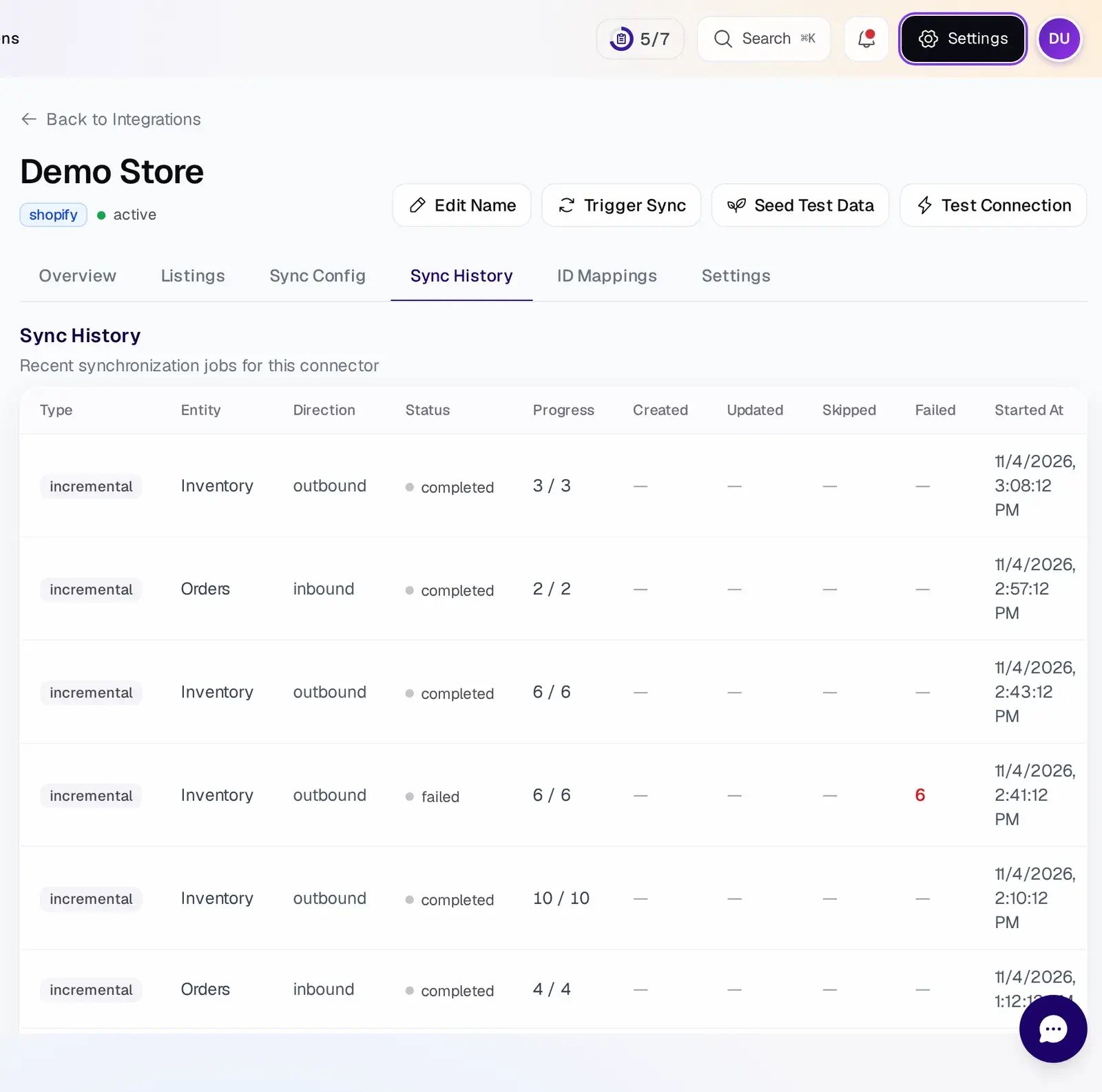
Sync history for a store connection, where a failed stock update is followed by updates that completed

An inventory management system that restocks before you run out.

Set a minimum, a maximum and a preferred vendor for each product. When on hand drops below the minimum, SkuNexus creates a restock job to bring it back up to the maximum.

  • Defaults for every warehouse, with levels per warehouse where you need them
  • A preferred vendor on every product
  • A daily limit for items a supplier caps, so the store never sells more than you can get
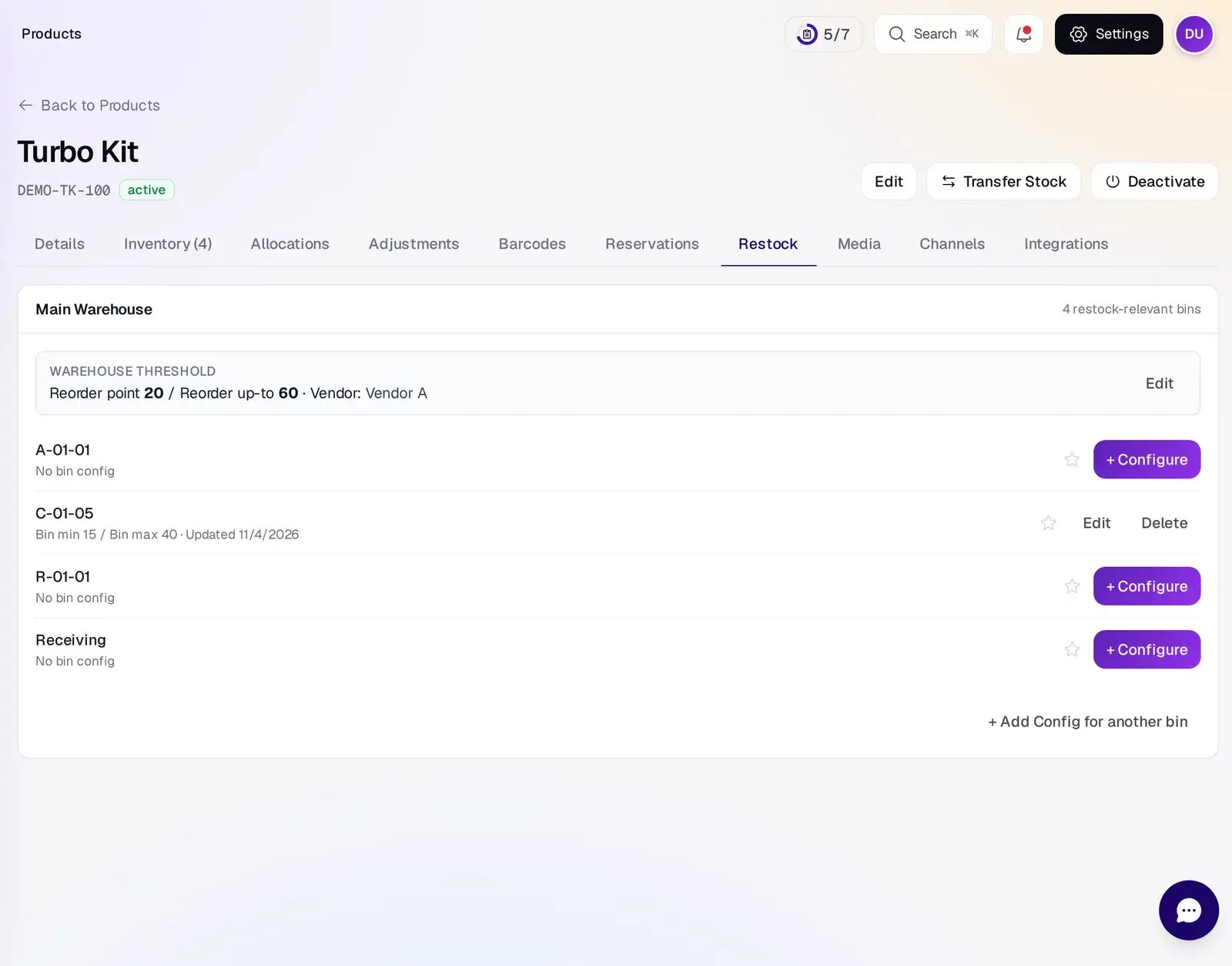
Restock settings for one product: a reorder point and reorder-up-to level for the warehouse with its vendor, and a minimum and maximum set for one bin

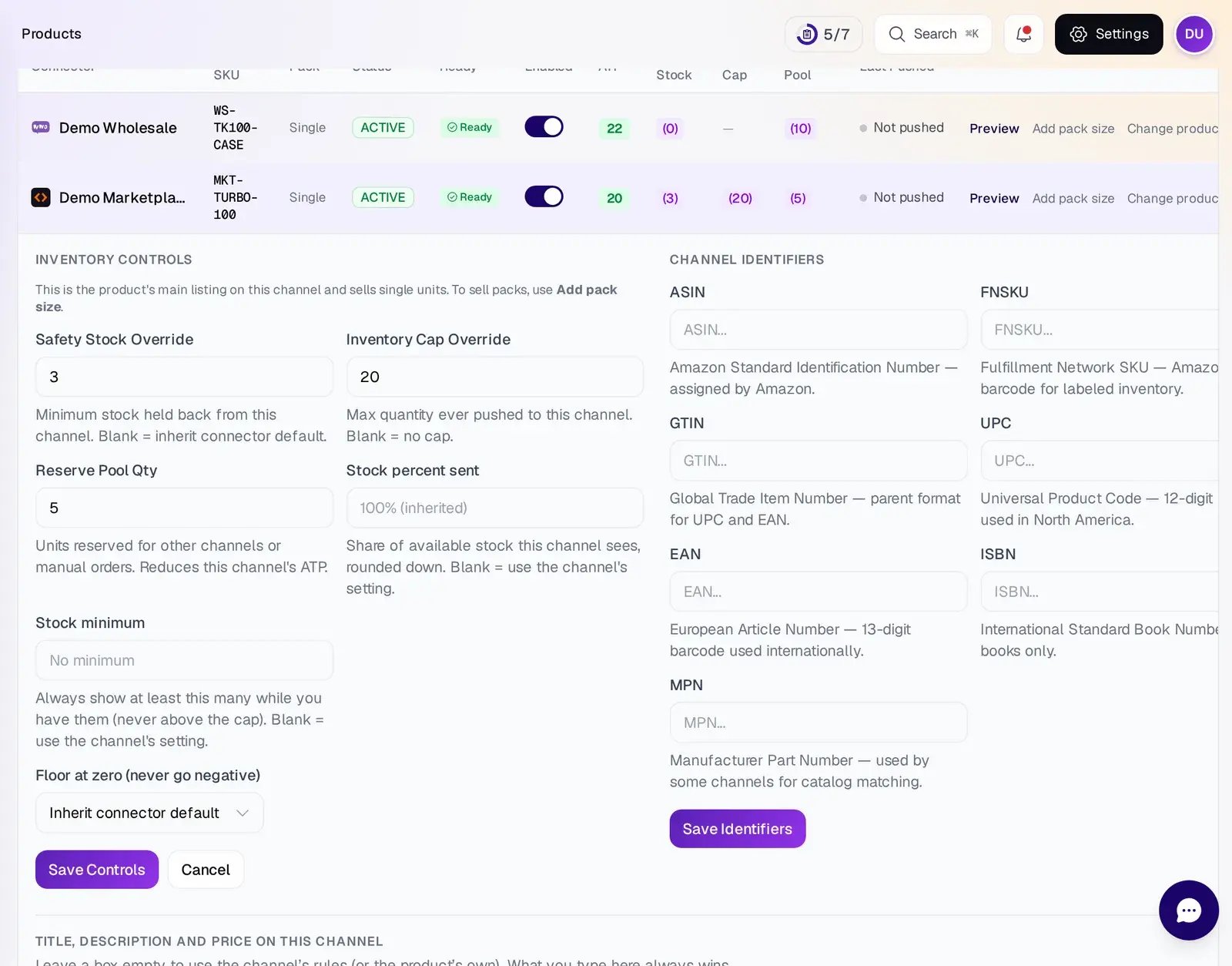
Sell the same stock on every store without overselling.

Each product keeps one count. Every store and marketplace gets its own listing, and when a unit sells on one channel, every other channel updates.

  • One stock count, a listing for each channel
  • Safety stock, a cap or a reserve per channel
  • Pause one channel and leave the rest selling
See multi-channel inventory →
Stock rules for one channel listing: safety stock, inventory cap, reserve pool, share of stock sent, a stock minimum and a never-go-negative setting
Customer story · Kitchen Equipment Retailer

From a copy-and-paste spreadsheet to a backorders screen.

A kitchen equipment retailer's inventory manager tracked backorders by copying rows out of the old admin panel into a spreadsheet. We replaced that with a backorders screen that works through orders oldest first, using rules their team wrote themselves.

What changed
  • A backorders screen instead of a spreadsheet
  • Backorders filled oldest first, with partial-shipping rules they set
  • 2 SKUs off at their March 2026 inventory audit

Works with what you already use.

All of these run live at SkuNexus customers today. Using something else? Ask on the call and we'll tell you what it takes.

STORES

Shopify · Shopify POS · BigCommerce · Adobe Commerce · Shopware

MARKETPLACES & ERP

Amazon and eBay orders by feed · ERPs · B2B order feeds

CARRIERS

UPS · FedEx · USPS

Built for merchants who hold their own stock, in one warehouse or several, and sell it through their own stores and marketplaces at 50 to 20,000 orders a day. Not built for 3PLs, or manufacturers who need MRP.

How fast you go live.

  1. Week 1
    A real order, end to end

    Carewell had its first order in, shipped and tracked seven days after connecting its store.

  2. Next weeks
    Your rules, vendors and stock

    We set up your routing rules with you and bring over products, vendors, bins and open orders.

  3. Go-live
    About 9 weeks to 6 months

    Recent launches took from about 9 weeks to about 6 months from kickoff, depending on how much was built. Cutover is planned with you for one window.

Questions buyers ask us

Can we keep store stock and web stock separate?

Yes. Each location keeps its own count, and online stock updates only the locations you choose.

What happens when we change a SKU in Shopify?

SkuNexus re-links the product automatically, keeps your past orders unchanged, and flags anything that needs a look.

Can we hold back a few units so we never oversell?

Yes. Set a stock floor per product, and daily limits for items a vendor caps.

Does it work with stock our vendors hold?

Yes. Vendor stock feeds count alongside your own warehouse, and orders route to whoever has it.

What happens to our ERP or accounting system?

It stays. SkuNexus keeps the stock count and passes stock, receipts and costs back to it.

Which stores and carriers does it connect to?

Shopify, Shopify POS, BigCommerce, Adobe Commerce and Shopware for stores, Amazon and eBay for marketplaces, and UPS, FedEx and USPS for labels. Systems without a ready connector are built against the open API. See the full list of integrations.

How is SkuNexus priced?

Pricing is scoped on the call, based on your order volume, channels and warehouses. See pricing for how scoping works.

Bring your stock numbers.

Show us where your counts drift today. We'll show you how SkuNexus keeps them in line, on a 30-minute call.