Customization, training, and ongoing support are the line items that move a warehouse budget the most.
"Barcode inventory system" covers everything from a single handheld scanner running a small-business app to a multi-site warehouse rollout wired into an ERP. The number that matters is not the sticker price of a scanner. It is the total of hardware, software, implementation, training, and the support you keep paying for after go-live.
This guide breaks the cost down line by line, shows which items scale with headcount, SKU count, and locations, and gives you a checklist for building your own estimate.
The scanner is the cheap part. Configuration is where the budget goes.
Buyers themselves raised barcode scanning in 51 of 78 recorded SkuNexus demos.
What you are actually buying
A barcode inventory system has four cost components. Quotes that look cheap usually cover one or two of them:
- Hardware. Barcode scanners, label printers, and any mobile devices your team carries on the floor.
- Software. The application that holds item records, receives scans, updates stock counts, and reports on them.
- Implementation. Configuration, integration with the systems you already run, data cleanup, and any custom work.
- Maintenance and support. Updates, technical support, repairs, and replacement hardware.
There is a fifth cost that never appears on a quote: downtime. Any window where the system is unavailable for maintenance or repairs turns into delayed shipments, mis-picked orders, and counts you have to reconcile by hand afterward. It is worth asking a vendor how updates are deployed and what happens to the floor while they run.
Budget for all four or the project runs over. The two that get underestimated most often are implementation and training, because neither one has a price tag on a product page.
What moves a barcode system budget
The line items are the same for everyone: scanners, label printers, software, implementation, training, support outside the contract, and repairs. What differs is which of them scale with headcount, SKU count and locations. The sections below walk each one and tell you what moves the number.
Hardware: scanners and label printers
Scanner prices by type
1D scanners read the standard lines-and-spaces barcode you see on everyday products. They are the most affordable option, and brand and build quality drive the spread.
2D scanners read standard barcodes plus QR codes and Data Matrix codes, and they read in any orientation, which saves seconds on every pick in a busy aisle.
Form factor is the other price driver. Handheld scanners are the most common. Fixed scanners suit high-volume points such as a packing lane or a receiving door, and cost more depending on features.
When you are buying in volume, price the fleet rather than the unit. Ten stations that each need a scanner, a charging cradle, and a spare put the hardware line well past what a single-unit quote suggests.
Label printer prices
Thermal printers are the standard for barcode labels. They are durable and built for the job, and industrial units handling large label volumes sit at the top of the range.
Laser printers make sense if you print barcodes alongside packing slips and other documents on the same device.
Inkjet printers start lowest but they are not recommended for barcode labels. Smudging and lower print quality lead to failed scans, and you spend the savings back on ink and reprints.
Keeping hardware cost down
Scanners and printers are consumables with a long fuse. Cleaning scanner lenses and printer heads on a schedule prevents most of the failures that turn into repair invoices. If you run multiple devices, rotate them so one unit does not absorb all the wear.
On repair versus replacement, the working rule is that a repair costing less than half the price of a new unit is worth doing. Once repairs become frequent on the same device, replacing it is cheaper than the downtime. Refurbished scanners and printers are a legitimate way to cut the hardware line, as long as you confirm compatibility with your software before you buy.
Software: what drives the license price
Software is the part of the system that determines how much work the barcodes actually save you. Item records, scan handling, stock counts, and reporting are the baseline. Real-time analytics, automated reordering, multi-location tracking, and integration with the systems you already run push the price up and are usually where the return comes from.
If you are comparing barcode software products feature by feature, our breakdown of barcode scanner inventory management software covers what separates the tiers.
Subscription or one-time license
Subscriptions fold updates and support into the fee, spread the cost, and keep you current without a large upfront payment. One-time licenses cost more up front and remove the recurring line from the budget.
The right answer depends on how your business prefers to carry expenses and on how fast you expect your requirements to change. Buy the model that matches your cash position, then confirm it still fits at the volume and location count you expect to hit next year.
Implementation is the line item worth scoping first: walk your warehouse through with us.
What it costs to implement a barcode system in a warehouse
Implementation is where warehouse projects diverge from stockroom projects. Hardware and software prices are roughly the same for both. The work of connecting the system to your operation is not.
Integration with the systems you already run
If the barcode system has to exchange data with an existing ERP or WMS, the setup and integration line is driven by how many systems are involved and how clean the data is. Older systems with limited APIs cost the most to connect because more of the work is custom.
Customization
Custom reports, modified workflows, and purpose-built integrations are their own line item. This is the line item people try to cut first, and it is often the one that decides whether the system gets used. A system your team has to work around produces exactly the manual workarounds you bought it to eliminate.
Training and the production time it takes
Initial training scales with team size and system complexity, and you keep paying for it as you add people and features.
The second cost of training is production time. Sessions take anywhere from a few hours to a few days, and during that window your team is not receiving, picking, or shipping. Run training in phases, or during a slower period, so the cost stays in the training line instead of showing up as missed orders.
The costs that arrive after go-live
Maintenance and support
Most providers include standard updates and basic technical support in the purchase price or subscription. Read what falls outside that. Urgent fixes and help with custom features are frequently billed separately, per incident.
Repairs and replacements
Scanners and printers take physical abuse. Repairs are billed per incident, and a full replacement costs whatever the device costs. In a warehouse running dozens of devices, this is a predictable annual line, not a surprise. Set the money aside up front.
Scaling
More products, more locations, and more users all add cost: additional scanners and printers, additional licenses, and sometimes a higher software tier to carry the load. Support fees and training for new hires rise with headcount.
The way to control this is to price the system you will need in 6 to 12 months, not the one you need today. Migrating to a different platform because you outgrew the first one costs more than buying the right tier at the start.
Cheapest versus lowest total cost
The lowest quote and the lowest cost are rarely the same system. A cheaper price usually buys fewer features, thinner support, and a shorter runway before you need to upgrade, and the second purchase costs more than the difference you saved on the first.
Price total cost of ownership instead. That means the upfront hardware and software, plus the recurring subscription or support contract, plus the annual maintenance reserve, plus the training you will run again next year, over the period you actually expect to keep the system. Then ask two questions about each option on your shortlist: does it remove work your team does manually today, and does it still fit when you add the location, channel, or SKU count you already know is coming.
A system that costs more up front and answers yes to both is the cheaper system.
Checklist for estimating your barcode system budget
Work through these steps before you request quotes. They convert a vague "what does a barcode system cost" question into a number you can defend.
| Step | What to do | Status |
|---|---|---|
| Count your scan points | List every place a scan happens: receiving, putaway, cycle count, pick, pack, ship. Each one tells you how many devices and how many labels you need. | |
| Identify essential features | Separate the features your operation cannot run without from the ones that are merely nice to have, so you do not pay for capability you will never turn on. | |
| Evaluate hardware needs | Audit what you already own. Decide what can be repaired, what should be replaced, and where refurbished units are acceptable. | |
| Choose the software model | Compare subscription against one-time license at your user count, and ask about bundling or longer-term terms before you sign. | |
| Scope the integration | Name every system the barcode data has to reach and confirm how each connection will be built. This is the largest source of estimate error. | |
| Plan for scalability | Price the system at the location count, SKU count, and headcount you expect within a year. | |
| Budget training | Include both the training fee and the production hours lost while the team is off the floor. | |
| Set a maintenance reserve | Put an annual figure against repairs, replacements, and out-of-contract support so they do not come out of operating margin. |
If you want to put a return against those costs, our WMS ROI calculator works the same way from the savings side.
Keeping the number down in a smaller operation
A small business does not need to spend enterprise money to get accurate counts.
Start with the essentials: inventory tracking and basic reporting. Skip advanced analytics until you have the volume to act on it. Choose a subscription so the cost spreads over time and you can add capability as you grow. Ask vendors about discounts for longer commitments or bundled services, because most will negotiate. Buy refurbished hardware where it fits.
You can also start with the devices you already own. A smartphone or tablet paired with a scanning app is a legitimate entry point, and it tells you quickly whether your process problems are actually barcode problems. Many providers offer free trials or a free tier, which lets you validate the workflow before any money moves. Upgrade the hardware once the process is proven and the volume justifies it.
Where SkuNexus fits
SkuNexus is an inventory, order, and warehouse platform for mid-market eCommerce operations that have outgrown off-the-shelf tools but cannot justify an enterprise suite. Barcode scanning runs inside that platform rather than as a separate system you have to integrate later.
The reason that matters to a cost conversation is the customization line. Most platforms charge for customization because you are pushing them past what they were designed to do. SkuNexus is built to be modified, so workflow changes are configuration and code you own rather than a fight with the product. Pricing is quoted per implementation, based on the volume, locations, and integrations you actually run.
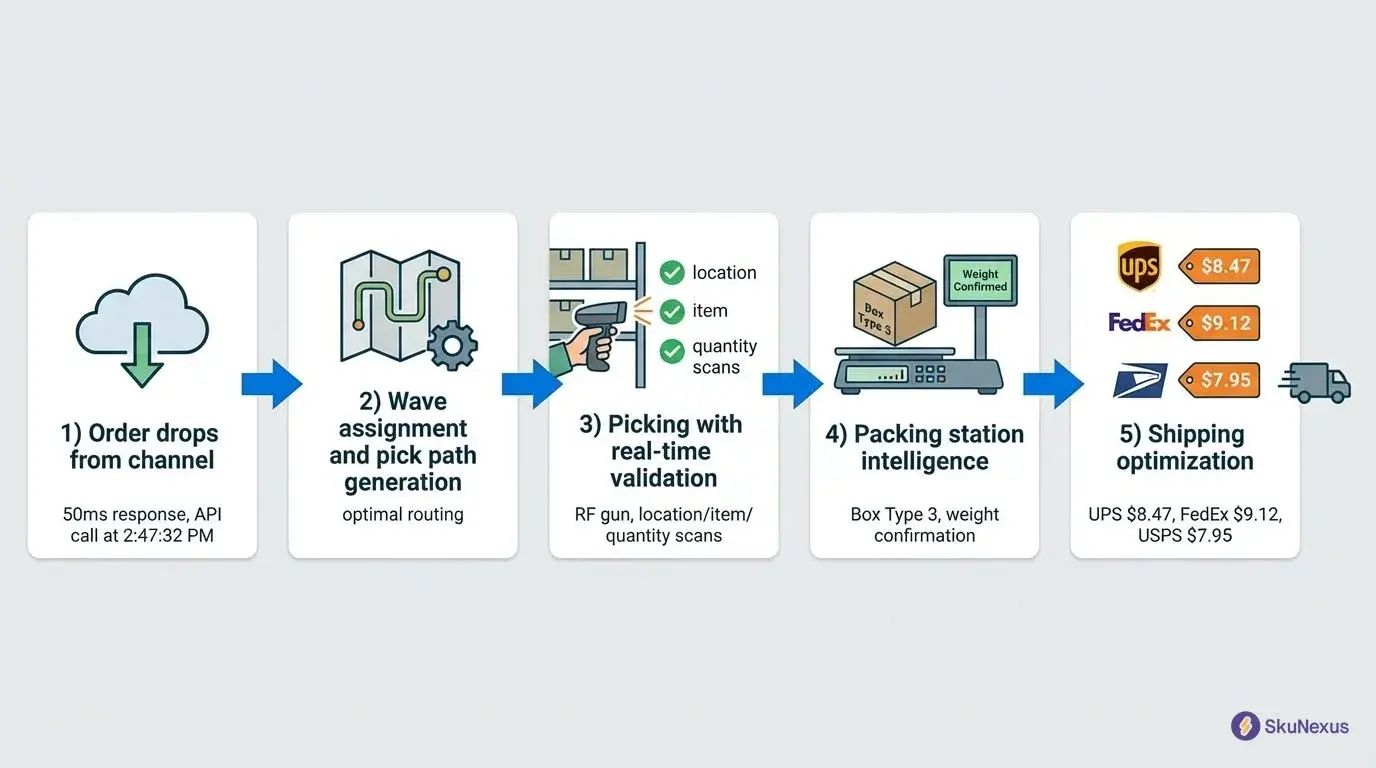
If the barcode work is mostly about picking accuracy, our guide to warehouse picking software covers where scanning fits into a pick path.
Book a demo and we will walk your current process, identify the scan points, and give you a cost picture based on your operation rather than a range.
Frequently asked questions
How much does it cost to implement a barcode system in a warehouse?
Integration scope, data cleanup, and custom workflow work decide the number, not the count of scanners. Book a demo and we will scope it against your operation.
What drives the price of a commercial barcode reader license?
User count, site count, and how much of the workflow the software has to run. Multi-site tracking, analytics, and automation sit above single-user packages on every vendor's list.
What is the average installation cost for an industrial barcode reader system?
There is no single average, because installation cost tracks integration complexity rather than device count. Expect the top of whatever your vendor quotes when the system has to exchange data with older platforms with limited APIs.
What does a barcode system cost for a small business?
An entry setup is a handheld 1D scanner, a light-volume printer, and basic software or a monthly subscription for the application itself. Using a smartphone or tablet with a scanning app removes the scanner cost while you validate the process.
Should I choose a subscription or a one-time purchase?
Subscriptions spread the cost, usually include updates and support, and are easier to scale up or down. One-time licenses cost more upfront and remove the recurring line. Decide based on how your business carries expense and how fast your requirements are changing, then confirm the model still works at the volume and location count you expect next year.
Ready to Transform Your Operations?
See how SkuNexus gives you full control over inventory, orders, warehouse, and shipping.
Schedule a Free Demo →
Yitz Lieblich
CEO & Founder, SkuNexus
Yitz Lieblich is the Founder and CEO of SkuNexus. He has spent 19 years in eCommerce, starting in 2007 when he founded Web Solutions NYC, an eCommerce agency he still leads today. His approach to inventory, order, and warehouse management did not come from a whiteboard. It came from the floor. Across nearly two decades, Yitz has worked with merchants of every size, from mom-and-pop startups to Fortune 100 enterprises, across auto parts, food and beverage, apparel, B2B wholesale, and retail/D2C. He has walked through hundreds of warehouses, watching where operations lose time, money, and orders, with one goal: optimize the operation and make it easier for the merchant. That hands-on pattern is what led him to build SkuNexus in 2018 as a full operational platform. The idea was simple. Configurable infrastructure that bends to each merchant workflow, supporting businesses that ship anywhere from 50 to 20,000 orders a day. A custom development background runs through everything he builds. When SkuNexus writes about fulfillment, WMS, or multi-channel inventory, it comes from operations Yitz has seen and solved firsthand. First as an agency partner since 2007, and now as the architect of the platform.
Keep Reading
WooCommerce Warehouse and Inventory Management
September 16, 2026