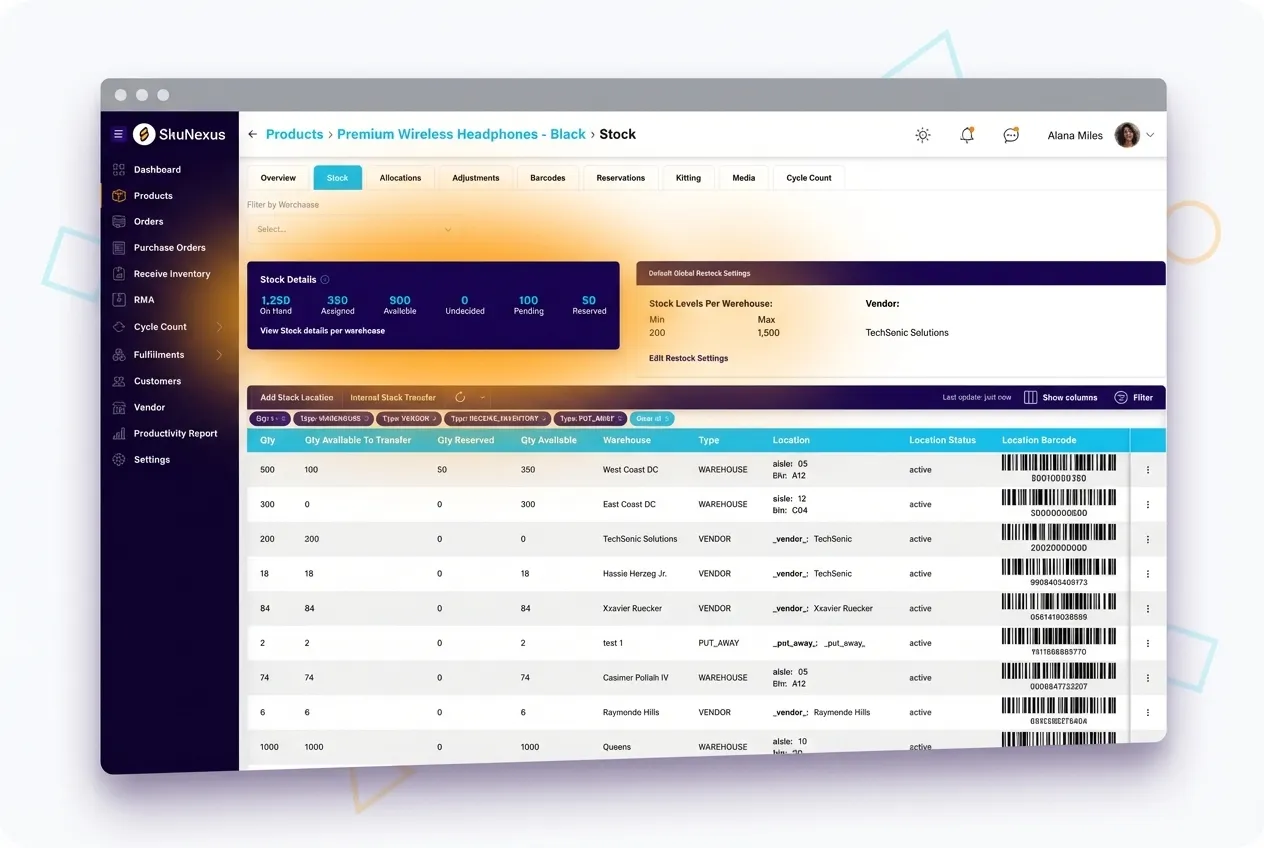
SkuNexus is an order management system that allows users full access to the source code, allowing complete control.
7400 Skokie Blvd, Skokie, IL 60077.
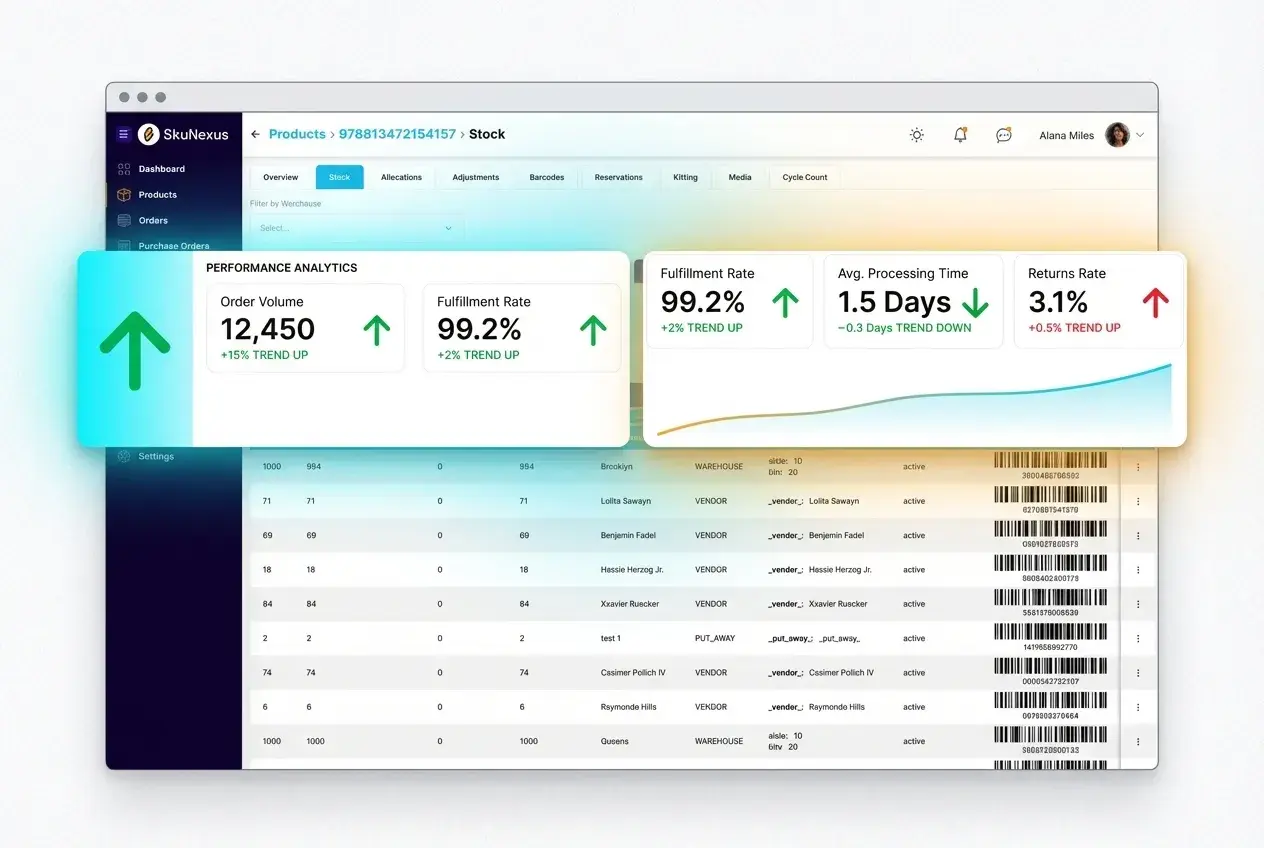
Your warehouse generates thousands of data points every day. SkuNexus AI turns that data into automated decisions: predictive reorders, optimized routing, intelligent carrier selection, and demand forecasting that gets smarter every week.
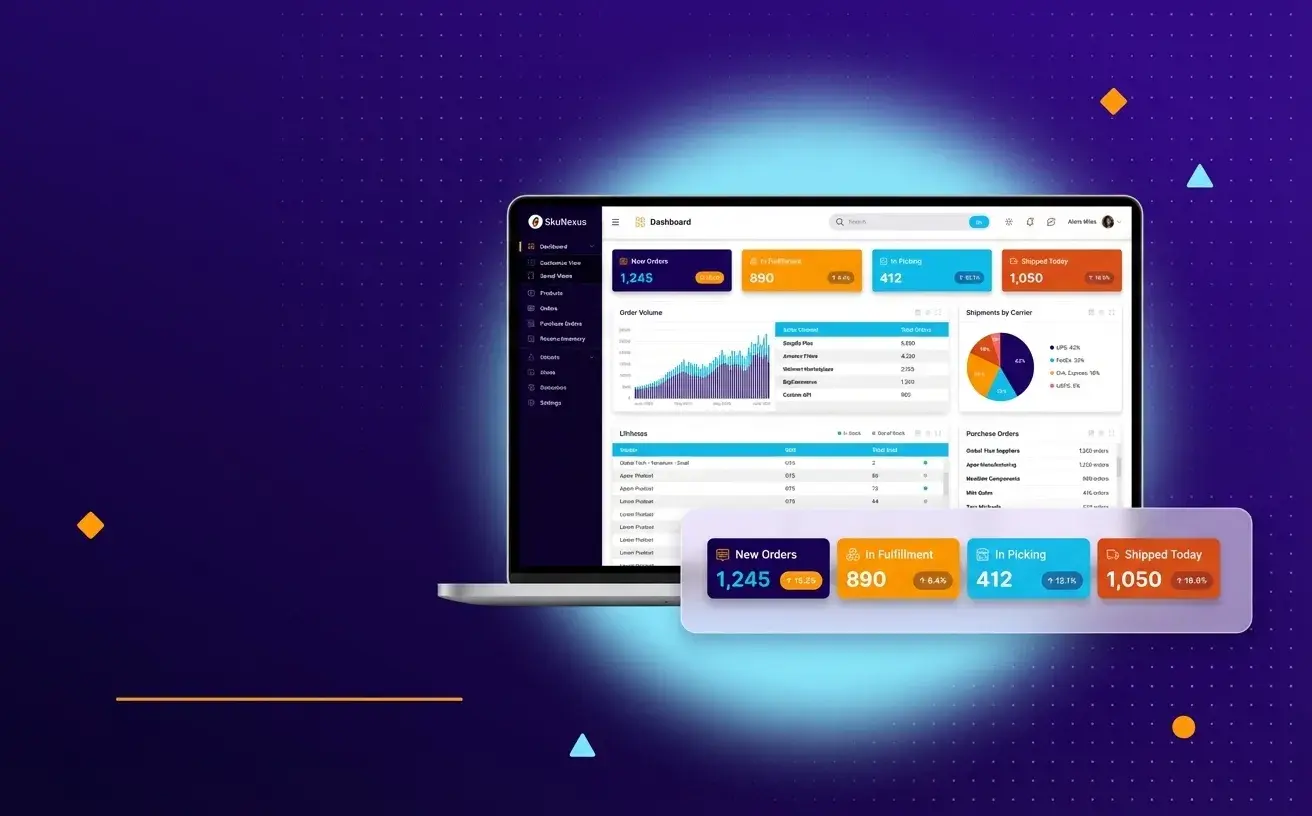
AI warehouse automation uses machine learning and rules-based intelligence to automate operational decisions — demand forecasting, order routing, carrier selection, reorder triggers, and workflow optimization — based on patterns in your actual operational data.
SkuNexus AI isn't a separate product or premium add-on. It's intelligence built into the platform that manages your orders, warehouse, and shipping. Demand forecasting uses your sales data. Routing optimization uses your real inventory positions and carrier rates.
The AI stack starts with rules-based automation (the Auto-Decision Engine) and layers on predictive intelligence as your data grows. You get immediate value from automation and increasing value from AI over time.
Trusted by leading brands processing millions of orders
"We're making the same routing decisions hundreds of times a day. The answers are in our data but our system doesn't use them."
Repeatable decisions that follow patterns should be automated. Your team's time should go to strategy, not routine.
Manual Decisions"Peak season catches us by surprise every year. We don't know how big November will be until we're already out of stock."
Spreadsheet-based demand forecasting takes days and is outdated the moment you finish. You need continuous, data-driven predictions.
No Forecasting"Our competitors are talking about AI in their warehouses. We don't know where to start."
The hype is overwhelming. You want intelligence that actually improves operations — not a buzzword on a pricing page.
AI ConfusionSkuNexus AI starts with practical rules-based automation and layers on predictive intelligence. Immediate value, increasing returns.
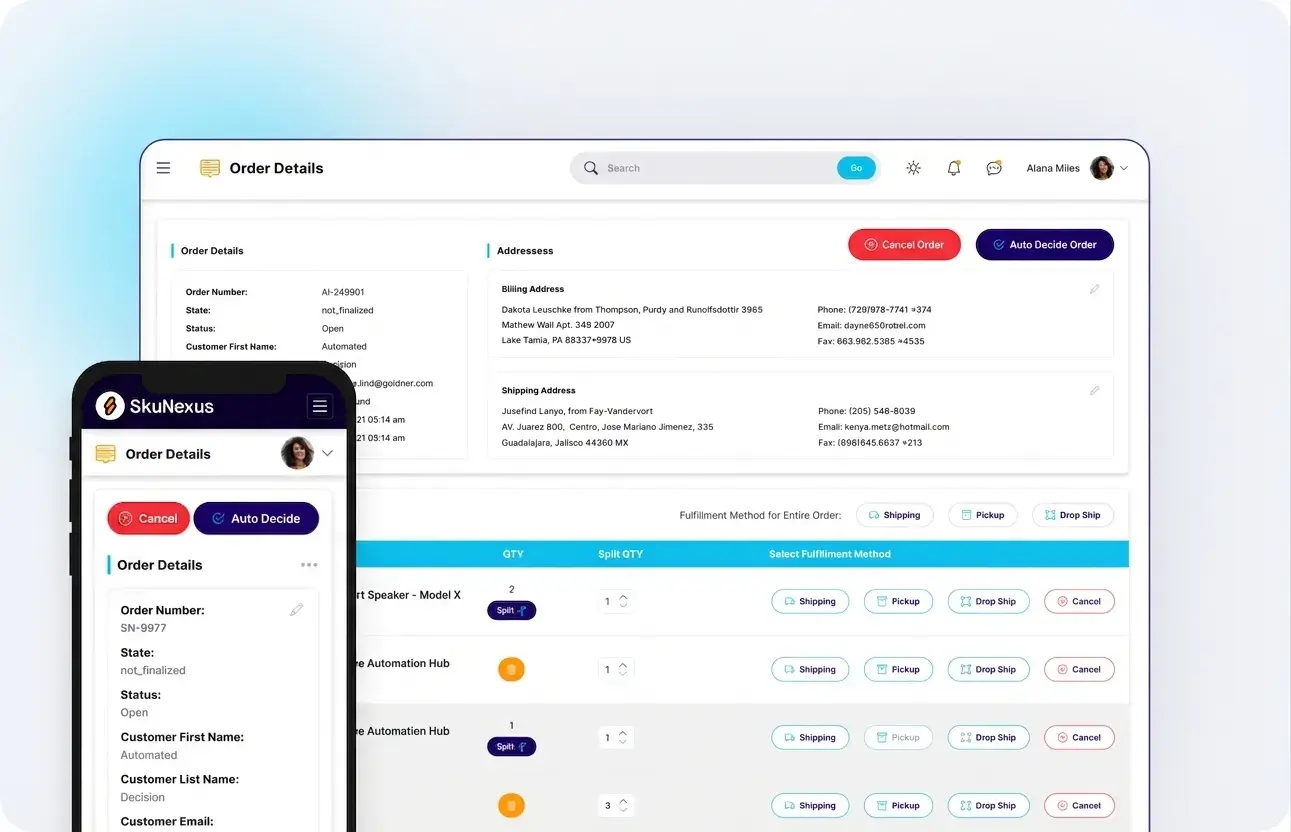
See How It WorksThe Auto-Decision Engine is the foundation: configurable IF/THEN rules that evaluate every order and route it without human intervention. This handles 80% of manual decisions immediately. It's not predictive AI, but it eliminates the repeatable, high-volume decisions eating your team's time.
SkuNexus analyzes historical sales data by product, channel, season, and day of week to predict future demand. Forecasts inform reorder timing, safety stock, and channel allocation. Instead of reacting when out of stock, you reorder before demand hits.
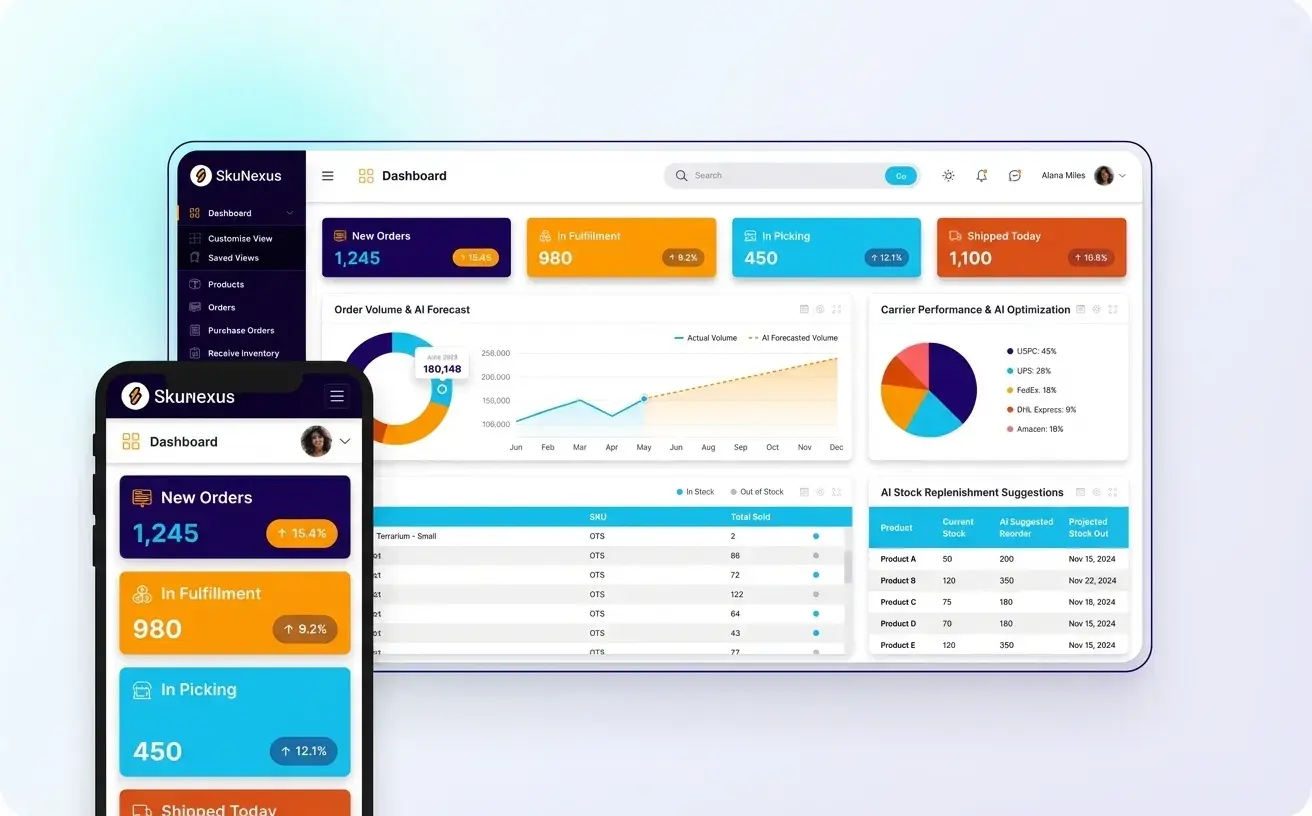
Beyond static rules, optimize routing based on real-time data: inventory levels, carrier costs, delivery requirements, and order priority. The system recommends the path that balances cost, speed, and inventory distribution.
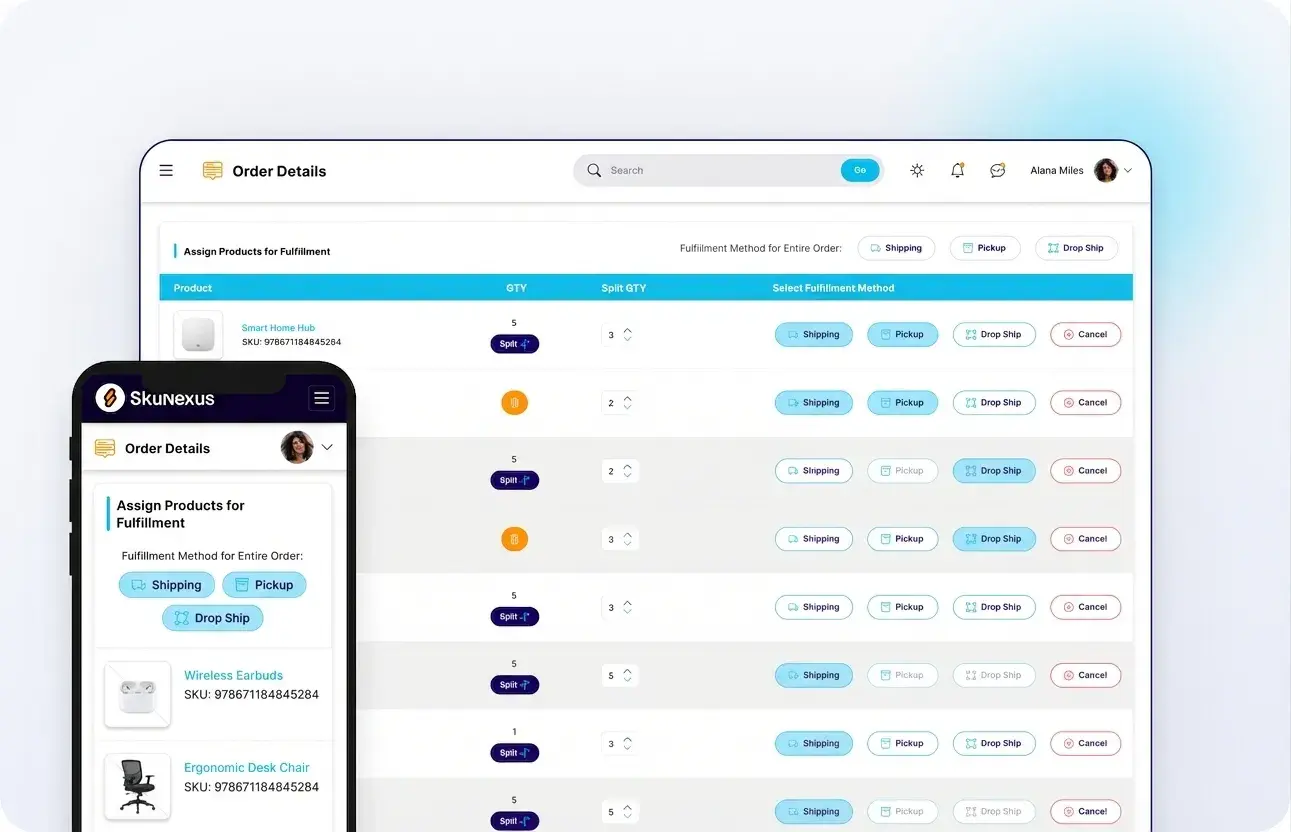
Auto-reorder when stock drops, auto-escalate overdue POs, auto-replenish pick-face locations, auto-flag cost overruns, auto-prioritize by customer segment. Configurable triggers that execute reliably, 24/7.
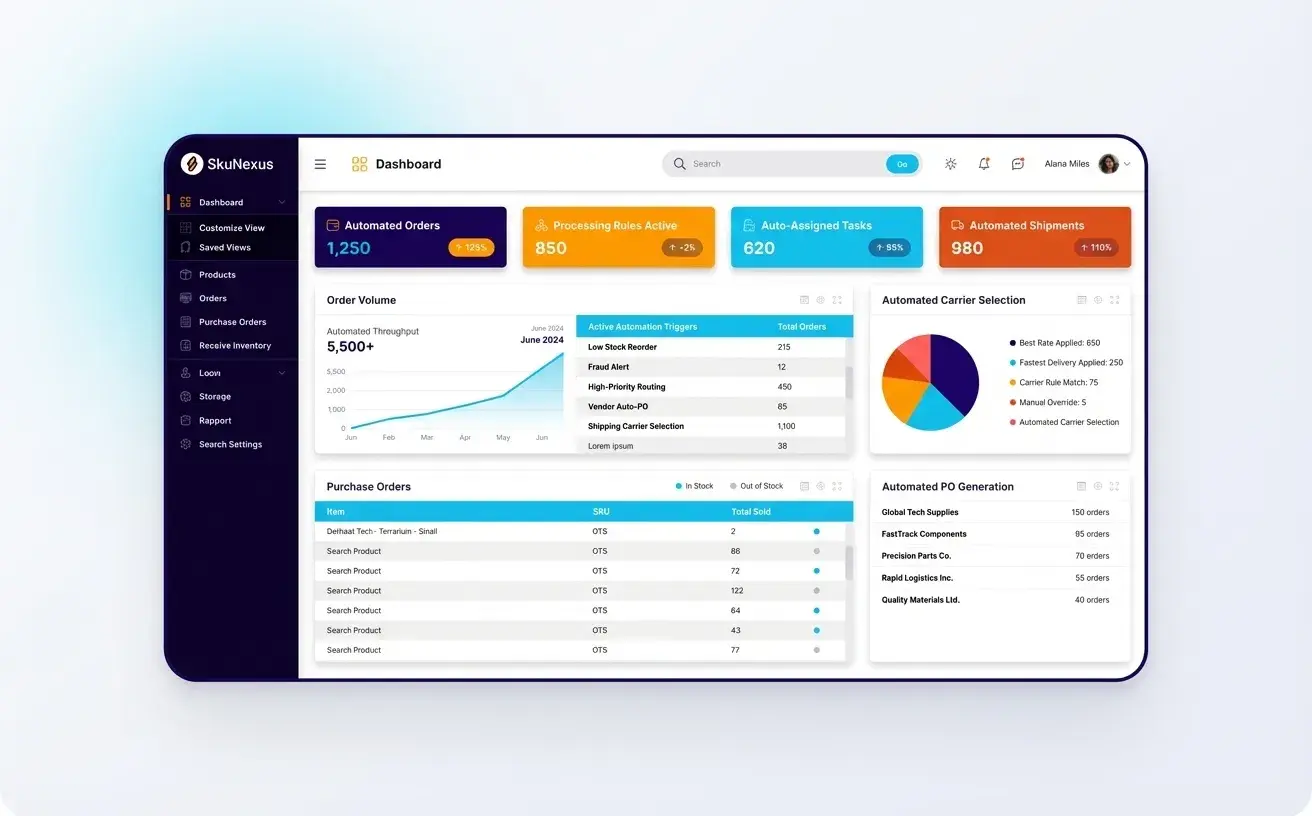
Why Teams Choose SkuNexus
Configurable rules that route every order automatically. Zero human decisions on routine fulfillment.
Predict future demand by product, channel, and season. Reorder before you run out, not after.
Custom automations for any operational event. Inventory thresholds, vendor delays, cost overruns — handled automatically.
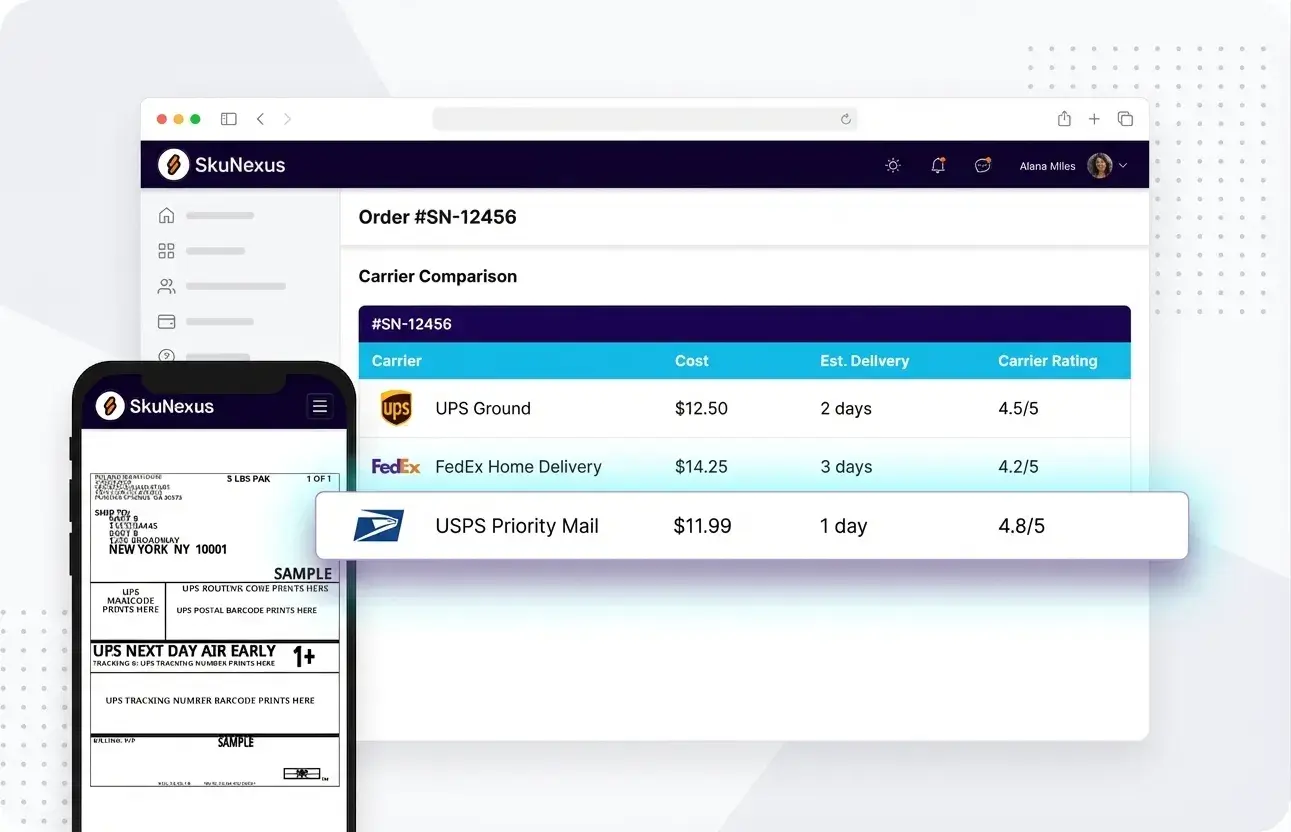
AI-optimized carrier selection goes beyond cheapest rate — factoring in delivery speed, reliability, destination zone, and package characteristics.
The system learns from your shipping history to improve carrier recommendations over time. Historical delivery performance by carrier and zone informs future selections.
Automatic purchase order recommendations based on demand forecasts, lead times, and current stock levels. Reorder before you run out, not after.
The system accounts for seasonality, vendor lead time variability, and sales velocity trends. Reorder recommendations get more accurate as the forecasting model learns from your data.
AI-powered insights into warehouse efficiency, fulfillment speed, shipping costs, and operational bottlenecks. Recommendations for continuous improvement.
Identify patterns your team can't see manually: which products slow down picking, which routes cost more than necessary, which times of day have the highest throughput.
SkuNexus AI isn't a separate product. It's intelligence built into the same platform managing your operations. No separate 'AI module' to configure — the intelligence comes from your operational data flowing through the system daily.
Every automated decision is visible, auditable, and overridable. See which rule fired, what data it evaluated, what action it took. This isn't a black box — it's transparent automation that earns trust through visibility.
API-first architecture means the platform connects to robots, conveyor systems, and automated sorting as your operation grows. The AI layer orchestrates human workers and automated systems alike.
We want to ensure that we future proof to be able to utilize robotics in the warehouse.
A 150-year-old premium ice cream brand selling DTC, wholesale, and through national retail partners.
"Our Smoothest Peak Season Ever"
Native integrations with leading eCommerce platforms, shipping carriers, and accounting tools.


Every repeatable decision your team makes manually is a decision the system should be making for them.
| Manual Operations | SkuNexus AI & Automation |
|---|---|
| ✕ Every order reviewed by a human | ✓ Auto-Decision Engine routes automatically |
| ✕ Spreadsheet demand forecasting | ✓ Continuous AI-driven predictions |
| ✕ Same carrier every time | ✓ Intelligent carrier selection per shipment |
| ✕ Manual reorder decisions | ✓ Predictive reorder triggers |
| ✕ React to stockouts | ✓ Predict and prevent stockouts |
| ✕ No operational intelligence | ✓ Data-driven continuous improvement |
Your data is already telling you what to do. SkuNexus AI turns that data into automated decisions, predictive forecasts, and continuous optimization.
Free demo • No credit card required
AI in warehouse and order management turns the data your operation generates every day - order patterns, inventory movements, vendor lead times, carrier costs, picking efficiency, return rates - into automated decisions that would otherwise require human judgment. Instead of someone reviewing each order and deciding where to ship from, the system evaluates historical data and business rules to make the optimal routing decision automatically, in milliseconds.
The foundation is the rules-based Auto-Decision Engine, which handles deterministic logic (if this, then that). AI layers on top add predictive capabilities: forecasting demand before stockouts happen, identifying the carrier most likely to deliver on time to a specific region, detecting anomalies in warehouse productivity, and recommending reorder quantities based on sales velocity trends. SkuNexus captures all this operational data natively because inventory, orders, warehouse, and shipping run on one platform - there's no data stitching required to feed the AI models.
Automated order routing evaluates every incoming order against your fulfillment rules and assigns it to the optimal warehouse, vendor, or store without human intervention. Rules factor in geographic proximity (ship from the closest warehouse), inventory availability (does that warehouse have stock), shipping cost (cheapest option meeting the delivery deadline), carrier speed (will it arrive on time), and order priority (VIP customers or express shipping get queue priority).
The impact is both speed and consistency. A person making routing decisions processes maybe 100 orders per hour and makes judgment calls that vary based on experience, attention, and time pressure. The Auto-Decision Engine processes orders in milliseconds with perfect consistency - the same rules applied every time, with no variation for fatigue or distraction. For operations doing 300+ orders per day, automated routing eliminates the need for a dedicated person making fulfillment decisions and ensures every order takes the optimal path.
Demand forecasting analyzes historical sales data, seasonal patterns, promotional impacts, and current sales velocity to predict when each product will need reordering - before it runs out, not after. Instead of discovering a stockout when a customer order can't be fulfilled, the system alerts your purchasing team days or weeks in advance and can auto-generate purchase orders to the right vendor with the right quantities.
The value compounds over time as the system accumulates more historical data. First-year forecasts are based on sales trends and seasonal patterns. By year two, the system has a full year of your specific data to identify product-specific cycles, promotional impacts, and vendor lead time variability. SkuNexus tracks sales velocity per SKU per warehouse, connects forecasting signals to automated reorder triggers, and links those triggers directly to PO creation with pre-populated vendor and product details.
Yes. Intelligent carrier selection goes beyond basic rate shopping by factoring in historical carrier performance data alongside live rates. The system compares rates across all your carrier accounts on every shipment, but also weighs historical on-time delivery rates by region, damage claim frequency, and actual versus quoted transit times. A carrier might offer the cheapest rate but consistently deliver late to certain zones - the AI learns this and routes accordingly.
This is more sophisticated than simple lowest-price-wins rate shopping. It's optimizing for total cost of delivery, which includes the cost of late deliveries (customer complaints, replacement shipments) and damaged packages (returns, reshipping). SkuNexus rate shops automatically at the pack station, comparing live carrier rates while incorporating performance data, and selects the optimal carrier without manual comparison.
Nearly every repetitive operational decision can be automated: order routing (which warehouse ships this order), wave pick generation (which orders to batch together for efficient picking), putaway assignment (which bin to place incoming inventory in), reorder triggers (when to create a PO based on stock thresholds and velocity), carrier selection (which shipping option gives the best cost-to-speed ratio), cycle count scheduling (which locations to count today), and exception alerts (flagging orders that fall outside normal parameters for human review).
The principle is that humans should handle exceptions, not routine decisions. If 95% of your orders follow predictable patterns, automate those patterns and free your team to handle the 5% that genuinely need judgment. One prospect saw the wave picking and automation demo and joked about reducing headcount - but the operational math was real. SkuNexus automates all of the above through configurable rules that run without human intervention on every order, every receiving event, and every inventory change.
Automation eliminates the manual decisions between workflow steps - the person reviewing each order, choosing the carrier, deciding which warehouse ships it, creating the fulfillment task, checking if items are in stock. Combined with wave picking (one walk for 20+ orders instead of 20 individual walks), scan-verified workflows (no time spent double-checking because the system verified at each step), and auto-label generation (no manual carrier selection or address entry), teams handle 3-5x more orders with the same headcount.
The headcount savings come from two places: eliminating decision-making roles (people who review and route orders) and increasing throughput per warehouse worker (wave picking + directed workflows). A warehouse doing 800 orders per month cut daily picking from an hour to 20 minutes. Larger operations see even greater impact because the time savings multiply across every worker and every order. SkuNexus automates the entire flow from order arrival to shipping label, with humans only involved in physical picking, packing, and handling exceptions.
Every operational data point generated by your fulfillment operation: order history (volume, frequency, channel mix, geographic distribution, seasonal patterns), inventory levels (per warehouse, per bin, per status bucket, with historical trend data), vendor performance (lead times, fill rates, defect rates, cost trends), carrier data (rates, transit times, on-time percentage, damage claims, zone-specific performance), and warehouse productivity (picks per hour, packing speed, error rates per worker, wave completion times).
The advantage of capturing this data in one platform rather than stitching it together from separate tools is that the relationships between data points are preserved. You can see that orders from Channel X routed to Warehouse Y and shipped via Carrier Z have a 15% higher on-time rate than the same orders routed to Warehouse W - insight that's impossible when order, inventory, warehouse, and shipping data live in four different systems. SkuNexus captures all of this natively because every operational function runs on the same platform.
Still have questions?
Talk to Our TeamEvery order, shipment, and inventory movement generates data that could make your next decision better. SkuNexus AI turns that into automated decisions and predictive forecasts.
SkuNexus is an order management system that allows users full access to the source code, allowing complete control.
7400 Skokie Blvd, Skokie, IL 60077.