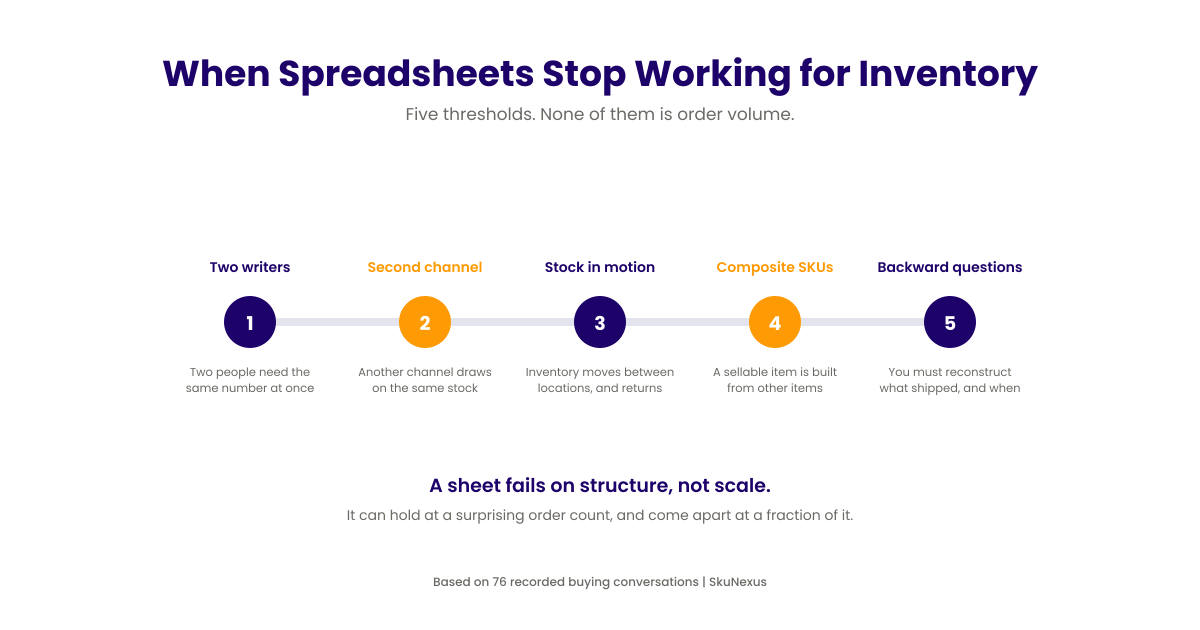
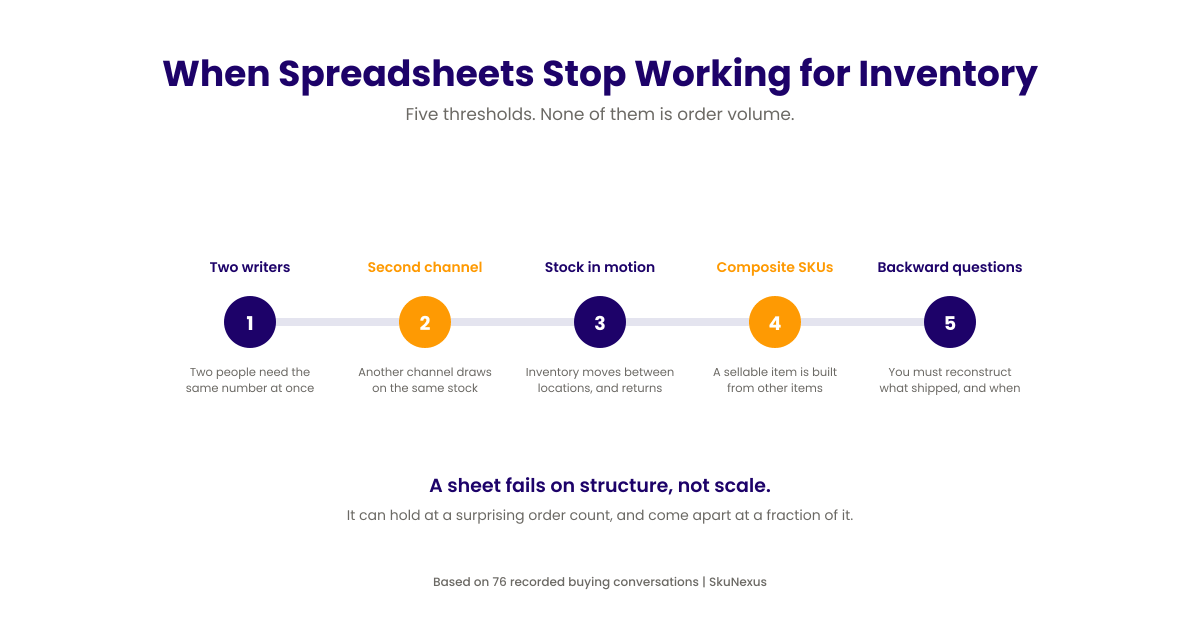
A spreadsheet stops working for inventory at the point it becomes a coordination tool rather than a record. The five practical thresholds: two people need the same number at once, a second sales channel draws on the same stock, inventory moves between locations, a SKU is built from other SKUs, or you have to reconstruct what shipped and when. Volume alone is not the trigger.
By Yitz Lieblich, Founder and CEO of SkuNexus. In eCommerce since 2007. Based on patterns across 76 recorded buying conversations with mid-market merchants.
The most common assumption we hear is that these files fail because of order volume. They do not, at least not primarily. One perishable food producer in our call records was moving roughly 8,000 orders a month with inventory still running on Google Sheets. It worked, in the sense that product went out the door every day. It also produced a failure mode they described as their single biggest problem: stock that was physically on the shelf but missing from the sheet, and stock that was long gone but still showing as available.
That is not a volume failure. That is a coordination failure, and it can arrive at 200 orders a month or survive until 8,000.
The five thresholds
Each of these showed up repeatedly across the calls. They are ordered by how early they tend to hit, not by severity.
| # | Threshold | The signal you have crossed it | What it costs |
|---|---|---|---|
| 1 | Concurrent writers | Two people need the same quantity at the same moment | Committed stock that does not exist |
| 2 | Second channel | Anything other than one storefront draws on the same pool | Overselling, cancellations, marketplace penalties |
| 3 | Stock in motion | Product moves between locations, or leaves and comes back | Counts that are right per-location and wrong overall |
| 4 | Composite SKUs | A sellable item is assembled from component items | Availability nobody can calculate before picking |
| 5 | Backward-looking questions | You need to answer what shipped, to whom, from which batch | Reconstruction from memory and archived files |
1. Two people need the same number at once
A spreadsheet has no concept of a reservation. It records what someone typed most recently.
A furniture retailer, whose operation comes up more than once below, described the mechanism exactly. They believe they hold three units of an item, so they sell three. Then someone walks to the shelf to pick, and finds two. Or one. Nobody was careless. The sheet answered the question it was asked, which was "what is the quantity right now," not "what is the quantity that is not already spoken for."
This is the threshold most operations cross first, and the one most often misdiagnosed as staff error. It is not staff error. Two people cannot safely share a document that has no locking, no allocation, and no audit of who committed what.
2. A second channel draws on the same stock
The moment stock is sold from more than one place, the sheet becomes a synchronization job someone has to perform by hand.
That same furniture retailer, running 20 to 30 orders a day, described the mismatch plainly: the internal stock sheet showed zero on an item while the website still showed three available, because nothing pushed the change across. They also maintained separate manual SKU entry for a partner sales portal, which meant the same product existed in three places, each one authoritative in someone's mind. Manual order entry into a second destination is never just a time cost. It is a second place where the truth can quietly diverge.
If you sell on Shopify and are still deducting stock by hand afterward, the platform-side mechanics are worth understanding before you change anything else. We cover that in Shopify inventory tracking.
3. Inventory moves, and sometimes comes back
Multi-location breaks a sheet in a way single-location never does, because a transfer is two edits that must both happen or neither.
The perishable food producer above ran an intake into a main distribution center, transfers out to cold storage, transfers on to a second regional hub, and occasionally a pallet coming back a month later. Every one of those legs was a manual edit in a sheet. They described the actual mechanic of the work as moving columns between sections of the sheet by hand. When a leg gets missed, the total is still correct and every location total is wrong, which is the hardest class of error to notice. The same operation hit a second-order version of this: stock sitting at cold storage still counted toward what the storefront advertised as available, even though nothing at that site could be picked to fill an order. The number was not wrong in any single place. It was answering a different question than the one the website was asking.
4. A sellable SKU is built from other SKUs
This is the threshold that most reliably defeats a sheet, and the one buyers are least likely to anticipate.
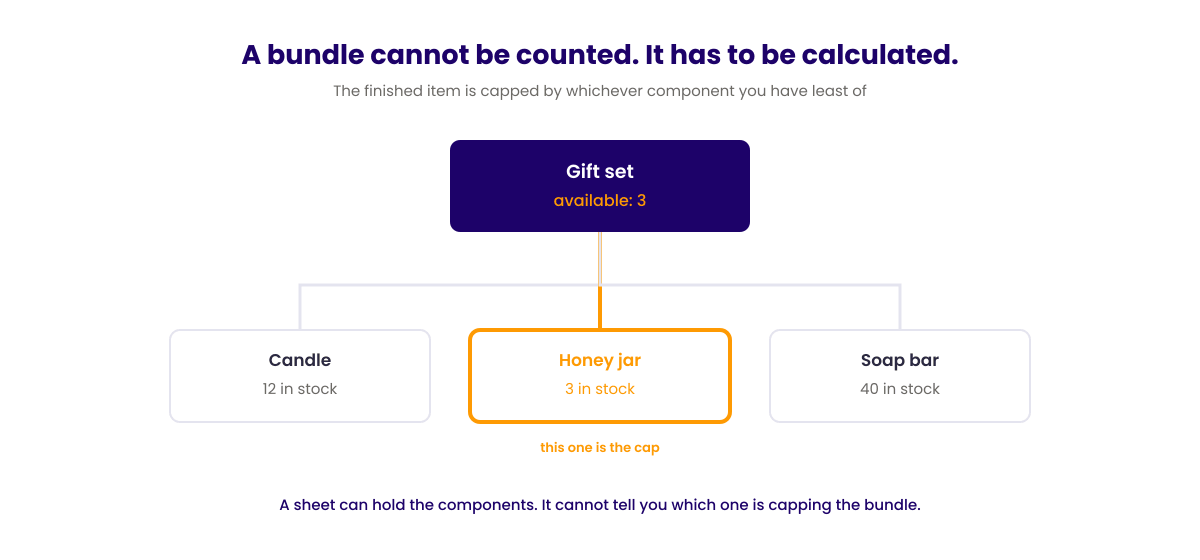
If you sell a bundle, kit, or assembly, the available quantity of the finished item is not a number you can store. It is a calculation across every component, constrained by whichever component you have least of. A sheet can hold the components. It cannot tell you which component is currently capping the bundle without someone tracing it by hand.
One consumer goods merchant doing roughly 1,400 orders a month had to export everything to Excel just to produce a stock report, and then work backward through it to find which component SKU was blocking a finished bundle.
5. You need to answer a question about the past
A sheet is poor at history because the most recent edit overwrites the previous truth.
The same producer wanted to be able to ask their inventory a question it could not answer: show me what is here by code, by case, by pallet. Not what the total is today, but where a specific thing sits and how it got there. A sheet can be made to hold that, but only by someone maintaining it as a second job, and it is the first thing to lapse in a busy week.
Price your own manual work
Do this on your numbers before you look at any product, including ours. The goal is to size the manual inventory work you are already paying for, and to find out whether it is a real cost or a tolerable annoyance.
The formula, in two parts.
Labor:
(daily minutes in the sheet / 60) x working days per year x loaded hourly rateErrors:
annual orders x error rate x cost per incidentWorked example. An operation doing about 2,000 orders a month, one warehouse, two sales channels.
Every input below is an assumption. Replace them with your own, and treat the result as a floor.
- Time in the sheet: 90 minutes a day across the team. (Assumption. An auto parts operation shipping around 430 orders a day put it at an hour every morning, sometimes two, just working out stock orders. Ninety minutes is a midpoint, not a worst case.)
- Working days: 250.
- Loaded hourly rate: $28. (Assumption. Wage plus payroll burden, not base wage.)
- Error rate: 1.5% of orders result in an oversell, short pick, or correction.
- Cost per incident: $22 blended. (Assumption. Service handling time plus reship or refund exposure, averaged.)
Labor: (90 / 60) x 250 x $28 = $10,500 Errors: 24,000 x 0.015 x $22 = $7,920 Total: roughly $18,400 a year
How to read your result. Three things matter more than the total.
First, the number excludes what you cannot see. It does not include the customer who found you out of stock and bought elsewhere without telling you. My own view is that this invisible loss is the larger number, and that nobody can size it honestly. Do not add a guess for it.
Second, check the direction. A figure that has grown proportionally with your order count is a cost. A figure growing faster than your order count is a constraint, and it will keep compounding. Manual order processing scales linearly at best, which is why it eventually overtakes growth instead of absorbing it.
Third, use rough bands. Under about $15,000 a year, process fixes are usually the better investment and you should read the next section before you buy anything. Above roughly $40,000 and climbing, the sheet is no longer recording your operation, it is limiting it. In between, it depends on whether you expect to cross any of the five thresholds in the next year.
If you want the same math extended to warehouse operations specifically, the WMS ROI calculator covers labor, space, and accuracy inputs.
When spreadsheets are genuinely fine
This section exists because the honest answer for a real share of readers is "do not buy anything yet."
A spreadsheet is a good fit while all of the following hold:
- One location, one channel, one owner of the number. Not one person doing the work, one person with authority to change a quantity. Two writers is threshold one.
- Every SKU sells as itself. No kits, no bundles, no assemblies.
- No lot, expiry, or serial obligation. If you never have to answer which batch went where, the history problem does not apply to you.
- Replenishment is scheduled, not reactive. You reorder on a cadence you set. If reordering is triggered by someone noticing a shelf is low, that is not a spreadsheet problem yet, but it is the pattern one merchant described to us as shooting from the hip, and it does not survive a second location.
- The sheet is a record, not a coordination device. This is the real test. If the sheet is how one person keeps track, it is fine at surprising scale. If the sheet is how three people tell each other what happened, it has already failed and the failures are just not visible yet.
Manual stock control fails on structure, not scale. Order volume is deliberately absent from that list, and that is the point: a sheet can hold together at a surprising order count while every condition above is true, and come apart at a fraction of it once two or three stop being true.
Fix the process before you buy anything
Several of these are free, and a system will not save you if you skip them. Automating a process nobody has defined tends to produce a faster version of the same confusion.
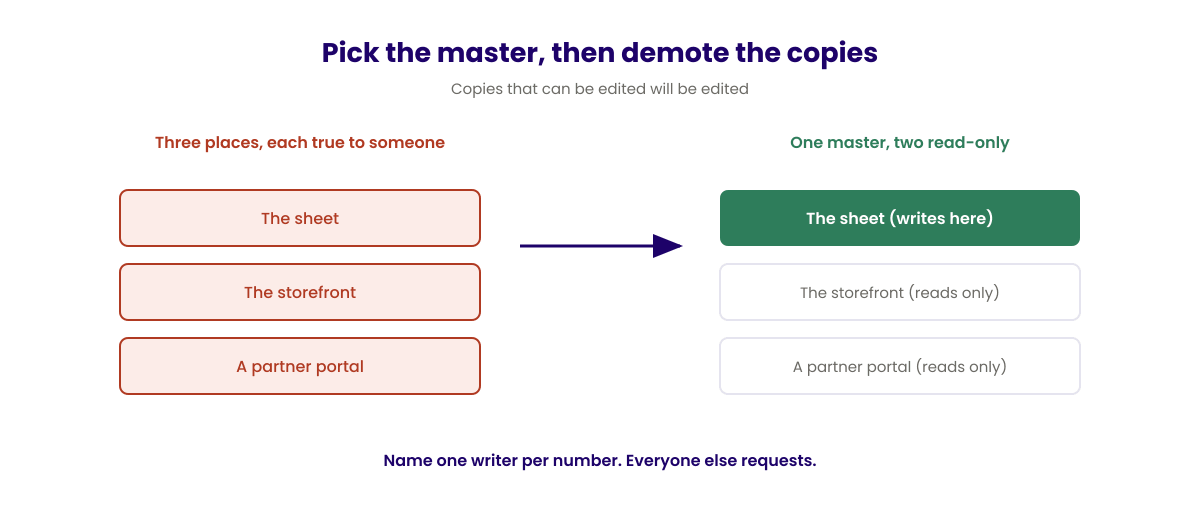
- Name a single writer per number. One person, or one role, with authority to change a quantity. Everyone else requests. This alone removes most of threshold one.
- Pick the master and demote the copies. If quantity is edited in the sheet, the storefront, and a partner portal, decide which one is true and make the others read-only in practice. Copies that can be edited will be edited.
- Make marking part of picking, not after it. A recurring root cause of drift in our calls is picking without recording. One operation moving several thousand orders a month described it precisely: people pull from the main inventory pool and do not mark it, so the count says fourteen and the shelf has twelve, and nothing in between explains the gap.
- Cycle count the fast movers weekly. Counting the top 20% of SKUs every week finds problems while you can still trace them. An annual full count finds a number you cannot explain.
- Write down a reorder point for every SKU that matters. Even a crude one, even in the same sheet. A written trigger beats institutional memory, and it is portable when you do move to a platform.
- Kill the double entry. Every place a human re-keys the same data into a second destination is a place the two records can diverge. One consumer goods operation shipping around 200 orders a day had to set an order aside, carry it to a different computer, and have someone type the details in again, purely because the two systems did not speak. The same furniture retailer above was maintaining separate manual SKU entry for a partner portal on top of their own sheet, which meant the same product existed in three places, each authoritative in someone's mind. Find yours and remove it, even if the fix is unglamorous.
If receiving and put-away are where your day disappears, layout is often the cheaper fix. Warehouse layout design covers that side.
Who this is not for
Three honest exclusions.
If you run fulfillment for other companies and bill them for it, your core requirement is client billing, storage accounting, and per-client rules. That is a different product category. Nothing above is aimed at you.
If your constraint is production, meaning bills of material, work orders, and shop floor scheduling, you need manufacturing planning software. Inventory and order tooling will not schedule production for you, and any vendor telling you otherwise is selling you a second problem.
If you are under about 20 orders a day, single channel, single location, the honest recommendation is the process fixes above, plus the free inventory controls in whatever storefront you already run. Come back when you cross a threshold.
There is also a middle path worth naming. Moving off spreadsheets onto an established multichannel platform such as Linnworks is a genuinely reasonable next step, and for a lot of operations it is the right one. The question to ask before you commit is a fit question rather than a feature question: whether the way that tool expects receiving, allocation, and routing to work matches how your operation actually runs. That is a different conversation than this page.
What actually changes
The change worth wanting here is not a feature list. It is that a recurring daily task stops being something a person has to hold together.
The relevant point about SkuNexus here is narrow and worth stating precisely: it is built as open infrastructure, so the workflow logic is yours to define rather than one you conform to. If your receiving requires a two-step quarantine, or your allocation rules favor a location for reasons only your business understands, those are configuration questions rather than feature requests that wait in a queue. That is the differentiator. It is not a claim that every capability exists natively out of the box, and you should be skeptical of anyone who makes that claim.
The failure mode we watch for is a merchant automating a process nobody has defined. Work the list above first. Then, if you have crossed two or more thresholds and your math lands in the constraint band, the question shifts from whether to move to what the new process should be.
The order management guide is the next read if orders rather than stock are where your operation breaks.
See it run on your own orders. The useful version of a demo is one where you bring your actual thresholds, your real SKU structure, and your worst week. Request a walkthrough.
Yitz Lieblich founded SkuNexus in 2018 and has worked in eCommerce since 2007, with merchants from mom-and-pop startups to Fortune 100 operations across auto parts, food and beverage, apparel, B2B wholesale, and retail. The patterns above are drawn from 76 recorded buying conversations with mid-market merchants. Individual details have been anonymized.
Ready to Transform Your Operations?
See how SkuNexus gives you full control over inventory, orders, warehouse, and shipping.
Schedule a Free Demo →
Keep Reading