The 90-Second Pick Pack Ship Blueprint
Your team takes 3-5 minutes per order. Here's the 90-second blueprint that processes 267% more orders with the same headcount.
Every second over 90 costs you $0.03 in labor. A 500-order day at 4 minutes per order burns $60 more than the same volume at 90 seconds. Scale that to 2,000 orders daily and you're bleeding $240 in pure labor waste. Over a year, that's $87,600 in recoverable costs.
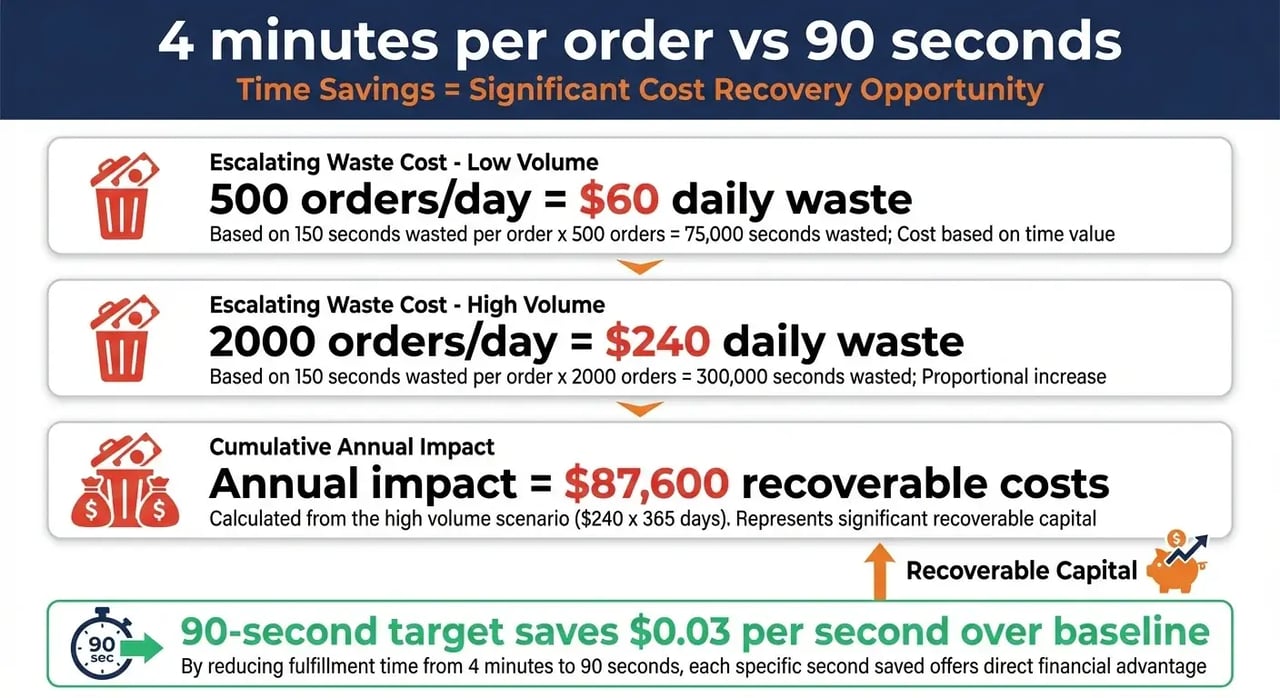
The pick pack ship process breaks at handoffs - picker to packer, packer to shipper. The 90-second model eliminates handoffs through station design.
Zone picking handles the first 30 seconds. A-zone items sit within 30 feet of packing stations. B-zone extends to 60 feet. Everything else gets batched during low-volume hours.
Packing stations run on the 45-second drill. Box sizes pre-selected by order weight. Tape dispensers mounted at elbow height. Shipping labels print before the packer turns around.
Fulfillment optimization starts with measuring your baseline. Time 20 random orders tomorrow morning. Track pick time, pack time, label generation separately. Most operations spend 90 seconds just walking between locations.
Step 1: Pick in 30 Seconds (Yes, Really)
Let's start with picking - where 80% of operations blow their time budget.
Your bin location naming system kills speed. Alphanumeric codes (A1-B7-C3) force mental translation. Sequential numbering (001-002-003) creates linear flow. Switch to sequential. Picker walks bin 001, then 002, then 003. No zigzagging across aisles.
Serpentine paths beat U-shaped routes by 15 seconds per pick. U-shaped forces backtracking. Serpentine flows like reading - left to right, drop down, right to left. Your picker never retraces steps.
Pick list organization determines everything. Group orders by zone, not by customer. Batch 10 orders from A-zone, complete the circuit, move to B-zone. Single-order picking wastes 40% of movement time.
Target metrics: Under 50 steps per pick. Most warehouses average 85 steps because items scatter across random locations. Order picking strategies that ignore physical layout fail every time.
Your picks per hour should hit 180-240 for single items. Below 180 means your layout needs fixing. The math behind 30-second picks starts with distance reduction. Every extra step adds 0.8 seconds. Cut walking to 30 steps through proper slotting. Position fast-movers within arm's reach of main aisles.
The 4 Picking Methods Ranked by Speed
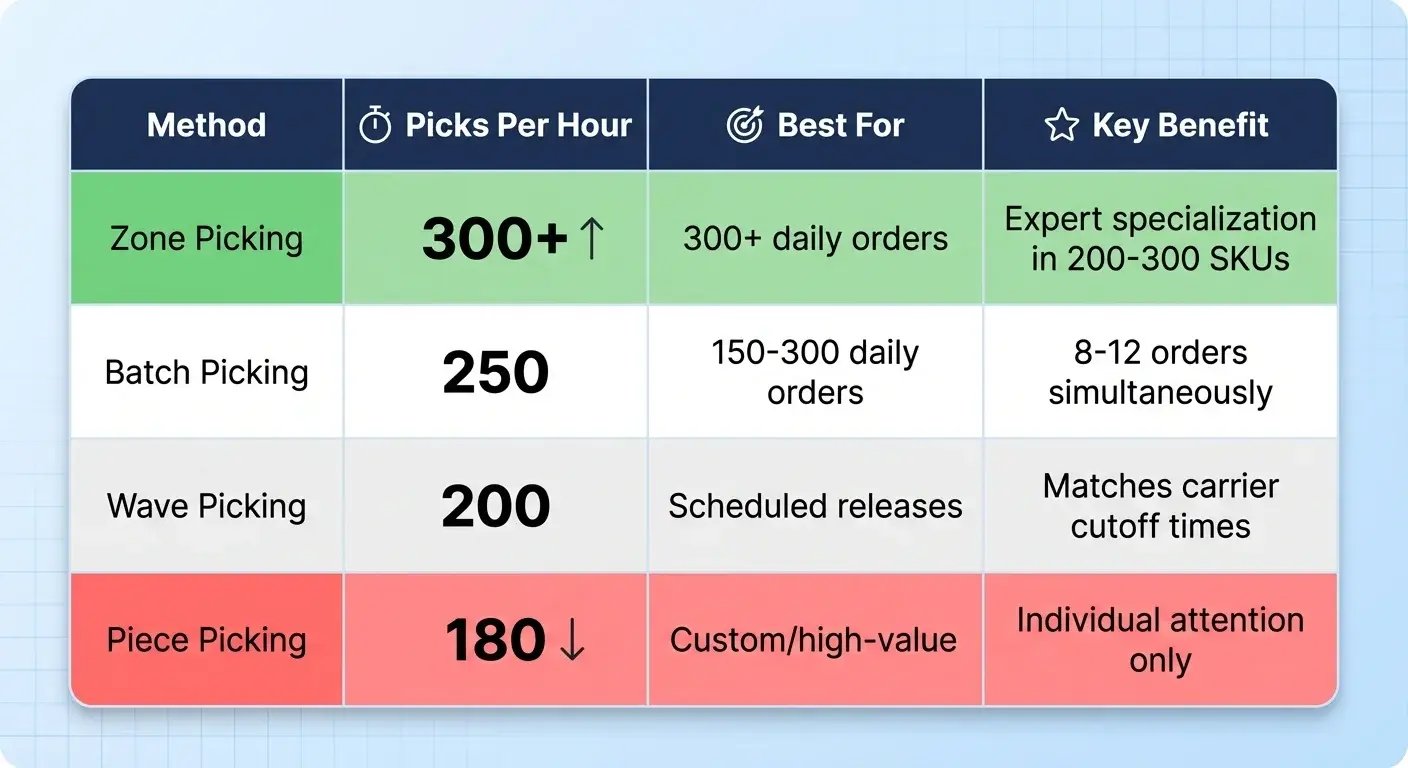
Zone picking dominates at 300+ picks per hour. Assign one picker per zone. Orders flow through stations. Picker A grabs A-zone items, passes tote to Picker B for B-zone items. No walking between zones.
Use zone picking when daily volume exceeds 300 orders. Each zone picker becomes an expert in 200-300 SKUs instead of managing thousands. Zone picking requires balanced workloads. Measure picks per zone over one week. Redistribute SKUs until each zone generates equal pick counts.
Batch picking delivers 250 picks per hour. One picker collects items for 8-12 orders simultaneously. Sort into individual orders at packing station. Deploy batch picking between 150-300 daily orders. Optimal batch size equals square root of daily order volume. 100 daily orders means batches of 10.
Wave picking processes 200 picks per hour. Release orders in scheduled waves - 9 AM, 1 PM, 4 PM. Wave timing should match your shipping cutoffs exactly. Wave size calculation: multiply your pick rate by available time window. 200 picks per hour × 2-hour window = 400-order maximum per wave.
Piece picking crawls at 180 picks per hour. One order, one picker, start to finish. Only use for custom orders or high-value items. Warehouse picking methods that ignore volume thresholds create bottlenecks.
Your Warehouse Layout Cheat Sheet
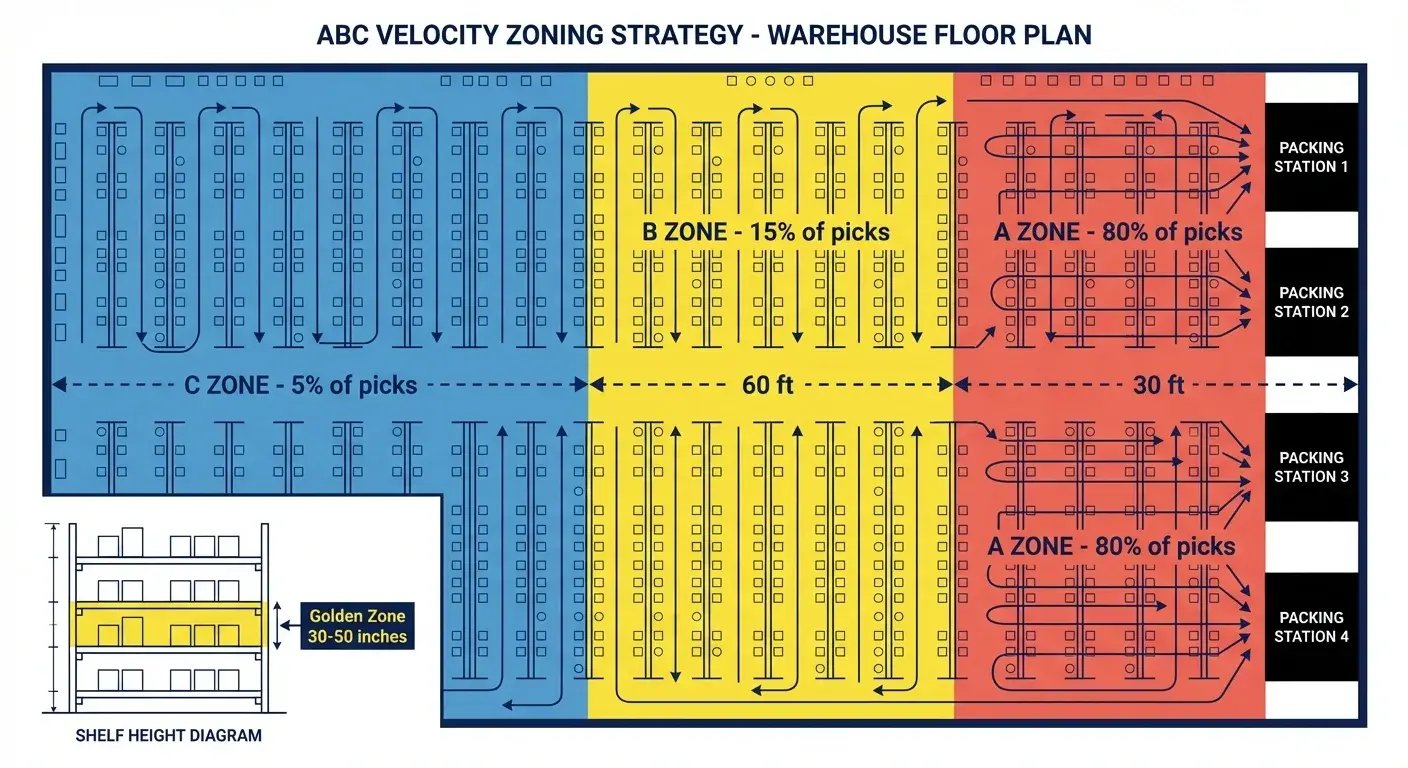
ABC velocity zoning follows the 80/20 rule precisely. A items represent 20% of SKUs but generate 80% of picks. Position A items within 30 feet of packing stations. B items comprise 30% of SKUs, 15% of picks. Place in middle zones, 30-60 feet from packing. C items fill 50% of SKUs but only 5% of picks. Banish to back zones beyond 60 feet.
Calculate optimal bin sizes using 7-day velocity data. Take your fastest-moving SKU. Count picks over seven days. Divide by seven for daily average. Size that bin to hold three days of inventory.
Fulfillment optimization means matching physical space to pick frequency. Measure walking distance for your top 20 SKUs. Total should be under 600 feet for complete pick circuit.
Bin height strategy follows picker ergonomics. Golden zone sits 30-50 inches from floor. Stock A items here exclusively. Aisle width impacts pick speed. Optimal width: 10 feet. Allows two-way traffic without congestion.
Step 2: Pack Like You're Running a 45-Second Drill
Fast picking means nothing if your packer spends 2 minutes finding the right box. Here's the 45-second station setup that makes the pick pack ship process flow.
Break the 45 seconds into drill segments: 10 seconds for box selection using the 3-box rule, 20 seconds for protective material and item placement, 10 seconds for sealing, 5 seconds for label placement. No exceptions.
The 3-box rule eliminates decision paralysis. Small orders (under 2 pounds) get 6x4x4 boxes. Medium orders (2-8 pounds) get 12x9x6 boxes. Heavy orders (over 8 pounds) get 16x12x8 boxes. Three choices. Done.
Box utilization targets 65-75% fill rate. Calculate it: (item volume ÷ box volume) × 100. Under 65% wastes shipping costs. Over 75% risks damage.
Position tape guns at elbow height, 18 inches from box center. Mount label printers 12 inches above tape level. Labels print while sealing happens.
Track your cost per package: $0.15 for boxes, $0.08 for void fill, $0.12 for tape, $0.10 for labels, $0.05 for labor. Total: $0.50 per package when you hit the 45-second target.
The $0.50 Per Package Packing Setup
Stack pre-cut boxes by usage frequency: medium boxes on top shelf (60% usage), small boxes middle shelf (25%), large boxes bottom shelf (15%).
Air pillows cost $0.03 per cubic foot. Paper costs $0.08 per cubic foot. Air pillows win unless you're shipping fragile items requiring cushioned support.
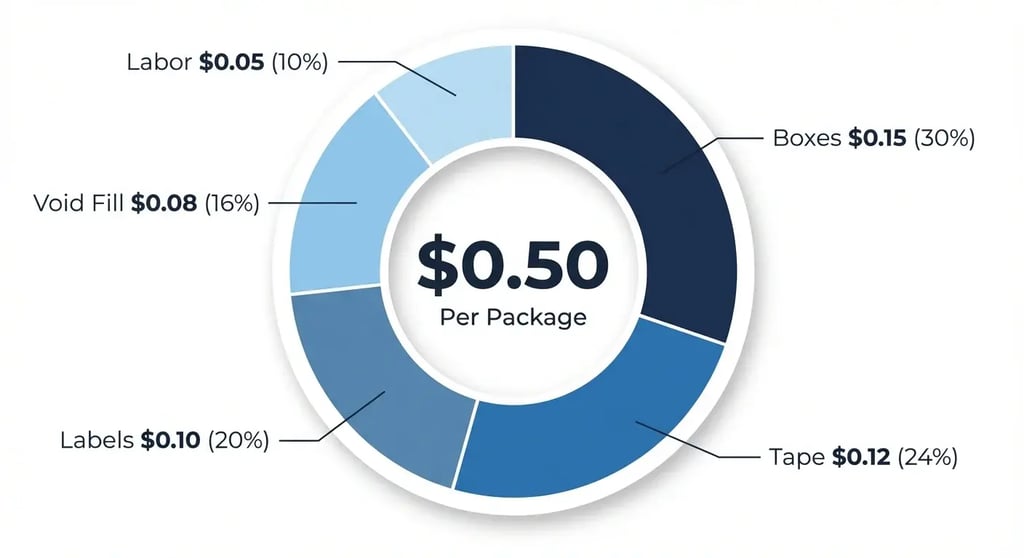
Mount air pillow machine 24 inches left of box center. Paper dispenser overhead, pulls down like paper towels. Tape gun at elbow height eliminates reaching. This setup processes 80 packages per hour at $0.50 cost per package.
Step 3: Ship Without the Shipping Desk Bottleneck
That label needs to print before your packer turns around. 15 seconds, automated.
Manual rate shopping murders your timeline. Your shipping clerk compares USPS, UPS, FedEx rates for 30 seconds per order. That's double your entire shipping budget. Rate shopping automation cuts this to 3 seconds with better carrier selection.
The 15-second shipping window breaks down: 3 seconds for automated rate comparison, 7 seconds for label generation, 3 seconds for carrier selection confirmation, 2 seconds for label printing. Total: 15 seconds from pack completion to shipping label in hand.
Carrier integration speeds determine your baseline: USPS API responds in 3 seconds, UPS in 5 seconds, FedEx in 4 seconds. Your system queries all three simultaneously, not sequentially. Parallel processing, not waterfall delays.
Rate shopping automation saves 18% on shipping costs through optimal carrier selection. Manual selection defaults to familiar carriers. Automated selection picks cheapest option every time.
The carrier decision formula eliminates guesswork: Weight × Zone × Delivery Time = Optimal Carrier. Under 1 pound to Zones 1-4 triggers USPS First Class. 1-5 pounds to Zones 5-8 routes to UPS Ground. Over 5 pounds defaults to FedEx Ground unless 2-day delivery required.
Multi-Carrier Rate Shopping in 3 Seconds
Your API configuration determines speed. Set timeout limits: USPS at 3 seconds, UPS at 5 seconds, FedEx at 4 seconds. Any carrier exceeding timeout gets skipped for that order.
The decision matrix eliminates manual intervention: Under 1 lb to Zone 1-4 = USPS First Class at $0.58 average. 1-5 lbs to Zone 5-8 = UPS Ground at $8.95 average. Over 5 lbs = FedX Ground at $12.40 average.
Weight thresholds trigger automatic routing. Items under 1 pound ship USPS First Class unless expedited delivery requested. 1-5 pound range compares all three carriers. Over 5 pounds defaults to FedEx Ground for reliability.
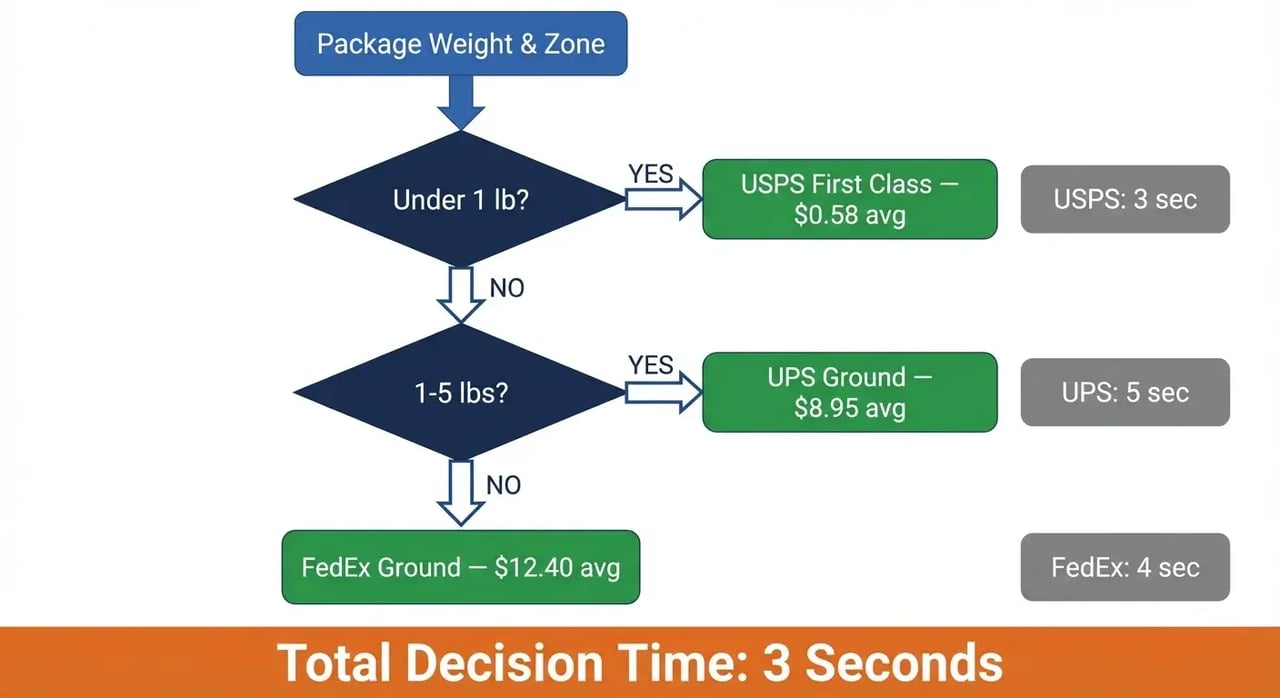
SkuNexus handles this decision tree automatically - no manual rate checking, just the cheapest option every time. The system adjusts thresholds based on your order patterns and delivery zones.
The Tech Stack That Makes 90-Second Fulfillment Possible
Manual rate shopping kills this timeline. You need three specific systems working together.
Your warehouse management system (WMS) handles pick path optimization. Budget $500-2000 monthly depending on order volume. Under 1000 orders daily, $500 systems work fine. Over 3000 orders, expect $2000 monthly for enterprise features.
The WMS must calculate optimal pick paths automatically. The system analyzes order composition, generates serpentine paths, batches compatible orders. Look for zone-based picking modules and real-time inventory updates.
Shipping software with multi-carrier support costs $200-500 monthly. $200 systems handle basic rate shopping across 3-4 carriers. $500 systems add dimensional weight calculations, hazmat routing, international shipping rules.
Your shipping software needs API connections to USPS, UPS, FedEx, and regional carriers. Real-time rate comparison in under 5 seconds. Automatic carrier selection based on cost and delivery requirements.
Barcode scanning systems require $2000 upfront investment. Handheld scanners cost $300 each. Expect 4-6 scanners for smooth operations. Add $800 for wireless infrastructure and $600 for software licenses.
ROI Calculation: Break-Even at 200 Orders Daily
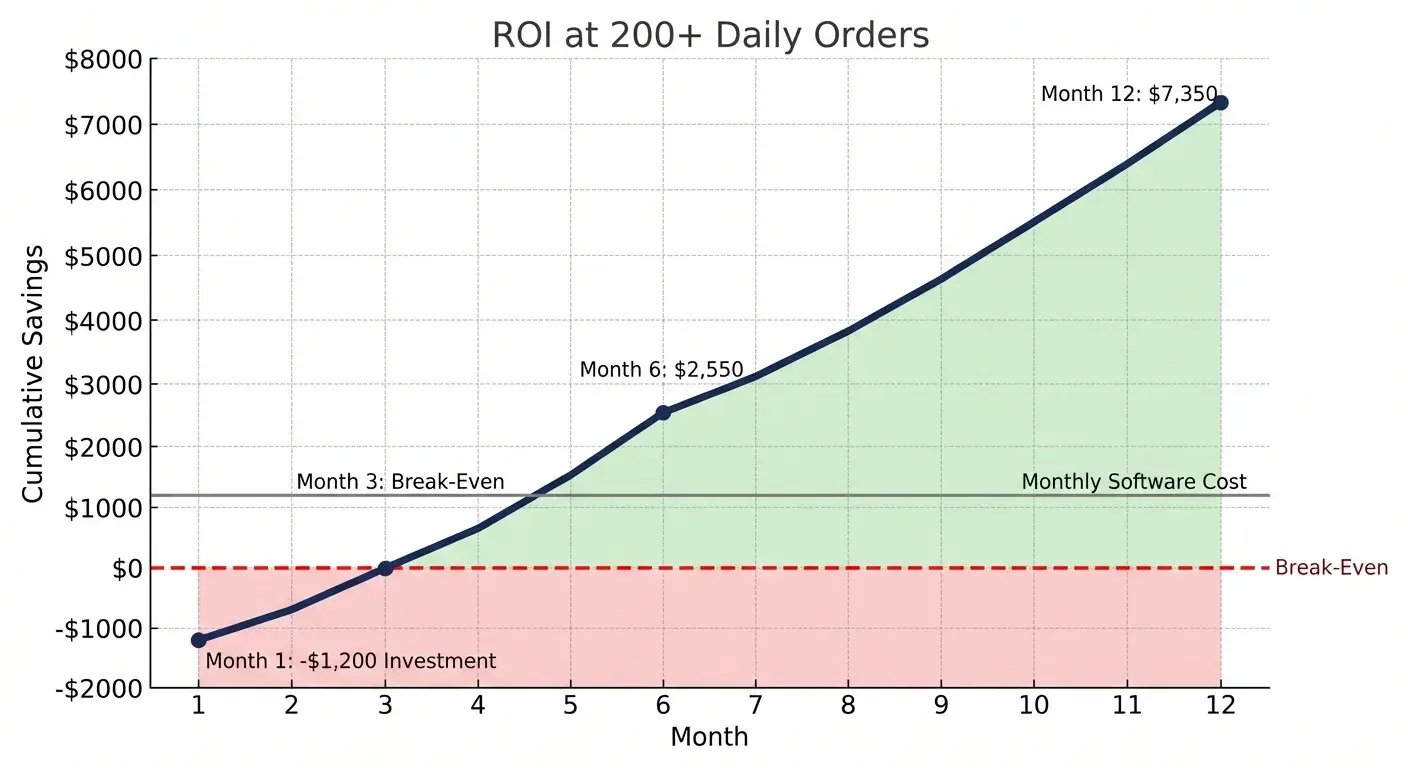
Current labor cost per order: 4 minutes at $15 hourly wage = $1.00 per order. Target labor cost: 90 seconds at same wage = $0.375 per order. Savings: $0.625 per order.
Monthly software costs: $1200 total. Break-even calculation: $1200 ÷ $0.625 savings per order = 1920 orders monthly. That's 64 orders daily.
Hit 200 orders daily and you generate $2550 monthly savings after covering software costs. Fulfillment optimization through technology pays for itself within 3 months.
When Your Pick Pack Ship Process Breaks (And How to Fix It)
Even perfect tech can't save you from five failure points that kill your 90-second target.
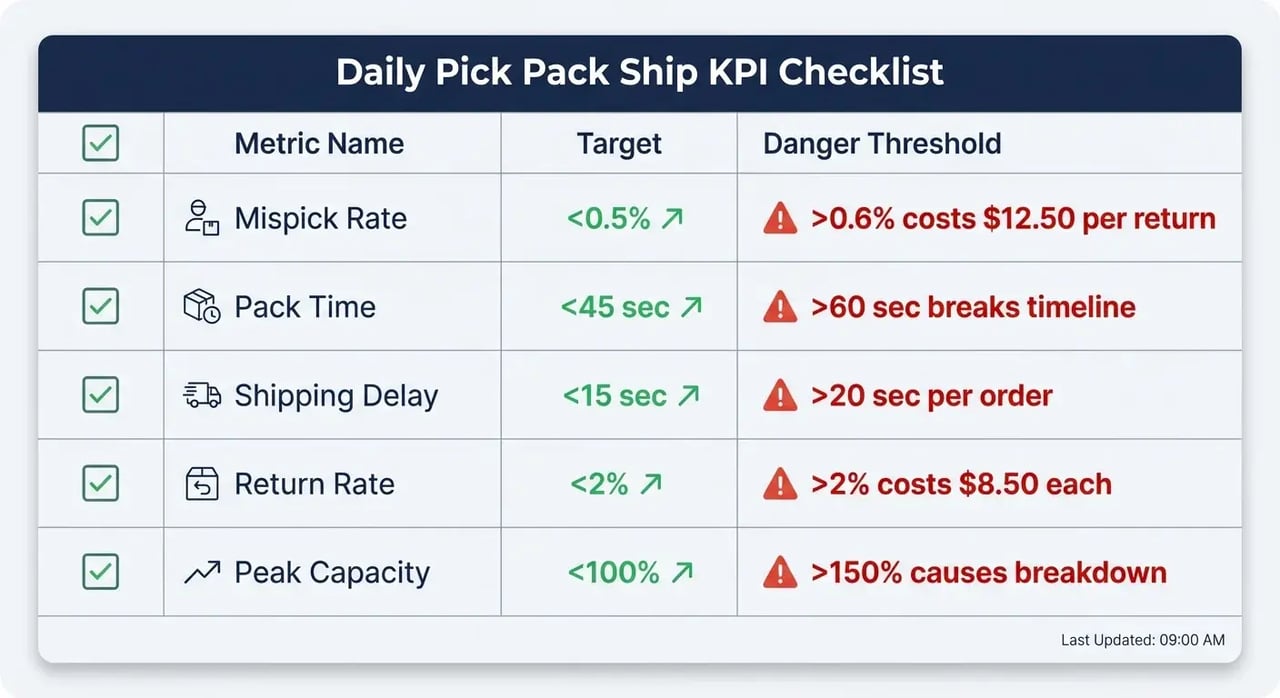
Mispicks above 0.5% trigger return cycles costing $12.50 each. At 1000 daily orders, 0.6% mispick rate burns $75 daily. Fix with double-scan verification: picker scans item, then order barcode. System confirms match before next pick. Takes 3 seconds, reduces mispicks to 0.1%.
Packing time over 60 seconds destroys your timeline. Root cause: decision paralysis from too many box options. Reduce to exactly 3 sizes: small (6x4x4), medium (12x9x6), large (16x12x8). Train packers: under 2 pounds gets small, 2-8 pounds gets medium, over 8 pounds gets large. Decision time drops from 20 seconds to 2.
Shipping delays over 20 seconds happen when rate shopping runs after packing. Pre-fetch rates during packing instead. While packer selects box, system calculates rates using estimated weight. Label prints in 3 seconds when packing completes.
Returns above 2% indicate quality problems. Each return costs $8.50 plus lost satisfaction. Add photo verification: packer photographs contents before sealing. Takes 5 seconds, reduces returns to 1.2% by catching errors pre-ship.
Peak season breakdown hits when volume exceeds 150% capacity. Your order picking strategies that work at 300 orders collapse at 450. Implement wave picking: release orders in 4-hour waves instead of continuous flow. Wave 1 (6AM-10AM) processes overnight orders, Wave 2 (10AM-2PM) handles morning volume, Wave 3 (2PM-6PM) clears afternoon orders.
Track daily: mispick percentage, pack time, shipping delays, return rate, peak volume handling. One trending metric signals trouble before complete breakdown.
Build vs Buy: The $50K Decision Framework
Sometimes the math says stop optimizing and start outsourcing. Here's the exact calculation.
If (daily orders × $3.50 internal cost) > (daily orders × $2.75 3PL cost + $500 daily overhead), then outsource. The breakeven point hits between 500-750 orders daily.
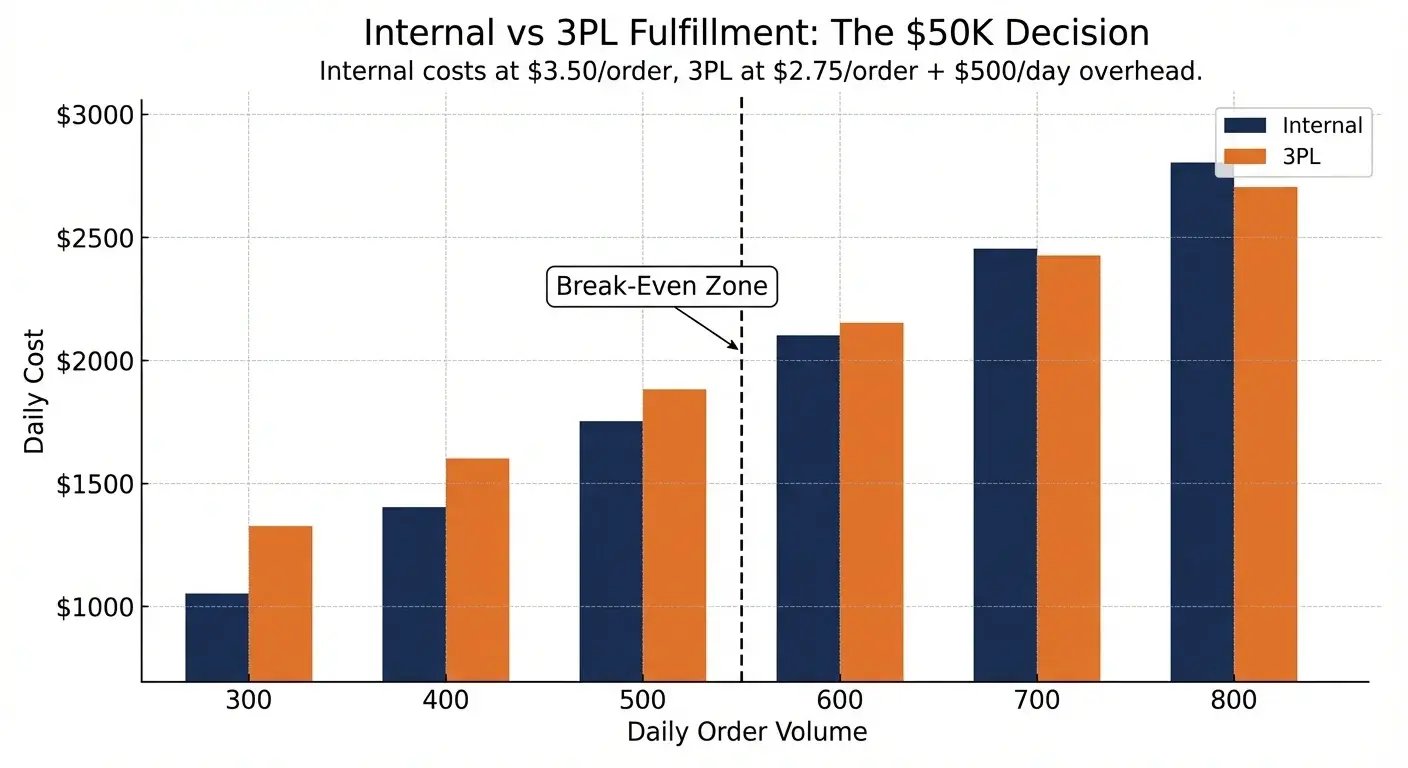
Your internal cost per order includes warehouse lease at $0.50 per square foot monthly, IT support at $2000 monthly, equipment depreciation, utilities, insurance. Most operations miss these costs and make bad decisions.
For 600 daily orders: Internal cost = $2100 daily. 3PL cost = $2150 daily. You're at the tipping point where pick pack ship outsourcing makes financial sense.
Hidden costs kill internal operations above 500 orders daily. WMS licensing jumps from $800 to $2000 monthly at enterprise volume. Equipment maintenance doubles when utilization exceeds 80%.
Quality 3PLs charge $2.75 per order plus $500 daily overhead for account management and technology integration. No lease obligations. No staff management.
Peak season changes everything. Your 600-order average jumps to 1200 orders in November. 3PL partnerships handle volume spikes without hiring temporary staff or leasing additional space.
Calculate your true cost per order including all hidden expenses. If you're above $3.25 per order at 500+ daily volume, start evaluating 3PL partnerships.