One Operator, 800 Orders a Month, Peak Season Solved
How a France-based artisan knife company replaced individual order picking and ShipStation with wave picking, bundle management, and French carrier integration - making peak season manageable for a single warehouse operator.
Before & After SkuNexus
The transformation at a glance
About French Artisan Knife Company
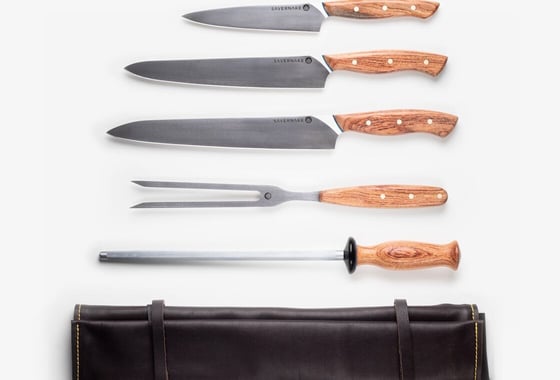
This artisan knife company manufactures and sells handcrafted kitchen knives from France. The product line runs to approximately 140 SKUs, including about 40 bundle configurations that group individual knives and accessories into sets. Orders come primarily through Shopify, with the bulk of annual volume concentrated in the November–December gift-giving season.
The warehouse operation is a one-person job for most of the year. At 800 orders per month during the steady season, a solo operator can manage individual order picking - one order at a time, start to finish. At 5,000 orders in November and December, that approach collapses.
The Challenge
The math of individual order picking is straightforward: at 800 orders per month, the operator was spending roughly an hour per day on picking. That’s manageable. At 5,000 orders in a peak month, the same individual-order approach would require five times the picking time. For a solo operator, that’s not possible.
ShipStation was the previous shipping tool. It worked well enough for label generation, but it wasn’t designed to optimize warehouse picking workflows. And it didn’t offer native integration with the French domestic carriers - GLS and Relaiscolis - that this company’s customers expected. International shipping was handled differently from domestic, and the patchwork of workarounds to make French carrier labels work added time to every shipment.
Bundle management was a separate pain point. With 40 bundle SKUs representing different knife-and-accessory combinations, tracking component inventory required manual reconciliation between what Shopify showed as available and what was actually in stock at the component level. Shopify’s native bundle handling wasn’t adequate, and the manual work-arounds created ongoing discrepancies.
The company needed wave picking to make peak season manageable for one person, French carrier support to serve its domestic customer base properly, and bundle management that kept component inventory accurate without manual effort.
Why SkuNexus
Wave picking was the primary capability gap. SkuNexus’s WMS generates optimized pick waves that batch multiple orders together by product location, dramatically reducing the travel time and touch count compared to picking one order at a time. For a solo operator, wave efficiency is the difference between a manageable peak season and an unmanageable one.
The French carrier integration - GLS and Relaiscolis - resolved the workaround approach that had been required with ShipStation. Labels generate natively within the SkuNexus shipping workflow, with the correct carrier format and documentation for French domestic shipments.
Bundle management in SkuNexus tracks component-level inventory rather than bundle-level inventory. When a bundle sells, the individual components deplete from stock automatically. Shopify sees accurate availability based on actual component inventory rather than a manually maintained bundle count.
What Was Built
Wave Picking for Solo Operations
Pick waves group multiple orders together based on product location in the warehouse. Instead of walking the full warehouse path for each individual order, the operator picks all products from a zone across multiple orders in a single pass, then sorts to orders at the pack station. The walk distance and pick time per order drops significantly compared to order-by-order picking.
Bundle Component Management
Each of the 40 bundle configurations is defined by its component SKUs. When a bundle order is placed, SkuNexus tracks the reservation and fulfillment at the component level. Shopify inventory availability reflects true component stock rather than a separately managed bundle count. The manual reconciliation between bundle and component inventory is eliminated.
French Carrier Integration
GLS and Relaiscolis are integrated natively into the shipping workflow. Label selection is based on shipment destination and service type. Labels generate in the correct format for each carrier without manual data entry or workaround steps. The shipping workflow that previously required extra handling for domestic French shipments now runs the same as any other carrier selection.
Shopify Integration
Orders import automatically from Shopify into SkuNexus. Inventory updates push back in real time as components are picked and bundles fulfilled. The connection runs without manual synchronization steps between the storefront and the warehouse system.
The Results
Peak season is no longer a capacity crisis for a solo operator. Wave picking compresses the picking work that would have required an unworkable number of individual-order passes into efficient multi-order waves. The November–December surge that previously overwhelmed the operation is now manageable within the same single-operator structure.
Bundle component inventory is accurate automatically. The manual reconciliation that had created ongoing discrepancies between Shopify’s displayed availability and actual warehouse stock is gone. Customers see accurate inventory; the operator doesn’t spend time correcting it.
French domestic shipping runs through native carrier integrations. Every GLS and Relaiscolis label generates correctly within the standard shipping workflow, without the workarounds that ShipStation required for carriers it didn’t natively support.
More Customer Stories
Multi-Brand Transport Retailer Consolidates 5 Shopify Stores
5 Shopify stores. 4,700 orders/mo. One unified platform.
Pleasant Hill Grain: From Spreadsheets to Scalable Fulfillment
First-ever WMS. Wave picking. 900+ new listings. 2× volume-ready.
Graeter’s Automates Every Order Across 3 Warehouses
550K+ pints shipped yearly. 100% order automation. 8+ year partnership.
What would you automate first?
Tell us what’s not working. We’ll show you what’s possible - with your actual data, your real workflows, your operation.
Book a Demo →