A Shopify WMS is a warehouse management layer that sits above your Shopify store and runs the physical side of fulfillment: where stock lives, which location ships an order, how it gets picked, packed, scanned, and out the door. Shopify handles the storefront and the checkout. A WMS handles everything that happens after the order drops.
I am Yitz, the founder of SkuNexus. I have spent years sitting in fulfillment operations with Shopify merchants, and most of the "Shopify WMS" content online is generic eCommerce filler with the word Shopify pasted on top. This page is not that. Below I get specific about where Shopify's own fulfillment and locations stop scaling, when you actually need a WMS layer (and when you honestly do not), and how merchants running multiple stores and tens of thousands of orders a month solved it.
Where Shopify's native fulfillment stops scaling
Shopify is genuinely good at a lot. Native multi-location inventory, the Shopify Fulfillment Network, Flow automation, and a deep app ecosystem cover most merchants for a long time. I am not here to tell you Shopify is broken. I am here to tell you where the wall is, because every merchant I talk to hits the same few walls in the same order.
The per-account location ceiling
Shopify caps the number of inventory locations on your account by plan. On standard plans you get a handful of locations; you have to be on Shopify Plus to raise that ceiling, and even then it is a fixed number you request, not unlimited. That sounds like an edge case until you are a merchant who wants every retail store, every 3PL node, every dropship vendor, and every staging area to be its own location with its own stock count. Once your real-world fulfillment footprint is larger than the number Shopify lets you define, you start faking it: lumping two physical sites into one "location," or tracking the difference in a spreadsheet. That is the wall.
One outdoor and cycling retailer we work with hit exactly this. They had more physical fulfillment points than Shopify's per-account location model would cleanly represent, and they wanted orders routed to the location closest to the customer. Inside Shopify alone they could not do it. With a WMS layer on top, they eliminated the location limitation entirely, added proximity-based routing so each order ships from the nearest stock, and unified more than 10,000 orders a month across those locations.
Multi-location inventory limits by plan
It is not just the count of locations. The granularity of what Shopify will track per location, and how it commits inventory to an order, is fixed by what the platform exposes. You can mark a product as tracked or untracked. For tracked items, Shopify commits inventory at a location when an order is placed and decrements it. That model is fine for simple cases. It gets thin when you need partial allocations, holdbacks for a wholesale channel, location priority that changes by season, or stock that is physically in one place but financially owned by another entity. Shopify will let you do some of this with apps. It will not let you do all of it natively, and the further you push, the more the native model fights you.
The multi-store problem: many storefronts, one inventory truth
This is the single most common reason a growing Shopify merchant calls us. You did not set out to run five Shopify stores. It happened. You launched a second store for a different brand, a third for a wholesale catalog, a fourth for a region, a fifth for a product line that needed its own checkout. Each store is its own Shopify account with its own inventory. There is no native "one inventory, many storefronts" mode. So the same physical unit on a shelf is now represented in five separate Shopify inventory tables, and keeping them honest is a full-time job that nobody wants.
A lifestyle retailer we work with was living this exact problem: five separate Shopify stores plus between 3,500 and 4,700 orders a month, all drawing from shared stock. They evaluated ShipHero and chose SkuNexus, specifically because they wanted less operational complexity, not a second platform to babysit. We consolidated all five storefronts and the order flow into one inventory and order truth. The stores stayed separate on the front end, exactly as their customers expect. The stock behind them became one number.
That is the architecture point worth sitting with: a real WMS layer does not replace your Shopify stores. It becomes the system of record for inventory underneath all of them, pushes the right available-to-sell count up to each storefront, and decrements the one shared pool when any store sells. Shopify stays the storefront. The WMS owns the truth.
How Shopify's inventory and location API actually behaves, and why a layer above it helps
If you want to understand why a WMS layer exists at all, look at how Shopify's inventory model works under the hood. Inventory is tracked per location through inventory levels, and an item is either tracked or untracked. When Shopify tracks an item, it holds a committed quantity against open orders at a specific location and reduces available as orders come in. Each location is a discrete bucket.
This is a clean model, and it is also a deliberately simple one. It answers "how many of this do I have at this location" very well. It does not, on its own, answer the questions a multi-location operation actually asks: which location should this order ship from given cost and distance, how do I rebalance stock between locations before a peak, how do I hold inventory back for one channel without hiding it from another, how do I reconcile a cycle count against what Shopify thinks is committed. Those are warehouse decisions, and Shopify's API gives you the raw inventory state but not the decision engine.
A WMS layer reads that inventory and location state through the API, applies the routing and allocation logic on top, and writes the result back so Shopify always shows an accurate available-to-sell number. You are not fighting Shopify's model. You are putting a brain on top of the inventory state it already maintains well.
Shopify Flow automation versus true warehouse automation
Shopify Flow is a legitimately useful tool, and merchants reach for it first because it is right there. Flow fires on triggers like an order being created or a fulfillment event, then runs conditions and actions: tag the order, send an email, hold it for review, call an app. For storefront and order-level logic, that is great.
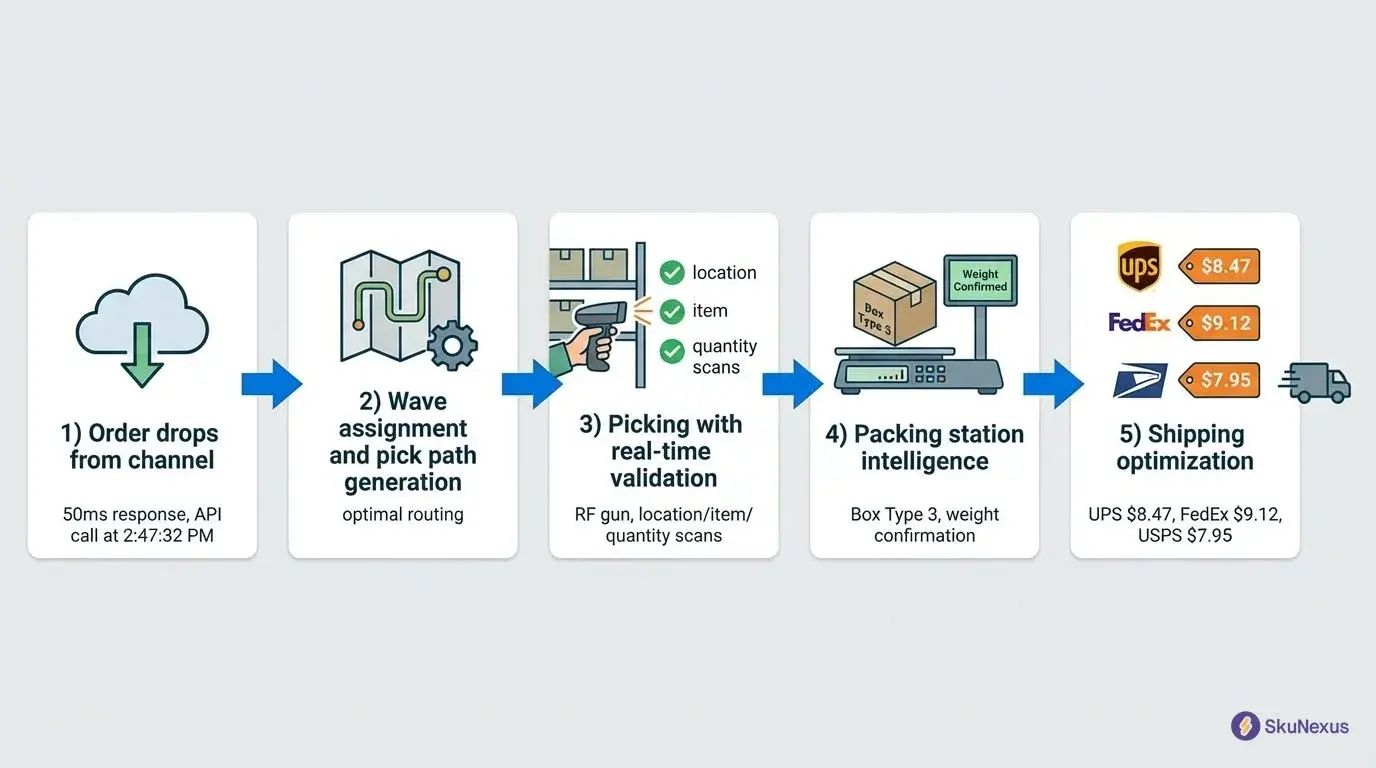
Flow is not warehouse automation, and the difference matters once you are shipping real volume. Warehouse automation is the physical workflow: generating a pick path that walks your team through the building efficiently, batching dozens of orders into a single pick wave, scanning each item to verify the right unit went in the right box, validating the pack, rating and buying the cheapest qualifying label, and printing it at the station. Flow can trigger that something should happen. It cannot run the pick, pack, and scan workflow on the warehouse floor, because that is not what it was built to do.
The honest framing: use Flow for order orchestration and storefront automation. Use a WMS for the physical fulfillment workflow. They are not competitors. One ends where the other begins.
The app patchwork tax
Here is the pattern I see constantly. A merchant solves each problem with the best individual app: one app for inventory sync, one for multichannel listings, one for shipping labels, one for purchase orders, one for returns. Five apps, each good at its one job. The problem is they do not share a source of truth. The inventory app and the shipping app disagree about what shipped. The listings app and the PO app disagree about what is on the way. Every disagreement is a manual reconciliation, and reconciliation work scales with order volume. That is the patchwork tax: you pay it every day in staff time spent making tools agree with each other.
A garden and nature retailer we work with runs roughly 1,000 dropship orders on a peak day across Walmart, Amazon, Target, and two separate Shopify stores. Try paying the patchwork tax at that volume across that many channels and the math falls apart fast. They run it as one operations layer instead: every channel's orders land in one place, inventory is one number, and the dropship purchase orders fire from the same system that holds the stock truth. The point of a WMS layer is not that it has more features than your five apps combined. It is that it is one system, so there is nothing to reconcile.
When you do NOT need a Shopify WMS
I would rather you not buy software you do not need, so here is the honest version. If you are shipping from one or two locations, your order volume fits comfortably inside Shopify's native multi-location inventory, and a single fulfillment or shipping app covers your label buying and picking, you probably do not need a WMS yet. Shopify native plus one well-chosen app is a perfectly good operation at that stage, and adding a WMS on top would be cost and complexity you do not have a problem for.
You start to need a WMS layer when the symptoms show up: you have run out of Shopify locations or you are about to, you are running more than one store off shared stock, you are reconciling inventory across apps by hand, your pick and pack process lives in your team's heads instead of in a scanned workflow, or your channel count has grown past what one person can hold in their head. If none of that is true for you, keep your money. If two or more are true, the patchwork tax is already costing you more than a WMS would.
What this looks like in practice: three operations
The walls above are abstract until you see what merchants did about them. These are real SkuNexus customers, with their real numbers.
Graeter's Ice Cream: automating 100% of orders on a fragile multi-warehouse setup
Graeter's is a family-owned craft ice cream producer shipping frozen product, which is about as unforgiving as fulfillment gets. Their existing system could not keep up with growing eCommerce demand. Inventory data was scattered and fulfillment was manual, which is dangerous when you are shipping something that melts. We built them a real-time system of record integrated with their store, with automated packing directions and accurate order routing. They automated 100% of their orders, grew eCommerce sales by 100%, and now ship more than 550,000 pints a year through that workflow. The lesson: the harder your product is to ship, the more the physical workflow has to be automated and verified, not held together by staff memory.
Carewell: order accuracy on branded dropshipping
Carewell is an online marketplace for caregiving products, and a lot of what they sell ships directly from vendors. Branded dropshipping at scale lives or dies on order accuracy and clean vendor communication, because you are coordinating fulfillment you do not physically touch. We automated their fulfillment and tightened the data flow between vendors. They improved order accuracy and fulfillment times. The lesson: dropshipping is not a way to avoid warehouse discipline. It needs more of it, just pointed at vendors instead of your own shelves.
New Look Vision Group: manual to automated in nine months
New Look Vision Group is Canada's largest eyewear retailer, and they were straining under a manual order fulfillment process. We moved them to a fully automated pick, pack, and ship workflow. They went from manual to automated in nine months, increased online sales, and ended up with a system flexible enough to keep scaling. The lesson: you do not have to rip everything out at once. A phased move from manual to automated, location by location, is the realistic path for a large operation that cannot stop shipping during the switch.
How to implement a Shopify WMS without breaking your operation
Every operation I named above had orders going out the door the entire time we were implementing. You cannot pause fulfillment to install software. So the sequence matters.
Get your product and inventory data honest first
Before you connect anything, your SKUs, variants, and counts have to be clean and consistent between Shopify and the WMS. If a SKU means one thing in Shopify and something slightly different in your stock records, that mismatch becomes a mis-ship the moment automation turns on. Spend the time here. It is the least glamorous step and the one that prevents the most pain. Then set up the sync so it stays honest automatically instead of drifting.
Match the setup to how you actually fulfill
There is no single correct configuration, because there is no single fulfillment model. If you ship from multiple locations, the work is in your routing rules: nearest location, cost, stock on hand, priority. If you lean on dropship vendors, the work is in automatic purchase order generation and giving vendors a clean way to see and act on their orders. If you have thousands of SKUs and high pick volume, the work is in barcode scanning and pick waves and batch picking. Configure for the operation you run, not a generic template.
Test against real orders before you cut over
Run live-shaped orders all the way through before go-live. Does inventory decrement the instant an order is placed. Does routing pick the location you expected. Does an out-of-stock item trigger the fallback you defined instead of silently overselling. Does the scan catch a deliberately wrong pick. Find the gaps in a test, not on a customer's order. Then cut over, ideally one location or one store at a time, the way New Look did.
Frequently asked questions about Shopify WMS
Does Shopify have its own WMS?
Not in the warehouse-operations sense. Shopify gives you native multi-location inventory, the Shopify Fulfillment Network as a 3PL option, and Flow for automation. What it does not give you natively is the warehouse decision layer: proximity routing across many locations, pick-wave batching, scan-verified pick and pack, and one shared inventory truth across multiple stores. That is the gap a WMS fills.
Can a Shopify WMS run more than one Shopify store on shared inventory?
Yes, and this is one of the most common reasons merchants adopt one. Shopify treats each store as its own account with its own inventory. A WMS layer becomes the single system of record underneath all your stores, holds one stock pool, and pushes the correct available-to-sell number up to each storefront. The lifestyle retailer above consolidated five Shopify stores and about 4,700 monthly orders onto exactly this model.
Does a Shopify WMS work alongside Amazon, Walmart, and other channels?
It should. Most merchants who need a WMS are not Shopify-only. The garden retailer above runs about 1,000 dropship orders on a peak day across Walmart, Amazon, Target, and two Shopify stores through one operations layer. The point of the layer is that every channel draws from the same inventory truth, so you are not reconciling stock across channels by hand.
How does a WMS handle Shopify returns?
When a return is processed, the WMS adjusts stock so the unit becomes available to sell again as soon as it is back and inspected, and it keeps that adjustment consistent across every store and channel drawing from the same pool. Because the WMS is the inventory truth, the returned unit shows up correctly everywhere at once rather than in one store's count and not the others.
What does a WMS for Shopify cost, and when is it worth it?
Cost depends on your volume, your number of locations and stores, and how much custom workflow you need. The honest test for whether it is worth it is the patchwork tax: add up the staff hours spent reconciling apps, fixing oversells, and manually routing orders. When that number is larger than the cost of consolidating onto one layer, a WMS pays for itself. When it is not, stay on Shopify native plus an app. I would rather tell you to wait than sell you something you will not use.
Where SkuNexus fits
SkuNexus is a fully customizable inventory, order, and warehouse management platform for mid-market eCommerce merchants, the ones shipping somewhere between 50 and 20,000 orders a day who have outgrown a stack of Shopify apps but cannot justify an 18-month enterprise implementation. The reason customization matters here is everything above: your location model, your routing logic, your multi-store setup, your dropship vendor flow, and your pick and pack workflow are specific to your business. A rigid system makes you change how you operate to fit the software. We built SkuNexus to fit how you already operate, which is exactly why the lifestyle retailer chose it over ShipHero when what they wanted was less complexity, not more.
If you are running into Shopify's location ceiling, juggling multiple stores on shared stock, or paying the app patchwork tax every day, that is the conversation worth having. If Shopify native plus one app still covers you, it is genuinely fine to wait. When the symptoms show up, book a demo and we will map it against how you actually fulfill, not a generic pitch. You can also read how we approach eCommerce fulfillment and the broader warehouse management and inventory platform if you want the wider context first.
About the author
Yitzchak Lieblich ("Yitz") is the founder and CEO of SkuNexus. He has spent years inside the fulfillment operations of mid-market eCommerce merchants, much of it on Shopify, working through exactly the location limits, multi-store inventory problems, and app-sprawl issues described above. He writes about warehouse and order management from that first-hand operational experience rather than from a feature sheet.
Ready to Transform Your Operations?
See how SkuNexus gives you full control over inventory, orders, warehouse, and shipping.
Schedule a Free Demo →
Yitz Lieblich
CEO & Founder, SkuNexus
Yitz Lieblich is the Founder and CEO of SkuNexus. He has spent 19 years in eCommerce, starting in 2007 when he founded Web Solutions NYC, an eCommerce agency he still leads today. His approach to inventory, order, and warehouse management did not come from a whiteboard. It came from the floor. Across nearly two decades, Yitz has worked with merchants of every size, from mom-and-pop startups to Fortune 100 enterprises, across auto parts, food and beverage, apparel, B2B wholesale, and retail/D2C. He has walked through hundreds of warehouses, watching where operations lose time, money, and orders, with one goal: optimize the operation and make it easier for the merchant. That hands-on pattern is what led him to build SkuNexus in 2018 as a full operational platform. The idea was simple. Configurable infrastructure that bends to each merchant workflow, supporting businesses that ship anywhere from 50 to 20,000 orders a day. A custom development background runs through everything he builds. When SkuNexus writes about fulfillment, WMS, or multi-channel inventory, it comes from operations Yitz has seen and solved firsthand. First as an agency partner since 2007, and now as the architect of the platform.
Keep Reading
WooCommerce Warehouse and Inventory Management
September 16, 2026