Shopify pick and pack is the warehouse work that happens after the order hits your store: someone walks the shelves, pulls the right SKUs, packs the box, and ships it. The hard part for a growing Shopify merchant is not the picking itself. It is keeping that physical work in lockstep with what Shopify thinks is true about inventory and fulfillment status, across more orders, more SKUs, and sometimes more than one store.
I am Yitz Lieblich, founder of SkuNexus. I have spent years inside the warehouses of Shopify merchants who shipped a few hundred orders a day and then a few thousand. What follows is how Shopify-specific pick and pack actually works when you tie scanning, routing, and verification directly to Shopify's inventory and fulfillment API, plus an honest section on when you do not need any of this and a Shopify app is enough.
How Shopify pick and pack actually works under volume
Every Shopify store ships the same way at the start. An order comes in, someone reads it off a screen or a printed slip, walks to the shelf, grabs the item, packs it, buys a label, and clicks "Fulfill" in the Shopify admin. That works fine at twenty orders a day.
The breakage starts somewhere around a few hundred orders a day, and it is almost always the same three failures. First, the picker grabs the wrong variant because two SKUs look nearly identical on the shelf, and nothing catches it before it ships. Second, two stores or two channels sell the same unit because inventory only reconciles on a delay. Third, the order ships from the wrong location because there is no logic deciding which warehouse should have picked it.
None of those are picking problems. They are sync problems. The fix is a system that sits between the shelf and Shopify and confirms every step against the live order, then writes the result back to Shopify the moment it happens. That is what the rest of this guide covers, in the order the work actually flows.
Scan-based pick confirmation tied to Shopify fulfillment
The single most valuable change you can make to a Shopify pick operation is to stop trusting the picker's eyes and start trusting a scanner. It is the cheapest error you will ever prevent, because catching a mis-pick at the shelf costs nothing while catching it after delivery costs a return, a replacement, and a customer who now reads your reviews differently.
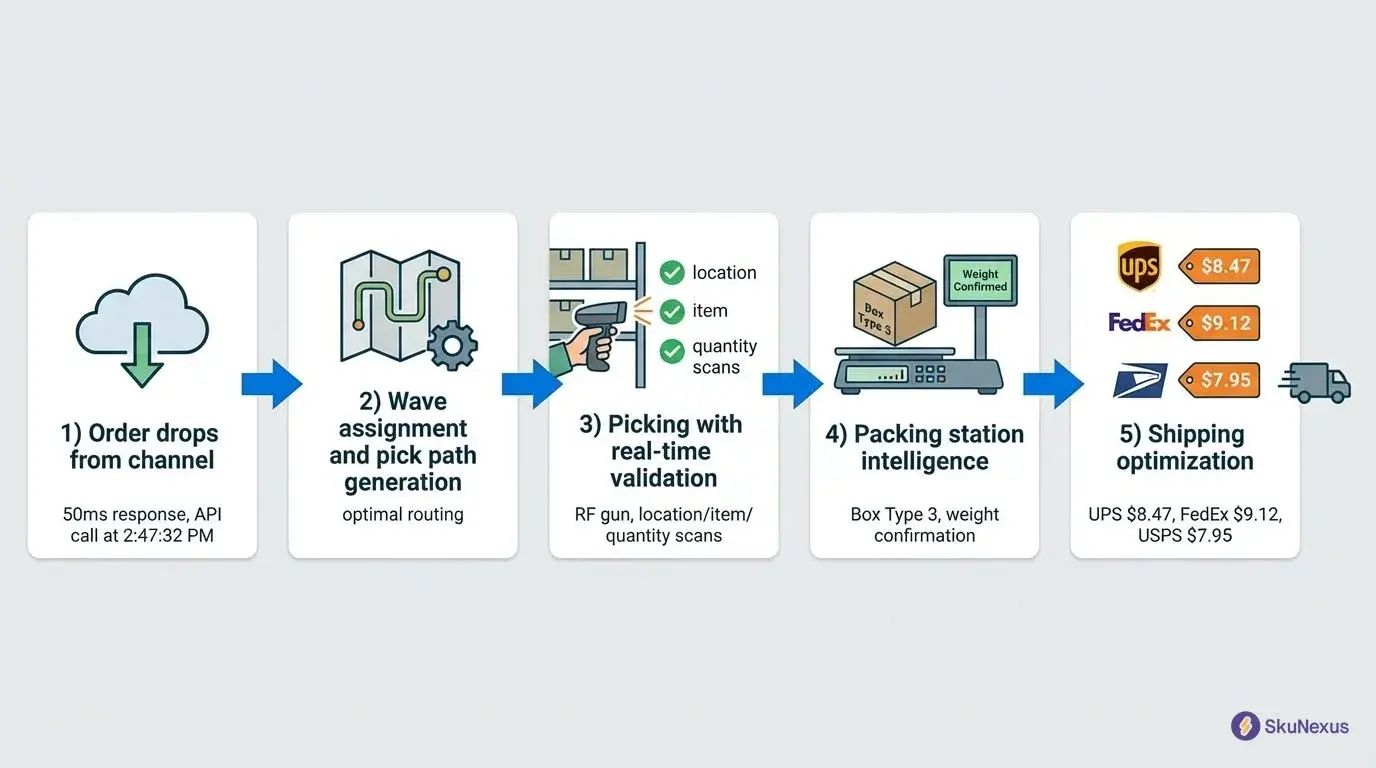
Here is the workflow we run. An order lands in Shopify and flows into SkuNexus within seconds through the Shopify API. The system builds a pick task with the exact SKUs, quantities, and shelf locations. The picker pulls up the task on a handheld scanner, walks to the location, and scans the product barcode. If the barcode does not match the SKU on the order, the scanner rejects it on the spot. The picker physically cannot confirm the wrong item.
The part that matters for a Shopify merchant is what happens after the scan confirms. SkuNexus writes the fulfillment back to Shopify through the fulfillment API in real time. The line item moves to fulfilled, the tracking attaches, and the customer-facing order status in the Shopify account page updates without anyone touching the Shopify admin. Your warehouse floor and your storefront stay describing the same reality, order by order, instead of reconciling in a nightly batch where errors hide for hours.
For a partial shipment, the same logic applies at the line level. If you pick three of five items now and two tomorrow, Shopify shows a partial fulfillment with its own tracking, automatically, because that is what physically happened at the scan station.
The operational payoff is that your customer service team stops being a reconciliation team. When a buyer emails asking where their order is, the answer in the Shopify admin is already correct, because it was written from the warehouse floor at the moment the item was scanned and packed, not entered by hand at the end of the day. The questions that used to eat an afternoon, which order shipped, which is still on the shelf, which went partial, are answered by the system before anyone asks them.
Choosing which location picks the order
Once you ship from more than one location, every Shopify order carries a hidden question: which warehouse should pick this? Shopify's native location logic is limited, and most merchants answer the question by habit, which means the East Coast customer's order gets picked on the West Coast because that is where someone happened to grab it.
SkuNexus answers that question automatically at order intake. It evaluates live stock at every location, the customer's shipping destination, and whatever business rules you set, then routes the pick task to the warehouse that minimizes distance and cost while actually having the item in stock. If the nearest location is out, it falls through to the next best one instead of stalling.
The rules are yours to shape. Maybe one warehouse holds the slow-moving long tail and another holds the bestsellers, so proximity is not the only factor. Maybe a specific brand always ships from a specific building. The routing engine takes those as inputs rather than overriding them, which is the difference between software that decides for you and software that decides the way you would have, only faster and on every single order.
One of our customers shows exactly why this matters. A multi-brand outdoor and cycling retailer runs three Shopify storefronts out of West Coast, Midwest, and East Coast warehouses, processing more than 10,000 orders a month. Their previous system fulfilled orders from fixed locations regardless of where the customer was. With proximity-based routing, West Coast orders pick on the West Coast and East Coast orders pick on the East Coast, automatically, for every order. The routing logic was a native capability for them, not a custom build, and it cut both carrier cost and delivery time directly.
Wave and batch picking against high Shopify order volume
Picking orders one at a time is fine until the order count makes single-order picking the bottleneck. A picker walking the whole warehouse for one order, then walking it again for the next, burns most of the shift on travel, not picking.
Wave picking groups orders into a single coordinated pass. SkuNexus batches Shopify orders into waves by zone, by carrier cutoff, by product proximity, or by whatever rule fits your floor, and generates one optimized route that pulls the inventory for many orders at once. The picker scans into a cart with positions, and each scan confirms which order each unit belongs to, so a batched pick never turns into a sorting problem at the pack bench.
This is where high-volume Shopify operations recover most of their throughput. Instead of adding people when order count spikes for a sale or a season, you change the wave size and the same crew clears more orders per hour, with the scan still guaranteeing the right unit lands in the right order.
A practical way to run it: build waves around carrier pickup times. Everything that has to make the 3pm ground cutoff goes into one wave, picked and packed as a block, so you never discover at 2:45 that forty orders are still sitting on shelves. Single-SKU orders, the ones where the customer bought one of one thing, can run as their own wave and clear in a fraction of the time because the route is trivial. The point is that the wave is a lever you set against your real constraints, not a fixed process you are stuck inside.
Packing accuracy and outbound verification
A correct pick can still become a wrong shipment at the pack bench. Two orders sit next to each other, two items get swapped, and the verification that should have caught it never ran.
At the pack station, every item gets one final scan before the box closes. SkuNexus checks each scanned unit against the order and will not let the order close if anything is missing or extra. The wrong item simply cannot ship, because the system holds the order open until the contents match.
When the pack passes, the same sequence that confirms accuracy also closes the loop with Shopify. Carrier rate shopping picks the shipping service that meets the delivery window at the lowest cost, the label generates, and SkuNexus writes the fulfillment and tracking number back to Shopify. The customer gets the Shopify shipping notification with live tracking, and you never opened the Shopify admin to make it happen. Accuracy and fulfillment sync are the same event, not two separate jobs someone has to remember.
One warehouse, several Shopify stores, one source of truth
Plenty of growing merchants run more than one Shopify store out of one building. The trap is that each store keeps its own inventory count, the same physical unit shows as available in two stores at once, and you oversell. Shopify on its own does not solve multi-store inventory as one pool, and bolting on a separate connector per store usually means separate logins and a destroyed audit trail.
SkuNexus connects every Shopify store to a single instance and treats the physical stock as one truth. When a unit is picked for store A, it decrements everywhere immediately, so store B cannot sell it. Every store's orders flow into one fulfillment queue that staff can work together or filter by store, and inventory updates push back to all stores in real time.
A multi-brand transport and lifestyle retailer we work with runs five Shopify stores through one SkuNexus instance, processing between 3,500 and 4,700 orders a month. Before, each store was managed on its own and the oversell risk climbed with volume. Now all five stores share one inventory pool, pickers work wave-picked routes with barcode verification, and tracking flows back to whichever store the order came from without manual entry. They had evaluated ShipHero first and decided it was over-engineered for their scale. The point is not that one tool is better in the abstract. It is that the system has to match the size of the operation, and theirs runs multi-store complexity without enterprise overhead.
When a Shopify app is enough, and when it is not
I am not going to tell you every Shopify merchant needs this. Most do not, and pretending otherwise is how you end up paying for software you do not use.
If you ship from a single location, your order volume is steady and well under a few hundred a day, your SKUs are visually distinct enough that mis-picks are rare, and you run one store, then Shopify's native locations plus a good pick-and-pack or shipping app will serve you well. That stack is cheaper, faster to set up, and entirely adequate. Outgrowing it before you need to is a waste of money.
You start needing something like SkuNexus when the failures I described earlier become routine costs instead of rare accidents. Concretely: you ship from more than one location and orders pick from the wrong one; you run more than one Shopify store and the same unit oversells across them; your SKUs are similar enough that mis-picks are a real return-rate problem; your volume is high enough that single-order picking is the bottleneck; or you have a fulfillment rule Shopify and the app ecosystem simply will not bend to, like cold-chain packing logic or compliance built into the label.
That last point is the honest dividing line. Shopify apps configure. A platform with full source code access builds. When your operation has a requirement no off-the-shelf app supports, the question stops being which app and becomes whether the system can be made to match your workflow instead of forcing you to change it.
A useful gut check before you move off the app stack: write down the three things your warehouse does that you have never been able to fully automate, and ask why. If the answer is "the app does not have that setting," you have found your dividing line. If the answer is "we have not gotten around to configuring it," stay where you are and configure it. Switching platforms to solve a problem you could have solved with a checkbox is the most expensive mistake in this category, and I would rather lose your business than sell you into it.
What "build it to match the workflow" looks like
The clearest example I have is not a Shopify store, and I will be precise about that so the proof stays honest. Graeter's Ice Cream runs on Magento, not Shopify. I am including them because the operational lesson transfers directly to any high-requirement pick-and-pack operation, and the customization story is the point.
Graeter's ships more than 550,000 pints a year of frozen ice cream across three warehouses, and every shipment needs the right amount of dry ice based on package size, destination zone, and transit time, plus IATA-compliant labels with perishable dates. They used to calculate dry ice by hand on every order. No app has a "dry ice by transit zone" toggle. Because SkuNexus provides full source code access, that logic was built directly into their fulfillment and labeling workflow, and they reached 100% order automation with their eCommerce sales doubling over the partnership. The transferable lesson for a Shopify merchant is the same: when your pick and pack has a rule that no app supports, you want a system that adapts to the rule rather than one that tells you the rule is not on the roadmap.
Frequently asked questions about Shopify pick and pack
How does a pick confirmation update Shopify fulfillment status?
When a picker scans the product barcode and the scan confirms against the order, SkuNexus writes the fulfillment back to Shopify through the fulfillment API. The line item moves to fulfilled, tracking attaches, and the customer-facing order status updates in real time, with no one touching the Shopify admin.
Can it route Shopify orders to the closest warehouse automatically?
Yes. At order intake the system evaluates live inventory at each location and the customer's shipping destination, then routes the pick task to the nearest warehouse that actually has stock, with fallthrough to the next best location if the closest is out.
Does it handle inventory across multiple Shopify stores as one pool?
Yes. Every store connects to a single instance and shares one physical inventory truth. A unit picked for one store decrements across all stores immediately, which is what prevents overselling the same unit twice.
Do I need this if I only run one Shopify store from one location?
Usually not. At a single location with steady, moderate volume and distinct SKUs, Shopify's native locations plus a pick-and-pack app will serve you well. You start needing a platform like this when multi-location routing, multi-store inventory, high volume, or a fulfillment rule no app supports becomes a routine cost.
The honest bottom line
Shopify pick and pack stops being a picking problem and becomes a sync problem the moment you add a second location, a second store, or enough volume that single-order picking drags. The job of a system like SkuNexus is to make the warehouse floor and the Shopify storefront describe the same reality at every step: scan to confirm the right unit, route to the right location, verify before the box closes, and write fulfillment and tracking straight back to Shopify. If you are not at that point yet, a Shopify app is the right call. If you are, you want a platform that bends to your workflow instead of asking you to bend to it.
The thing I want you to take from this is that pick and pack quality is measurable and fixable. Mis-pick rate, the share of orders that ship wrong, is a number you can drive close to zero with scan confirmation. Orders picked from the wrong location is a number proximity routing erases. Oversells across stores is a number a single inventory pool ends. None of these are vague promises about being faster. They are specific failures with specific mechanisms that close them, and you can hold any system, ours included, to whether it actually moves those numbers.
If your Shopify fulfillment has outgrown the app stack, book a demo and we will walk through your actual order flow, location by location, and tell you honestly if you are not there yet. You can also read more on pick and pack software, automated order routing, and wave picking, or see how managing multiple warehouses works in one platform.
About the author
Yitzchak Lieblich, known as Yitz, is the founder and CEO of SkuNexus. He has spent his career inside the fulfillment operations of mid-market eCommerce merchants, building inventory, order, and warehouse management systems that adapt to how a business actually ships rather than forcing the business to change. He writes about pick and pack, order routing, and multi-location fulfillment from direct work with Shopify and Magento merchants shipping anywhere from a few hundred to many thousands of orders a day.
Ready to Transform Your Operations?
See how SkuNexus gives you full control over inventory, orders, warehouse, and shipping.
Schedule a Free Demo →
Yitz Lieblich
CEO & Founder, SkuNexus
Yitz Lieblich is the Founder and CEO of SkuNexus. He has spent 19 years in eCommerce, starting in 2007 when he founded Web Solutions NYC, an eCommerce agency he still leads today. His approach to inventory, order, and warehouse management did not come from a whiteboard. It came from the floor. Across nearly two decades, Yitz has worked with merchants of every size, from mom-and-pop startups to Fortune 100 enterprises, across auto parts, food and beverage, apparel, B2B wholesale, and retail/D2C. He has walked through hundreds of warehouses, watching where operations lose time, money, and orders, with one goal: optimize the operation and make it easier for the merchant. That hands-on pattern is what led him to build SkuNexus in 2018 as a full operational platform. The idea was simple. Configurable infrastructure that bends to each merchant workflow, supporting businesses that ship anywhere from 50 to 20,000 orders a day. A custom development background runs through everything he builds. When SkuNexus writes about fulfillment, WMS, or multi-channel inventory, it comes from operations Yitz has seen and solved firsthand. First as an agency partner since 2007, and now as the architect of the platform.
Keep Reading
WooCommerce Warehouse and Inventory Management
September 16, 2026