How a Barcode Rollout Runs, in Order
SkuNexus turns a barcode plan into a working warehouse system in this order: clean the item and location data, set barcode prefixes so every scan resolves to a product, location, cart, or tote, then pilot the scanned workflow in one area before rolling it out warehouse-wide.
This guide is written from implementation work, not from a spec sheet. SkuNexus has been building eCommerce operations software since 2018, and the ordering of the steps below is the ordering that survives contact with a live warehouse: data first, prefixes second, hardware third, pilot fourth.
What this guide covers:
-
The prep work that decides whether the rollout is boring or painful: workflow audit, item and location data, code format.
-
The build: labeling scheme, location and bin naming, printers, and the handoff into your WMS.
-
The rollout itself: pilot area, training, cutover, and the problems that show up in week one.
What Goes Wrong Without Scanning
If you’ve been running a warehouse without a barcode system, you’ve probably felt the pain.
Manual data entry is not only slow - it’s error-prone. Small mistakes snowball into bigger problems. Maybe you’ve experienced inventory shrinkage where stock levels don’t match up with reality, or perhaps your team spends too much time hunting for misplaced items. These inefficiencies hit your bottom line hard.
The failure modes are specific, and buyers name them out loud. Across 78 buyer-eligible SkuNexus demo calls, buyers themselves raised overselling or running out of stock in 9 of them and picking or shipping the wrong item in 4, both of which are downstream of a count nobody can trust.
Customer dissatisfaction is another consequence. When inventory is inaccurately tracked, orders are delayed, or the wrong products are shipped. In today’s market, customers expect near-instant gratification. If you can’t deliver, they’ll find someone who can.
It’s clear - manual systems just can’t keep up with modern warehouse demands.
Choosing hardware and software first?
This guide assumes you have already picked, or are close to picking, the scanner and the platform behind it. If you have not, start there instead: our team ran seven scanners through 92 days of live warehouse work in our tested guide to warehouse barcode scanners and barcode inventory systems, which also covers how the scanner, labels, network, and software fit together. Come back here for the rollout.
What to Know Before Implementing a Barcode System
(Preparation is key to successful implementation)
Implementing a barcode system is not just about slapping a barcode on a product. It’s about transforming the way your warehouse operates from the ground up. But before you dive into the tech, you’ve got to lay the foundation. We’re talking about assessing what’s already working (and what’s not), choosing the right barcode technology, and making sure you’ve got the best hardware for the job. Preparation is everything - and getting this part right sets you up for smooth sailing ahead.
Assessing Your Warehouse’s Current Workflow and Pain Points
(Identify bottlenecks and inefficiencies that can be solved with barcode systems)
Before you even think about implementing a barcode system, take a hard look at your warehouse’s current workflow. What’s slowing you down? Where are mistakes happening? Are your pickers wasting time hunting for products? Are stock levels inaccurate because of manual data entry errors? These are the kinds of pain points that barcode systems can eliminate - but first, you need to identify them.
At SkuNexus, we always recommend starting with a workflow audit. Track the flow of inventory, from the moment it hits your receiving dock to when it leaves for shipment. Talk to your team - your employees are the frontline experts on the inefficiencies you might not see. This simple step can reveal surprising bottlenecks that a barcode system can fix almost overnight.
Write the bottlenecks down before you shop. “Pickers hunt for items in aisle 4” and “receiving keys quantities into a spreadsheet twice” are the kind of findings that tell you which workflow to scan-enable first.
Choosing the Right Barcode Technology: 1D vs. 2D Barcodes
(Understanding the difference and selecting the best fit for your operations)
Not all barcodes are created equal. You’ve probably heard of 1D (one-dimensional) and 2D (two-dimensional) barcodes, but which one should you choose? The answer depends on your warehouse needs.
1D barcodes are the most common. You’ve seen them everywhere - think UPC codes on groceries. They’re great for basic inventory tracking and can be read quickly by any standard scanner. But here’s the catch: 1D barcodes store limited information. If you’re only tracking a product’s SKU or basic stock levels, they work fine. But if you need more complex data (like batch numbers, expiration dates, or product specs), you’ll want to look at 2D barcodes.
2D barcodes - like QR codes - are the next level up. They can store way more information in a much smaller space. That makes them perfect for tracking detailed data with just a single scan. Plus, they’re more versatile; they can be scanned at any angle, which is a game-changer for speeding up workflow in a busy warehouse.
The practical difference: a 2D code can carry more than an identifier, so a single label can hold lot, expiry, or order reference alongside the SKU. If you need any of that on the label itself rather than looked up from a database, choose 2D and buy imagers that read it.
Selecting the Appropriate Barcode Scanners and Devices
(Wireless scanners, handheld devices, and their roles in warehouse automation)
Okay, you’ve chosen your barcode format. Now it’s time to talk about the tools that make the magic happen: barcode scanners. These devices are the workhorses of your barcode system, so picking the right ones is crucial.
For most warehouses, we recommend wireless scanners. They give your team the freedom to move without being tethered to a terminal, which means faster picking and scanning. Plus, with Bluetooth and Wi-Fi capabilities, they can instantly sync data to your warehouse management system (WMS) without delay. SkuNexus integrates effortlessly with most modern scanners, meaning your on-hand count changes the moment a product is scanned.
Another option is handheld devices that combine barcode scanning with inventory management software. These all-in-one tools not only scan products but also allow your team to track stock levels, update orders, and even process returns - all from a single device. It’s like giving your warehouse employees a pocket-sized command center.
Match the device to the job before you compare brands: fixed stations tolerate corded units, roaming pickers do not, and anyone climbing or carrying needs a hand free.
Next, let's look at how to design a barcode system that fits your warehouse like a glove - because one size definitely doesn’t fit all.
Designing Your Barcode System
(Customizing the system to your warehouse’s unique needs)
Now that you've got a solid foundation, it’s time to build a barcode strategy that fits your warehouse like a glove. This isn’t about using a cookie-cutter solution - it’s about customizing your barcode system to your specific operations. You need a setup that not only works but works effortlessly. That means designing everything from the barcode labels themselves to how your products are stored and how it all integrates into your warehouse management system (WMS). Let’s dive into how you can build a system that’s tailor-made for success.
How to Develop a Barcode Labeling System for Your Products and Inventory
(Step-by-step guide on setting up barcode formats and assigning SKU numbers)
First things first: your barcode labels need to be rock solid. The last thing you want is a system where labels are hard to scan or even worse, misleading. That’s why creating a clear, logical barcode labeling system is crucial.
Start with SKU numbers. Every product in your inventory needs a unique SKU (Stock Keeping Unit). The key here is to make these SKUs easy to understand for both your team and your barcode scanners. Keep the format consistent and meaningful. For example, a product SKU might reflect the product type, size, or even the warehouse location. For instance, "SHOE-BLK-9" might represent a black size 9 shoe. This makes scanning fast, intuitive, and error-free.
Once you’ve got your SKU numbers, the next step is to decide on the barcode format. For most warehouses, a Code 128 barcode format is ideal for 1D barcodes - it’s compact and can encode all kinds of alphanumeric characters. If you’re working with 2D barcodes, something like QR codes will give you more flexibility in storing extra product data.
At SkuNexus, we recommend starting with a small batch of products to test your barcode labels. This helps identify any potential scanning issues before you roll it out across your entire inventory. Pro tip: Make sure the labels are durable! Warehouse environments can be tough, so using waterproof or scratch-resistant labels will save you headaches down the road.
Organizing Your Warehouse for Optimal Barcode System Performance
(Re-arranging product storage to maximize scanning efficiency)
You’ve got your labels, now let’s talk about warehouse layout. A barcode system is only as good as the organization that supports it. If your products are scattered or your pickers have to weave through a maze to find items, even the best barcode system will struggle.
Start by looking at your high-demand items - the ones that are flying off the shelves. These should be located in easily accessible areas of your warehouse. That means minimizing travel time for your pickers, ideally storing these products near packing stations or at the front of the warehouse. Fast in, fast out.
Then, consider grouping products logically. Items that are frequently ordered together should be stored in proximity. This eliminates wasted time running from one end of the warehouse to the other. For example, if customers often buy shirts and pants together, store them nearby.
Finally, ensure your storage shelves and bins are clearly labeled with barcodes. This is a game-changer for efficiency. Imagine a picker scanning a barcode on the shelf itself to confirm they’re in the right location before scanning the product. It’s these little touches that make a big difference in speed and accuracy.
Layout and labeling are one job, not two. If bin labels are unreadable from the aisle or two locations share a name, the scan step gets skipped and the count drifts again.
Integrating Barcode Software with Your Warehouse Management System (WMS)
(Why integration with SkuNexus is crucial for a seamless process)
Here’s where the magic happens. Your barcode system isn’t just about the labels or the scanners - it’s about how the data flows. To get the most out of your barcode system, you need it to work in perfect harmony with your Warehouse Management System (WMS). This is where SkuNexus comes into play.
Integration latency is the thing to pin down. As soon as an item is scanned - whether during receiving, picking, or shipping - the count needs to change in your WMS. That part is immediate. Pushing the new count out to your sales channels is not: connectors poll on an interval, 5 minutes by default on Shopify and 60 on the other supported platforms. Ask for the number rather than the phrase.
SkuNexus makes this process seamless. Our system is designed to integrate smoothly with any barcode setup, ensuring that scanned data is instantly reflected in your warehouse dashboard. Automated workflows kick in the moment a barcode is scanned, reducing manual input and ensuring that your warehouse runs like a well-oiled machine.
The integration test worth running before cutover: scan one item in receiving, then confirm the quantity moved in the WMS, on the storefront, and on the location record. If any of the three lags, fix that before more scanners reach the floor.
With your barcode system fully integrated into your WMS, you’re not just scanning items - you’re unlocking data-driven efficiency. And that’s what takes your warehouse to the next level.
Now that your barcode strategy is designed and your warehouse is organized for success, let’s move on to the exciting part: actually implementing the system step by step.
How to Implement a Barcode System, Step by Step
(Get the system up and running with ease)
Now that you’ve designed the perfect barcode strategy and have everything in place, it’s time to bring it all to life. This is where the rubber meets the road, and we’ll take you through the exact steps to get your barcode system implemented flawlessly. From setting up the printers and software to getting your team trained and ready, we’ve got it covered. And remember, SkuNexus is here with you every step of the way to make sure things go smoothly. Ready? Let’s do this!
Setting Up Barcode Printers and Software Configuration
(How to install, configure, and test printers and software effectively)
The first thing you’ll need is a reliable barcode printer. This is your workhorse for printing out clear, scannable labels that will be used throughout your warehouse. Trust me - this is not the place to cut corners! Invest in industrial-grade printers that can handle large volumes without compromising on quality. Zebra Technologies and Honeywell make some of the best barcode printers in the game, but do your research to see which fits your needs.
Once your printer is set up, it’s time to configure your Barcode Software. This software should allow you to easily design, print, and manage barcode labels. The setup is fairly straightforward. Start by creating templates for each type of barcode label - whether it’s for products, shelves, or shipping cartons. Make sure the design includes necessary information like SKU numbers, product descriptions, and any other important details. SkuNexus integrates seamlessly with these systems, so your data will flow right from our software to your printer, ensuring accuracy and consistency.
Testing is absolutely critical here. Print a few sample labels and test them with your barcode scanners. Does the barcode scan on the first attempt? Is the information accurately logged into your WMS? If anything’s off, now’s the time to adjust before you print hundreds (or thousands!) of labels.
Print a short test batch on the exact stock and printer you will use in production, then scan those labels with the exact device the operators will hold. Label problems are cheap to fix at ten labels and expensive at ten thousand.
Training Your Warehouse Staff on Barcode System Usage
(Ensuring your team is comfortable and confident with the new technology)
Once the tech is in place, it’s time to turn your attention to what may be the most important step: training your staff. After all, even the best barcode system in the world will be useless if your team doesn’t know how to use it effectively.
Start with the basics. Every team member should know how to scan barcodes, understand what the system is tracking, and how to troubleshoot any basic issues. This includes knowing what to do if a barcode doesn’t scan or if the system doesn’t update correctly. Make sure everyone is clear on the standard operating procedures for scanning during picking, packing, and shipping.
At SkuNexus, we always recommend hands-on training. Set up mock workflows where your team can practice scanning items, updating inventory, and tracking shipments. This gives them the confidence they need to hit the ground running when the system is fully implemented.
You’ll also want to assign a few barcode champions - team members who are experts on the system and can provide help to others as needed. This ensures that issues are resolved quickly without disrupting the entire operation.
Train on the exception paths, not just the happy path. Most week-one support tickets are not “how do I scan” but “what do I do when the scan is rejected, the bin is empty, or the label is torn.”
Conducting a Pilot Run Before Full Implementation
(Testing in a controlled environment to identify and fix potential issues)
Before you roll out the barcode system across your entire warehouse, it’s smart to conduct a pilot run. This is where you test the system in a controlled environment, allowing you to identify and fix any issues before they become full-scale problems.
Start by selecting a small section of your warehouse or a specific product category to run the pilot. During the pilot, track everything - how smoothly the scanning goes, how accurate the inventory updates are, and whether any bottlenecks occur. Pay close attention to real-time data flow between the barcode system and your WMS. If there are any hiccups, now’s the time to address them.
A two-week pilot on high-traffic products surfaces the boring failures early: label sizes that scan poorly at arm’s length, bins whose labels sit behind stock, and dead spots where the read never reaches the server.
Once you’re confident the system works as expected, you can roll it out to the rest of your warehouse with full confidence. A well-executed pilot ensures that when you go live, everything is smooth, efficient, and ready to scale.
Next, let's talk about overcoming common challenges during barcode system implementation, so you can be fully prepared for any bumps along the way.
Troubleshooting a Live Barcode Rollout
(Troubleshooting and resolving issues to ensure a smooth transition)
Even with the best preparation, things don’t always go as planned. But don’t worry - we’ve got your back! When you encounter hiccups during barcode system implementation, it’s essential to have a problem-solving mindset and a plan in place. Whether it's a malfunctioning scanner or issues with label placement, every challenge can be fixed with the right approach. So let’s tackle some of the most common challenges and show you how to breeze through them!
Addressing Scanner Malfunctions and Reading Errors
(How to resolve scanner issues and improve read rates)
Scanners malfunctioning? It happens. Whether the scanner won’t read the barcode or it’s scanning but not registering in your system, don’t panic - there’s almost always a quick fix.
First, check for dirt or smudges on the scanner lens. You’d be surprised how often a simple wipe-down can solve the problem. If the barcode itself is the issue, it might be too small, faded, or damaged. In these cases, reprint the barcode at a higher resolution or increase the label size for better readability.
Next, check the scanning distance. Some scanners work best within a certain range, so if your team is holding the scanner too close or too far from the barcode, this could be causing the issue. You’ll also want to ensure that your barcode contrast is adequate. A barcode printed with poor contrast (e.g., light ink on light backgrounds) will be harder to read. Opt for dark barcodes on light backgrounds for maximum readability.
Finally, update your scanner's firmware. Sometimes, older firmware can cause glitches, so keeping it up to date is a good preventive measure. At SkuNexus, we’ve seen scanner issues get resolved quickly just by performing regular maintenance and firmware updates.
What to Do When Your Barcode System Doesn’t Integrate Properly
(Steps to troubleshoot integration problems with your WMS)
Integration problems are a biggie. Nothing's more frustrating than scanning an item and not seeing that data reflected in your WMS. When this happens, the key is to pinpoint where the breakdown is happening.
First, ensure that your network connection is stable. Real-time updates between your barcode system and WMS rely on a strong network. A poor connection could cause data lag or prevent updates entirely. If everything’s connected properly but the issue persists, check the API settings for both the barcode system and your WMS. Make sure they’re communicating in the same format and that all permissions are properly configured.
Also, review the data mapping between your barcode system and WMS. Sometimes fields aren’t mapped correctly, causing scanned data to either get lost or be misinterpreted. For example, a product’s SKU might not be syncing with the correct field in the WMS. SkuNexus makes integration seamless, but if you run into issues, double-check these mappings to ensure everything is set up properly.
Still no luck? SkuNexus support is here to help troubleshoot integration issues with you, so don’t hesitate to reach out. We’ve helped clients sort out integration glitches in no time, getting their systems back to full functionality with minimal downtime.
Avoiding Common Mistakes in Barcode Label Placement and Durability
(Best practices for ensuring your labels last and are easily scannable)
Even the best barcode system can’t overcome poor label placement or low-quality labels. Placement matters - a lot. If your barcodes are placed in hard-to-reach areas or spots that get a lot of wear and tear, scanning becomes difficult, and your efficiency takes a hit.
Here’s a pro tip: Place barcode labels where they are easy to see and scan without moving the item too much. Avoid placing them near edges or corners of products, as these areas are more prone to damage or bending. Ensure there’s enough flat surface for the scanner to read the entire code in one smooth motion.
Durability is just as important. Use durable label materials - especially if your warehouse environment is harsh. Think about exposure to moisture, heat, or dust. Waterproof and scratch-resistant labels can be a game-changer, ensuring your barcodes remain scannable even in tough conditions.
At SkuNexus, we’ve seen labels fail due to improper placement or cheap materials - which led to wasted time and resources. But with the right best practices in place, you’ll avoid those common pitfalls and keep your barcode system running like a well-oiled machine.
Next, let’s explore how to go beyond the basics of barcode systems and start optimizing your warehouse operations for even greater efficiency.
Optimizing Operations After Barcode Rollout
(Maximizing efficiency once the system is live)
Congratulations! You’ve implemented your barcode system, and things are running smoothly. But now comes the fun part - taking your warehouse operations to the next level. Barcode systems aren’t just about scanning products; they’re about creating a well-oiled, data-driven machine that runs with precision and efficiency. Once your system is live, it’s time to start maximizing efficiency and really squeezing every ounce of value from your investment. Let’s explore how SkuNexus can help you do just that.
How Barcodes Improve Inventory Visibility
(Recording stock movement at the point it happens)
One of the biggest perks of barcode systems is that they close the gap between the physical move and the record of it. Knowing what is in your warehouse stops depending on somebody remembering to write it down.
Each time a product is scanned, the count changes in your WMS immediately, and each connected channel picks that change up on its next sync rather than at the same instant. This level of visibility is crucial when you’re managing inventory across eCommerce platforms, retail stores, or even wholesale channels. You’ll never have to worry about overselling a product or disappointing a customer with backorders.
The gain is not the scan, it is the removal of the gap between the physical move and the record of it. With scanning at receiving, picking, and shipping, inventory movement is recorded at each step instead of reconstructed at month end.
Automating Order Fulfillment and Reducing Picking Errors
(Using barcode systems to streamline order processing)
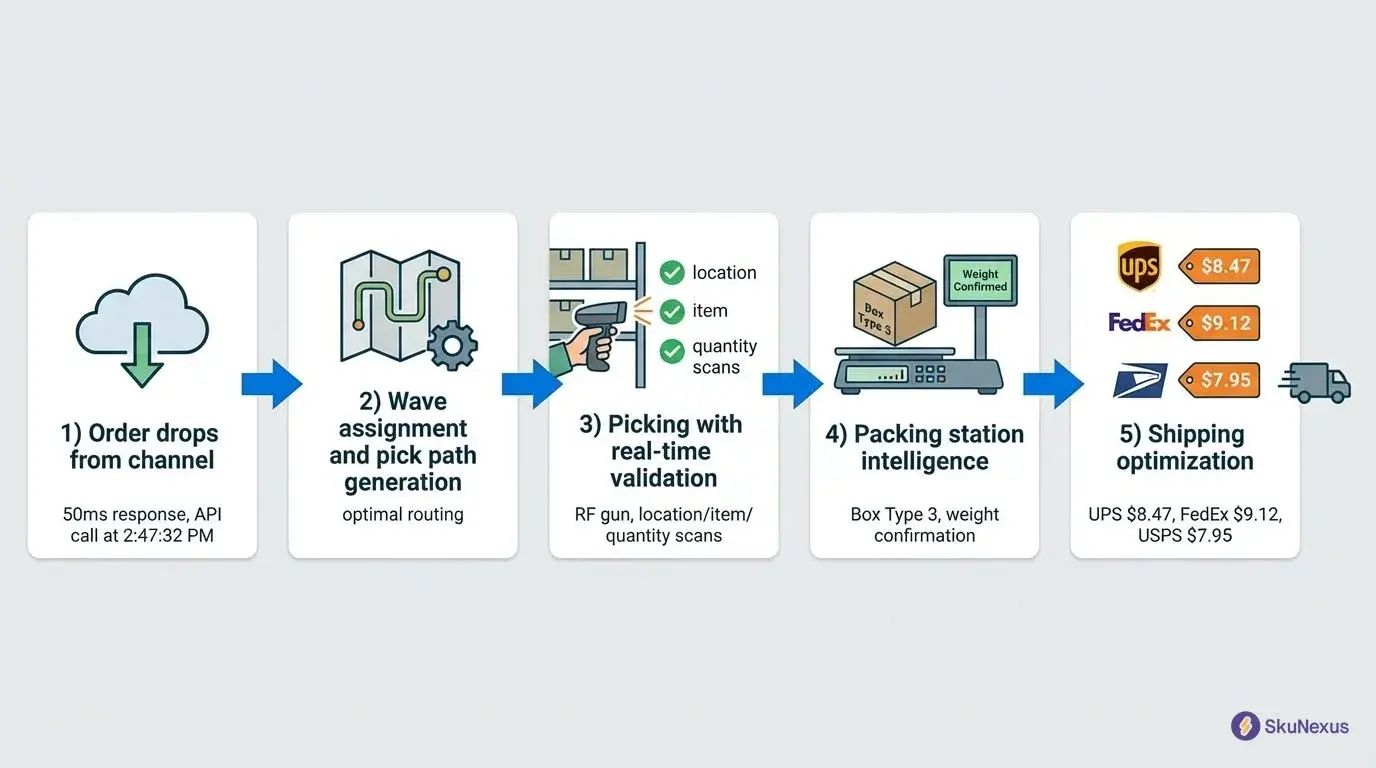
Order fulfillment is where your warehouse truly shines - or stumbles. With a barcode system, you can turn it into a smooth, automated process that runs like clockwork. Barcodes allow you to track every product from the moment it’s picked off the shelf to when it’s packed and shipped.
Scanning during the pick is what turns the barcode into a control rather than a record. In SkuNexus the scan is validated against the fulfillment, so the wrong item is rejected at the shelf instead of discovered by the customer.
And it doesn’t stop there - SkuNexus takes automation even further by enabling automated order decision rules. These rules can automatically route orders to the closest warehouse or optimize picking sequences based on product locations. Less running around means faster fulfillment, and faster fulfillment means happier customers.
Leveraging Data from Barcodes for Better Forecasting and Reporting
(How barcode data can enhance warehouse decision-making and future planning)
Here’s the secret sauce that many overlook: barcode data isn’t just for tracking inventory - it’s a goldmine for forecasting and reporting. Every time a barcode is scanned, valuable data is collected, and SkuNexus helps you harness that data to make smarter decisions.
Need to plan your next stock order? By analyzing barcode data, you’ll see which items are moving quickly, which are sitting on the shelves, and even spot seasonal trends. This allows you to forecast demand with precision and avoid both overstocking and stockouts.
SkuNexus also helps you generate custom reports based on barcode data. Whether you’re looking to track the efficiency of your pickers, monitor stock turnover, or get insights into fulfillment times, the data is right at your fingertips.
FAQs: Implementing Barcode Systems in Warehouse Management
(Answering the most common questions and concerns)
Let’s get into the nitty-gritty - you’ve probably got some questions about implementing barcode systems, and we’re here to give you the clear, actionable answers you need. These are the most common questions we get from businesses just like yours when they’re ready to take the plunge into barcode-driven warehouse management. Whether you're wondering about timeframes, costs, or operational needs, we’ve got you covered.
How long does it take to implement a barcode system?
The timeline for implementing a barcode system varies depending on the size of your warehouse, the complexity of your operations, and how prepared you are for the transition. For a small to medium-sized warehouse, you’re looking at anywhere from 2 to 4 weeks.
This includes everything from setting up barcode printers, configuring software, training staff, and running pilot tests. If your warehouse is larger or has more complicated workflows, it might take longer - but rest assured, SkuNexus provides you with all the support you need to get up and running as quickly and efficiently as possible. With the right plan, you could see your system live and fully functional within a month.
What are the costs involved in barcode system implementation?
Budget by component rather than by a single number, because the mix is what moves: scanners and the count of them, a label printer per print station, label stock in the material and size your environment needs, the software that receives the scans, and the internal hours for data cleanup and training. Sites with cold storage, outdoor yards, or heavy drop exposure spend more on hardware and less on everything else.
The cost that gets missed is the data work. Cleaning item and location records is unglamorous, it happens before a single label prints, and skipping it is what turns a two-week rollout into a two-month one.
Do I need a WMS to implement a barcode system?
While you can technically run a barcode system without a full Warehouse Management System (WMS), it’s far from ideal. A barcode system is most effective when integrated with a robust WMS, like SkuNexus. Why? Because a WMS allows you to automate processes, track inventory as it moves, and optimize order fulfillment based on barcode data.
Without a WMS, you’d be using your barcode system in a manual fashion, which defeats the purpose of its ability to streamline and automate warehouse tasks. So, while you could get by without one, you’ll be missing out on the massive potential that a fully integrated system can provide.
Can barcode systems handle high-volume operations?
Absolutely! Barcode systems are designed to handle high-volume operations with ease. In fact, the more volume you’re managing, the more you’ll benefit from the efficiency and accuracy a barcode system provides. Whether you’re managing hundreds or tens of thousands of SKUs, barcode systems will help you track and fulfill orders without a hitch.
SkuNexus supports operations shipping 50 to 20,000 orders a day, and volume is exactly where scanning earns its keep: the check happens at the shelf and the packing bench rather than in an end-of-day reconciliation.
How SkuNexus Handles Warehouse Barcoding
For a concrete reference point, here is what the moving parts of a rollout map to inside SkuNexus.
- Prefixes decide what a scan means. Barcode prefixes are configured per warehouse so the system auto-detects whether a scanned code is a product, a location, a cart, or a tote, and acts accordingly.
- Locations carry their own barcode. Each bin, shelf, or staging area is created with a label, a scannable barcode value, a location type, and rules such as pickable and allow multi-SKU. Locations can be bulk-created with naming patterns.
- Labels are built, not bought. The label template builder places barcodes, text, images, and dynamic variables such as order number and SKU on your own stock.
- Receiving records by scan. The scan interface takes a product barcode and a quantity per scan, with manual SKU search as the fallback.
- Picking validates the scan. Items are presented in walk-path order with SKU, quantity, and location. Scanning the item confirms the pick; a short pick takes the real quantity and a reason, and the remainder routes by your configuration to another warehouse, to hospitalization, or to back-order.
- Packing runs as a scan loop. Pack Station moves an operator through load, pack, ship, and done, starting from a scanned fulfillment barcode with the box chosen before packing begins.
- Counts reuse the same barcodes. Cycle counts walk locations in path order and require a location scan to confirm the operator is in the right place before quantities are recorded.
- Each warehouse can differ. Pick method and pack verification level are part of per-warehouse workflow configuration, so a second site does not have to run like the first.
Getting Started with SkuNexus
If you want to see the workflow above run against your own SKUs, bin naming, and scanners before you commit to a rollout, book a demo and bring a real order with you. A working session on your data is more useful than a feature tour.
Rollout Checklist
The actions from this guide in order, with a column to track your own progress.
| Action Step | Description of Action Step | Status (Fill In Yourself) |
|---|---|---|
| Assess Current Workflow | Identify bottlenecks and inefficiencies that can be improved with a barcode system. | |
| Choose Barcode Technology | Select between 1D or 2D barcodes based on your warehouse needs. | |
| Set Up Barcode Printers & Software | Install and configure printers, and test your barcode software. | |
| Train Staff on Barcode Usage | Ensure your team is comfortable using scanners and following proper workflows. | |
| Conduct a Pilot Run | Test the system in a controlled environment before full implementation. | |
| Address Common Challenges | Troubleshoot scanner malfunctions and fix label placement issues. | |
| Integrate with WMS | Ensure real-time updates and smooth data flow between your barcode system and WMS. | |
| Optimize Warehouse Layout | Organize your warehouse for maximum efficiency and ease of scanning. | |
| Monitor and Scale | Use barcode data to track performance and scale the system as your business grows. |
Related Resources
Looking for even more ways to optimize your warehouse operations? Here are some additional must-read resources to help you fully harness the power of barcode systems and beyond:
-
Barcode Programs for Inventory: Top Software Solutions Explained
Learn about the best barcode programs for efficient inventory management. -
Scannable Inventory System: The Ultimate All-In-One Solution
Discover how a scannable inventory system can streamline your operations and boost accuracy in your warehouse. -
Online Sales and Inventory Management System: The Complete Guide to Success
Explore how an online sales and inventory management system can connect your barcode strategy with multichannel sales for greater efficiency. -
Best Barcode Software for Warehouse Management: Ultimate Guide
This comprehensive guide covers barcode software for warehouse management, for teams comparing platforms rather than devices. -
Best Cloud-Based Warehouse Management System Solution
Looking for a flexible, scalable solution? A cloud-based warehouse management system could be the answer to optimizing your barcode integration. -
Best Inventory Tracking Software with Barcode Scanner Optimize
Get the inside scoop on the best inventory tracking software paired with barcode scanners for real-time visibility and error-free operations. -
Best SaaS WMS Ultimate Solution & Guide
Discover why a SaaS WMS solution is essential for growing businesses that need seamless integration with barcode systems. -
Best Shopify Inventory Management Software | Full Guide
Managing inventory on Shopify? Learn about the best Shopify inventory management software to integrate with your barcode system. -
New Auto Parts Inventory Management Must Read Guide
A guide tailored for auto parts inventory management with tips on leveraging barcode systems for better tracking. -
Best Ecommerce Warehouse Management System Must See Features
Find out how an eCommerce warehouse management system supports barcode-driven receiving, picking, and packing.
Each of these guides provides practical insights and proven strategies to help you get the most out of your barcode system. Dive in and explore which tools and techniques are best for your unique warehouse needs!
Where to Go Next
Still choosing devices and software? Start with our tested guide to warehouse barcode scanners and barcode inventory systems. Ready to run this sequence on your own data? Book a demo.
About The Author
Yitz Lieblich (Itzchak Lieblich) is founder and CEO of SkuNexus. He has worked in eCommerce since 2007, founded Web Solutions NYC that year, and started SkuNexus in 2018 to run inventory, order, and warehouse operations for merchants shipping 50 to 20,000 orders a day. He has been hands-on in hundreds of warehouses across auto parts, food and beverage, apparel, B2B wholesale, and retail/D2C, with merchants ranging from mom-and-pop startups to Fortune 100.
Ready to Transform Your Operations?
See how SkuNexus gives you full control over inventory, orders, warehouse, and shipping.
Schedule a Free Demo →
Yitz Lieblich
CEO & Founder, SkuNexus
Yitz Lieblich is the Founder and CEO of SkuNexus. He has spent 19 years in eCommerce, starting in 2007 when he founded Web Solutions NYC, an eCommerce agency he still leads today. His approach to inventory, order, and warehouse management did not come from a whiteboard. It came from the floor. Across nearly two decades, Yitz has worked with merchants of every size, from mom-and-pop startups to Fortune 100 enterprises, across auto parts, food and beverage, apparel, B2B wholesale, and retail/D2C. He has walked through hundreds of warehouses, watching where operations lose time, money, and orders, with one goal: optimize the operation and make it easier for the merchant. That hands-on pattern is what led him to build SkuNexus in 2018 as a full operational platform. The idea was simple. Configurable infrastructure that bends to each merchant workflow, supporting businesses that ship anywhere from 50 to 20,000 orders a day. A custom development background runs through everything he builds. When SkuNexus writes about fulfillment, WMS, or multi-channel inventory, it comes from operations Yitz has seen and solved firsthand. First as an agency partner since 2007, and now as the architect of the platform.
Keep Reading
WooCommerce Warehouse and Inventory Management
September 16, 2026