
Shopify Order Management
Shopify has become the backbone for thousands of fast-scaling ecommerce brands. But as sales channels multiply and fulfillment complexity grows, operational clarity starts and ends with effective order management. Shopify's native Order Management System (OMS) lies at the core of this process, bridging the gap between customer purchase and fulfillment handoff. Yet, for all its strengths, Shopify OMS comes with notable boundaries, especially for brands at scale or operating across multiple channels.
This sub-pillar examines the conceptual mechanics of Shopify order management, the lifecycle of an order from placement through fulfillment readiness, and the operational realities teams face as growth introduces scale and complexity. It does not jump into step-by-step workflows or granular splitting, merging, or exception handling, those are covered in depth in supporting guides. Instead, this page focuses on what Shopify OMS is, how it functions at a systemic level, where its value and boundaries lie, and where operational reality begins to strain the native model.
Key Takeaways
-
Shopify order management serves as the central hub for capturing, organizing, and tracking every ecommerce order across sales channels.
-
A robust Shopify Order Management System (OMS) is crucial for scaling brands, reducing manual errors, and supporting accurate fulfillment.
-
Shopify OMS enables real-time event-driven updates, helping teams monitor each step of an order’s lifecycle from placement through fulfillment readiness.
-
Despite its strengths, Shopify order management has limitations with advanced routing, prioritization, and handling complex or multichannel workflows.
-
To overcome the boundaries of native OMS, fast-growing brands often rely on supplemental integrations or middleware solutions.
What Is Shopify Order Management (OMS)?
How Shopify Order Management Fits Into the Operations Stack
Shopify Order Management (OMS) serves as the central nervous system for ecommerce order flow. It's the layer that captures, organizes, and tracks every sales order, whether placed on a Shopify storefront, via a marketplace integration, or through manual channels like phone or wholesale portals. Sitting between your front-end sales channels and downstream fulfillment tools, Shopify OMS acts as the data backbone, aggregating all order data into a single operations hub for visibility and control. It doesn't dictate fulfillment logic, but it provides the structured record and essential context that fulfillment, customer service, and analytics functions depend on.
Why a Strong OMS Matters for Scaling Brands
The importance of robust order management grows exponentially as brands scale. A strong OMS minimizes order misfires, reduces manual intervention, and ensures customers receive accurate updates. By providing a reliable source of truth for order status and history, the OMS lays the foundation for seamless fulfillment handoffs, faster customer response times, and operational resilience, even as order volume and complexity rise. Without a dependable system here, operational cracks widen fast, undermining customer experience and team performance.
How Shopify Processes Orders From Placement to Fulfillment Handoff
The Core Shopify Order Lifecycle (Conceptual)
From the moment a customer places an order, Shopify OMS springs into action. Each order is created as a distinct record containing products, payment, customer info, and custom attributes. The order lifecycle, viewed conceptually, moves through several high-level states: creation, payment validation, ready-to-fulfill, and (optionally) edit or hold for review. Shopify records also handle transitions: payment status updates, additions or edits to items, and notes from automated apps or human agents. This abstraction lets brands track order intent and fulfillment readiness, regardless of whether fulfillment is in-house, 3PL, or hybrid.
How Shopify Updates Order Records and Statuses
Shopify maintains a real-time, event-driven model for order updates. When an order is placed, it is immutable in its original state, but append-only updates record payment capture, edits, cancellations, or changes to fulfillment status. Crucially, Shopify OMS is designed to represent changes as a chain of events, each one logged for reporting and traceability. This event model powers everything from basic operational dashboards to advanced audit trails, giving teams precise visibility into an order's journey from placement through fulfillment preparation.
Where OMS Ends and Fulfillment Begins
The dividing line between OMS and fulfillment is critical: OMS is responsible for organizing and updating order records until they are handed off for fulfillment action. Once a fulfillment request is triggered, manually or via integration, the operational ownership shifts from record management to physical execution. Detailed fulfillment routing and packing logic live outside core OMS responsibilities, but the accuracy of the OMS handoff is what enables downstream efficiency. For a broad overview of how OMS and fulfillment interlock, see the Shopify Inventory & Fulfillment Operations overview.
Key Capabilities of Shopify’s OMS
Consolidating Multi-Channel Orders
Shopify's OMS is built to bring together orders from every connected sales touchpoint. Whether a brand sells through direct-to-consumer, social, B2B, or retail integrations, the OMS gives operators a unified record for each transaction. This consolidated view is especially valuable for teams overseeing hybrid or omnichannel operations, allowing them to avoid channel-specific blind spots or duplicate fulfillment attempts.
Supporting Edits, Draft Orders, and Special Scenarios
Few high-growth brands have a truly uniform order flow. Shopify OMS supports direct edits to orders before fulfillment, creation of draft orders for manual or phone sales, and handling of special cases like prepayments, address changes, or last-minute SKU substitutions. While not all special situations are frictionless, OMS does offer a baseline set of tools for making adjustments or corrections before fulfillment begins. For deeper workflows such as splitting, merging, or complex exceptions, see the dedicated guides below.
Filtering, Views, and Operational Visibility
A central strength of Shopify OMS is its ability to slice and filter orders for operational needs. Operators can build custom views based on status, channel, tag, or order attributes, enabling teams to prioritize urgent orders, spot patterns, and quickly investigate anomalies. This visibility empowers proactive management, especially during peak periods or when troubleshooting suspected issues across the order pool.
OMS Operational Realities
Managing High Order Volume
As order volume increases, even the smoothest OMS faces stress. Shopify's interface and API-driven updates can handle substantial throughput, but bottlenecks still emerge, particularly during flash sales, seasonal spikes, or periods of rapid scaling. At scale, teams often encounter minor lags or UI slowdowns, making operational rigor (and reliable filtering/views) essential for triage and keeping shipping on track.
Handling Cancellations and Partial Fulfillments
Real-world order flow is rarely perfectly linear: cancellations, partial fulfillments, or late-stage edits can disrupt even the best-laid plans. Shopify OMS allows teams to cancel entire orders or units, and to track the progression of partially fulfilled orders, in concept if not always seamlessly. When operational volume is high, keeping track of which items were cancelled, which shipped, and what's still pending demands sharp process alignment across OMS and downstream systems. Detailed procedural guidance for edge scenarios, like splitting or merging, is best found in these guides:
Keeping Teams and Systems Aligned
Order management lives at the intersection of data and teamwork. As staff or system integrations multiply, so does the risk of status conflicts, duplicate work, or orders falling through cracks. Shopify OMS helps by standardizing order records and providing shared real-time updates, but human process and carefully architected integrations remain indispensable for truly synchronized operations, especially as org charts and tech stacks grow.
Common Shopify OMS Problems
Orders Getting Stuck
Even robust OMS systems face edge cases where orders seem "stuck", often in a pending, on-hold, or payment review state that halts further fulfillment or customer updates. Sometimes the root cause is a payment delay, sync error, or missing address: other times, custom app automations or API integrations introduce processing conflicts. Operationally, these stuck orders require vigorous monitoring and proactive exception management.
Inconsistent Statuses Across Systems
Brands selling in multiple channels or integrating with 3PLs and ERPs frequently encounter status mismatches. An order marked as fulfilled in Shopify may still show as "open" or "in progress" elsewhere, often due to timing differences or incomplete sync cycles. Inconsistent statuses don't just affect reporting, they can trigger duplicate shipments, missed SLAs, or misinformed customer service communications. Resolving these issues calls for routine audits and careful bidirectional sync design.
Limited Support for Complex Scenarios
While Shopify OMS handles mainstream DTC flows well, it offers limited built-in support for advanced multichannel, bundle, or custom workflow requirements. Large brands looking to programmatically split, merge, or reallocate orders largely run into guardrails, often resorting to third-party tools, custom scripting, or offline spreadsheets for edge case resolution. For tailored operational logic, teams must reference external systems or design complex workarounds.
Limitations of Shopify’s OMS
Routing and Prioritization Gaps
Shopify OMS is intentionally generic and channel-agnostic, meaning that sophisticated fulfillment routing or order prioritization logic sits largely outside its scope. There are no native automations for prioritizing high-value customers, customizing lead times, or arbitrating inventory allocation on the fly, that's left to custom workflow layers or third-party solutions plugged in downstream.
Challenges in Multi-Workflow Environments
Operational complexity scales fast in brands with multiple teams, fulfillment models, or regional differences. Natively, Shopify OMS struggles to orchestrate parallel workflows within the same store, think wholesale versus retail, or subscription versus one-time sales, without significant process and integration overhead. This limits flexibility for brands with hybrid operations or frequent cross-team collaboration, often driving a search for more specialized OMS or middleware.
Next Steps and Related Guides
Shopify's order management tools represent a powerful foundation for most high-growth online brands, but every OMS, no matter how mature, has boundaries. When operations outpace Shopify's OMS native capabilities, the path forward often lies in layering targeted processes, integrations, or seeking out more robust middleware.
For those looking to go deeper into workflows, logic, and edge case handling, use these focused guides:
For an architectural overview of how order management connects to inventory, location, and fulfillment operations, see the Shopify Inventory & Fulfillment Operations overview.
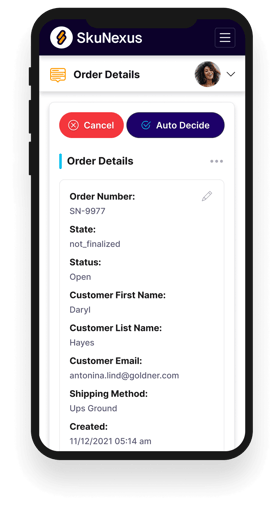
See How SkuNexus Transforms Inventory, Orders, and Fulfillment
- Say goodbye to stock issues with real time inventory tracking
- Make shipping and handling a breeze with our automated system
- Easily manage orders from all your channels in one place