The Ultimate Guide to Order Management: How the Process Works
What Is Order Management?
An order management system (OMS) is the software that tracks an order from the moment a customer places it through fulfillment and delivery. It pulls orders from every sales channel into one place, checks and reserves inventory, routes each order to the right location, and pushes status back to the customer. For a multi-channel merchant, it is the single source of truth that keeps sales, stock, and shipping in agreement. If you are evaluating systems to buy rather than learning how order management works, our omnichannel order management software page is the better starting point.
Order processing is the narrow mechanical part: take the payment, pick the goods, hand the parcel to a carrier. Order management is the wider job of holding the promise you made to the customer and making every downstream decision consistent with it, across every channel you sell on.
In plain terms, an OMS does five jobs:
- Captures orders from your store, marketplaces, retail, and phone into one queue.
- Validates payment, address, and fraud before an order moves forward.
- Allocates inventory in real time so you stop overselling across channels.
- Routes each order to the warehouse, store, or vendor that should ship it.
- Tracks the order through shipment, delivery, and returns, keeping the customer informed.
The rest of this guide goes deeper on each of those, on the seven-stage process, the features that matter, the deployment models, and how to actually evaluate a system against your own orders.
What Is the Difference Between an Order Management System and an Inventory Management System?
An order management system owns the order and every decision it triggers; an inventory management system owns the count. The split shows up in the reservation lifecycle. An inventory tool records that you hold 40 units. The OMS is what reserves stock when an order is created, allocates it to a warehouse, dispatches it to a picker, and clears it at shipment, moving a different quantity counter at each step. That is why a count on its own cannot tell you what is genuinely sellable right now. In SkuNexus the two run on one platform, so the reservation, the routing decision, and the available number are one record instead of two systems reconciling overnight.
Do You Need an Order Management System
What 78 buying conversations actually show
We reviewed 78 buyer-eligible SkuNexus demo calls. In 42 of them at least one third-party inventory, warehouse, or shipping tool was named on the call, and in 35 the buyer named the tool themselves rather than being asked. The count proves the tool was in the room, not why it was there, so read it as a map of what mid-market operations are running today.
ShipStation is the most-named point solution in that set: buyers raised it in 15 of the 78 calls, and no other point tool in our tracked list passes 8. What the transcripts show is not a bad shipping tool. It is a shipping tool being asked to be the system of record. World Parts Direct said it outright on their call: "we don't even have a WMS. We use ShipStation, and we use it for more than it should be used for. We're using it as an OMS and shipping platform." A European jewellery brand described the same drift from the other end: "since the beginning, we used ShipStation just for creating labels, but with our growth, ShipStation is too poor for us." A third merchant had spent more than a year trying to get box and weight data out of their cart and into ShipStation so pickers would know which box to use.
That is the real answer to "do I need an OMS, or is my shipping tool enough." A shipping tool picks a carrier and prints a label. It does not reserve inventory, decide which of your locations should ship, or hold the record of what you promised the customer. When those decisions have nowhere to live, they end up in the shipping tool, in a spreadsheet, or in someone's head. If you are already there, our rundown of ShipStation alternatives covers the replacement paths.
I'll tell you what the wall actually looks like, because it surprises people. We worked with a garden and nature retailer who, on a peak day, auto-routed close to a thousand dropship orders across Walmart, Amazon, Target, and two separate Shopify stores. The hard part was never the order count. It was the routing. Every order had to find the right source, the right channel rules, and the right hand-off, without a human deciding each one.
That's the thing most people get wrong. They assume the breaking point is volume. It isn't. It's complexity. Almost every operational mess I walk into comes from one cause, scaling at speed without a process. The orders grew faster than the way of handling them did, and now routing decisions that used to be obvious eat the whole day.
That pattern shows up in almost every conversation we have. One merchant ran two Shopify stores feeding an off-the-shelf inventory tool they had used for four or five years. As they grew, the tool stopped growing with them: it got clunky, inventory "droppage" crept in, and they could no longer track stock or orders accurately. They were not looking for more features. They were looking for a system that would not break at their new size.
A larger retailer we spoke with sold across 21 markets through their own sites, marketplaces, and physical stores, with every store doubling as a fulfillment point. Their words for it were "friction" and "bottleneck," because inventory was not consolidated across channels and countries. Sales in one channel had no reliable view of stock sitting in another. That is the real cost of running without a unified order and inventory layer: not a missing feature, but an operation where no single number is trustworthy.
You need a real order management layer when these scenarios describe your daily reality:
Orders arrive across multiple fulfillment sources. Manual routing means checking inventory levels, calculating shipping costs, and coordinating fulfillment requirements for each order.
Routing decisions eat hours of your day. You're checking vendor inventory feeds, calculating shipping costs from different locations, and coordinating channel-specific fulfillment requirements.
Managing inventory across several locations or vendors. Your warehouse shows 12 units available, but Vendor A has 8, Vendor B has 15, and your retail store has 3. Manual coordination leads to overselling when multiple channels compete for the same inventory pool.
Coordinating complex fulfillment requirements. Amazon orders need specific packaging. Wholesale clients demand fast processing. Dropship vendors have different lead times and shipping restrictions.
Priority handling becomes critical when order priorities conflict. Your largest wholesale account places a big order requiring fast fulfillment while Amazon expects same-day processing for Prime orders. Without automated priority management, you'll consistently disappoint your most valuable customers.
The breaking point hits suddenly. Last Tuesday felt manageable. This Tuesday, three vendors are out of stock, Amazon suspended your account for late shipments, and your biggest wholesale client is threatening to switch suppliers.
An OMS eliminates manual routing by automatically evaluating all fulfillment options against your business rules, maintaining real-time inventory accuracy across all sources, and coordinating complex fulfillment requirements without human intervention.
Two ways to use this guide
If you are still mapping how order management works, keep reading; the sections below walk the process end to end. If you already know you need a system that routes every order to the right warehouse, vendor, or 3PL using rules you define yourself, the buyer-facing page is the faster read.
The Order Management Process: 7 Critical Steps
These steps determine whether your customer receives their order in two days or two weeks. Each stage has its own failure points that compound downstream.
Most businesses think the order management process means "take payment, ship product." Reality involves seven interconnected stages where delays cascade through the entire workflow.
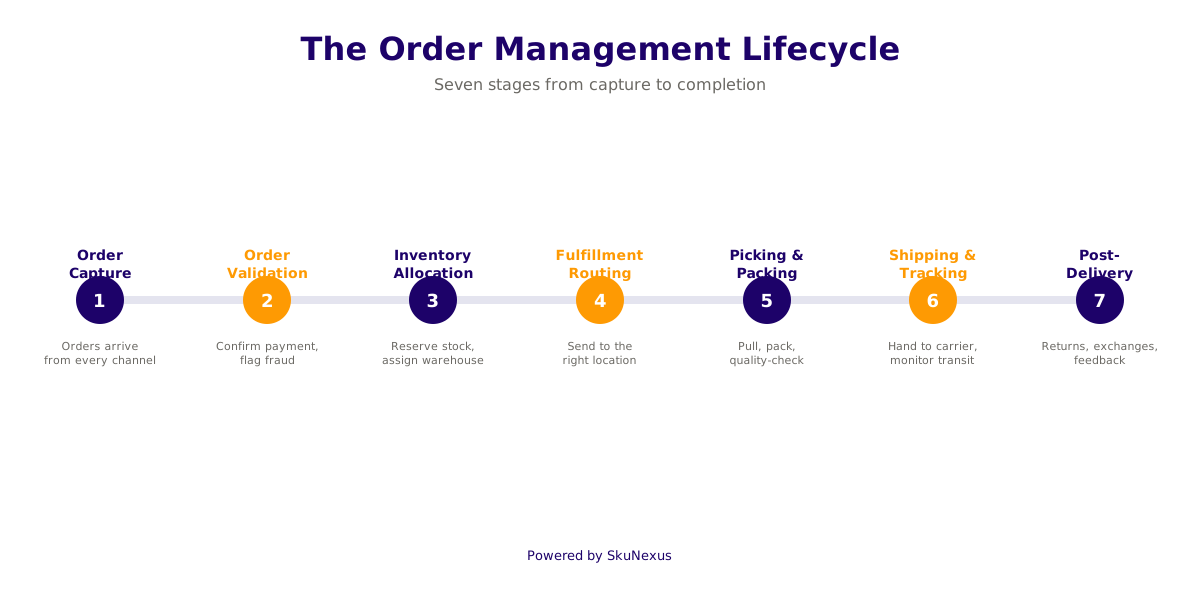
Problems emerge at predictable points. Address mismatches freeze orders in validation. Phantom inventory creates allocation failures when your system promises stock that does not exist. Without clear fulfillment routing, orders sit in limbo while teams debate which location should ship. Most operations do not break because of raw volume. They break when manual coordination across channels stops being something one person can hold in their head.
How Does an Order Management System Work?
An order management system works by holding one authoritative order record and advancing it through a fixed sequence of automated decisions, writing the result back to inventory and to the sales channel at every step. Orders arrive from each channel and are normalized into that single record. Validation clears the address and the payment. Inventory is reserved, which changes a counter rather than moving a box, then allocated to a specific location once routing rules pick the warehouse and the fulfillment method. Picking, packing, and shipping events decrement the count and emit tracking. Status flows back to every channel from the same record, which is why the storefront and the warehouse stop disagreeing.
Order Capture and Validation
The first few minutes determine order success. Your system receives customer information, product details, shipping address, and payment method. Validation checks address formatting and data integrity. Orders fail when required fields are missing.
Payment validation follows. Card authorization confirms the payment method while address verification matches billing and shipping locations. Fraud scoring evaluates order patterns against risk indicators. High-risk orders get flagged for manual review, which can hold an order for hours.
Inventory allocation happens simultaneously. Your system reserves ordered quantities and confirms stock levels, preventing overselling when multiple orders compete for the same product. Without real-time allocation, you oversell during peak periods, when the gap between what you've sold and what you've synced is widest.
Critical failure points: Incomplete customer data, address mismatches, and stale inventory data. Prevent with mandatory field validation, real-time address verification, and tight inventory sync intervals.
Inventory Allocation and Routing
Routing decisions determine which warehouse, store, or drop-ship location fulfills each order. The logic weighs inventory levels, shipping costs, and delivery speed requirements. Most systems default to single-location fulfillment unless shipping cost differences are large enough to justify a split.
Smart routing considers product availability at each location, shipping zones, carrier rates, and service level commitments. A customer in Chicago ordering a product available in both New York and California warehouses gets routed to New York for faster delivery, unless California offers significantly lower shipping costs.
Critical failure point: Suboptimal routing that increases shipping costs or delays delivery. Configure routing rules that prioritize based on your service level commitments and cost thresholds.
Fulfillment Execution
Pick list generation converts order data into warehouse instructions. Lists include product locations, quantities, and packing specifications. Batch picking groups multiple orders with overlapping products, cutting warehouse labor compared to order-by-order fulfillment.
How an Order Management System Works With a 3PL
An order management system works with a 3PL by treating it as one more fulfillment node: the OMS captures orders from every channel, decides which orders route to the 3PL versus your own warehouse, transmits them electronically, and ingests the 3PL's shipment confirmations and inventory counts back into the shared record. That last flow is the one that breaks most often. If 3PL stock levels are not synced into the same inventory record your channels sell from, the 3PL's stock gets oversold or stranded. The payoff of the node model is flexibility: the same routing rules that split volume between two of your own warehouses can split it with a 3PL, which also makes it practical to bring fulfillment in-house gradually instead of in one cutover.
Packing procedures vary by product type and shipping method. Fragile items need protective materials. Gift orders require custom packaging. Automated carrier selection chooses based on delivery speed, package dimensions, and negotiated rates.
Tracking numbers generate automatically and customers receive shipment notifications. Status updates continue until delivery confirmation. Proactive communication is one of the most reliable ways to cut down on "where is my order" support tickets.
Critical failure points: Pick list errors from outdated product locations, wrong packaging selection, and missing tracking updates. Use barcode scanning verification, automate packaging rules and carrier selection, and set up automated notifications at key milestones.
Essential Features to Look For in an OMS
Feature checklists get long fast, but a short list separates a real order management platform from a glorified order log. When you evaluate systems, look for these:
- Multi-channel order capture. One queue for your store, Amazon, eBay, Walmart, retail POS, and phone orders, not a separate login per channel.
- Real-time inventory sync. Stock updates flow continuously across every channel and location, so the last unit sold on one channel shows as unavailable on the others without waiting for a batch run.
- Rules-based order routing. Orders route to the optimal warehouse, store, or vendor automatically, weighing inventory, shipping cost, and delivery speed against rules you set.
- Inventory allocation and reservation. Units are reserved the moment an order validates, which is what actually prevents overselling when channels compete for the same pool.
- Pick, pack, and ship workflow. Pick list generation, barcode verification, and carrier rate shopping built into the fulfillment flow rather than bolted on.
- Returns and reverse logistics. Returns, restocks, and refunds handled inside the same order record, not in a side process.
- Integration surface. Pre-built and API-based connections to your ERP, storefronts, marketplaces, WMS, and carriers, with webhooks and documented rate limits.
- Order tracking and customer notifications. Automated status updates at confirmation, shipment, and delivery so your team stops fielding "where is my order" tickets.
- Reporting and exception alerts. Real-time visibility into stuck orders, payment failures, and stockouts before they reach the customer.
- Configurable workflows. The ability to change routing logic, statuses, and business rules to match how you actually operate, instead of bending your process around a fixed template.
If you are still sorting out where the order layer ends and the warehouse layer begins, see OMS vs WMS: what is the difference.
The last item is where mid-market merchants get burned. Standard configurations work for standard businesses; the edge cases that make you competitive are exactly where rigid platforms break. We cover that trade-off in Types of Order Management Systems below.
What an OMS Should Do for a Mid-Size Ecommerce Brand
For a mid-size ecommerce brand, an order management system should do six things: capture orders from every channel into one queue, keep inventory allocated and in sync across channels in near real time, route each order automatically to the best fulfillment location, handle split and partial shipments cleanly, process returns inside the same order record, and support wholesale requirements such as EDI alongside direct-to-consumer orders. Roughly 500 to 5,000 orders a day is the range where each of these stops being a nice-to-have, and it sits squarely inside the range SkuNexus serves.
- Multi-channel order capture means every order, from your store, marketplaces, retail, and wholesale, lands in one queue with one set of statuses, so nobody works out of five browser tabs.
- Real-time inventory sync means stock is reserved the moment an order validates and every channel sees the change; at mid-market volume, an hourly batch sync leaves a window in which two channels can sell the same unit.
- Automated order routing means rules decide which warehouse, store, or dropship vendor ships each order; once you ship from more than one location, routing by hand becomes a full-time job that still misses the cheapest option.
- Split and partial fulfillment means one order can ship from two locations, or in two waves, without breaking tracking, customer notifications, or the financials behind the order.
- Returns processing means the return, the restock decision, and the refund live on the original order record instead of in a side spreadsheet.
- EDI and wholesale support means the system can exchange the standard documents retail partners require, such as purchase orders, advance ship notices, and invoices, without a separate manual workflow.
The honest counterpoint: below a few hundred orders a day on a single channel, your commerce platform's order screen plus a shipping app usually covers this list well enough, and a full OMS is more system than the problem calls for.
Omnichannel Order Management
Omnichannel order management processes orders from your website, Amazon, eBay, retail stores, phone sales, and mobile app through a single unified workflow. Each new channel you add multiplies the coordination points where manual management breaks down.
This guide covers omnichannel at a working level. For the deeper playbook on unifying inventory and order flow across every channel, see our omnichannel order management breakdown.
Each channel has different requirements. Amazon expects same-day processing. Your website offers gift wrapping. Phone orders need manual payment verification. Retail stores require immediate inventory deduction.
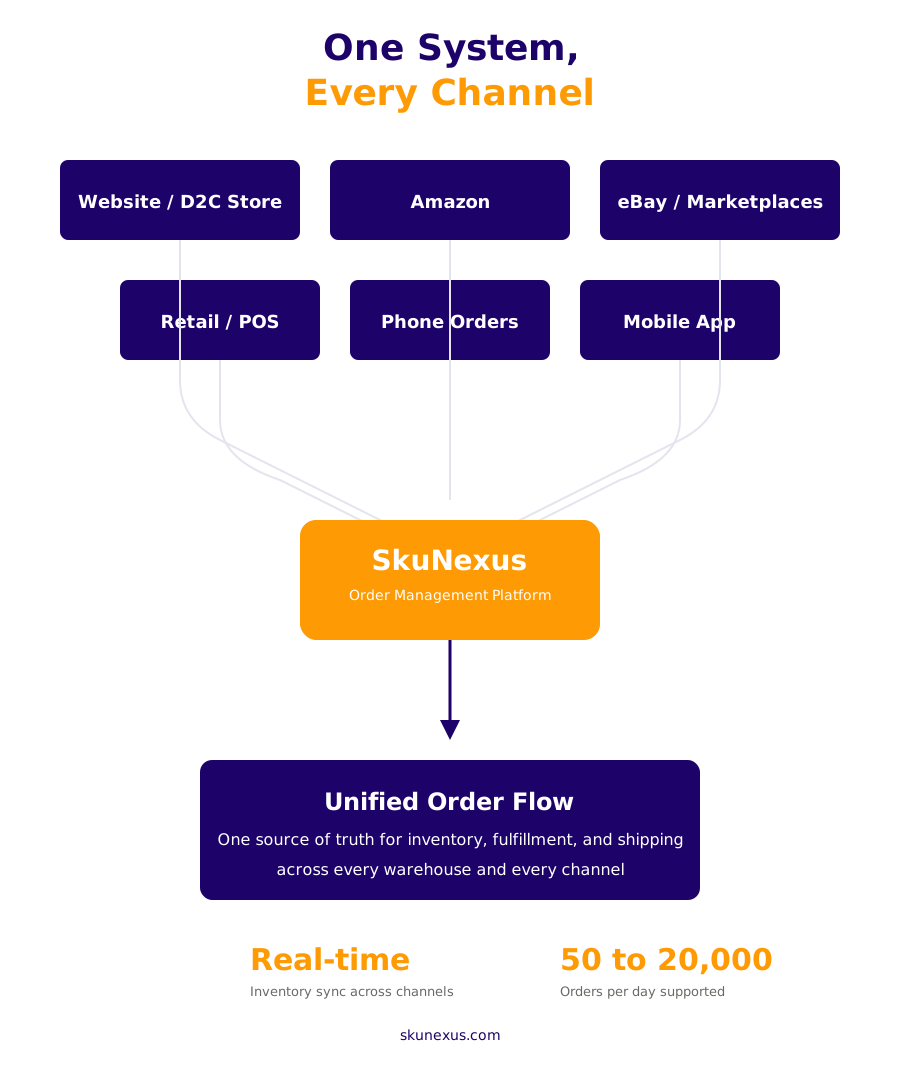
Most businesses fail at multi-channel order management because they process each channel separately. Orders use different workflows. Inventory counts don't sync. Customers receive conflicting delivery information.
A specialty automotive parts distributor managing B2B wholesale, Amazon marketplace, eBay auctions, and direct sales shipped Amazon orders from the closest warehouse while wholesale orders always shipped from their main facility. A wholesale customer in Florida received parts from California while an Amazon customer in the same city got parts from Jacksonville.
Unified Inventory Visibility
Real-time inventory tracking prevents overselling and enables accurate availability promises. When a customer buys your last unit on Amazon, your website should reflect "out of stock" almost immediately, not hours later.
Most businesses sync inventory on a schedule, every couple of hours. Your website shows 10 units while Amazon shows 15 units and your retail store shows 8 units. All three numbers are wrong.
The automotive client oversold during peak periods because inventory updated on a delay. A popular brake pad sold out on Amazon, but their website kept accepting orders until the next sync. Those gaps created a steady stream of weekly cancellations, and every cancellation is a customer you have to apologize to.
Real-time sync means inventory updates flow continuously, with API connections that can keep pace during a sales spike.
Consistent Order Routing Rules
Order routing complexity multiplies when channels have competing fulfillment requirements. Wholesale orders need fast processing. Amazon orders require same-day fulfillment. Website orders have more slack but need detailed tracking.
The automotive distributor needed routing logic considering inventory levels, shipping costs, carrier relationships, and service commitments at the same time. Wholesale customers paid premium prices for guaranteed fast delivery while Amazon customers expected free shipping over a threshold.
Custom routing rules prioritize high-margin wholesale orders for fastest shipping while routing Amazon orders to minimize costs. The system evaluates inventory levels at each warehouse, carrier rates, delivery zones, customer history, and order value.
Centralized Customer Communication
Customers expect consistent communication regardless of order channel. They shouldn't receive different tracking formats based on whether they ordered through your website or mobile app.
The automotive client's support team used several different systems, which meant customers could receive conflicting delivery dates for the same order. Centralized communication means every interaction references identical order data with consistent messaging across all channels.
How Does an Order Management System Enable BOPIS?
An order management system enables buy online, pick up in store by treating each store as a fulfillment location with its own available count, then holding the exact unit the customer paid for. Three things have to be true. Store stock has to reach the website in near real time, or you sell an item that left the shelf an hour ago. The order has to reserve that unit at that location on placement. And once staff set the unit aside, it has to stop counting as sellable. SkuNexus does the last part with location availability config, which excludes staging locations from available stock, and routes pickup as its own fulfillment method in the routing decision engine. The BOPIS implementation checklist covers the store-side rollout.
Managing Inventory in Real-Time
Four inventory management failures destroy order fulfillment before products leave your warehouse. Each creates cascading problems that turn simple orders into customer service nightmares.
Overselling happens when you sell items you don't have. Your website shows 15 units available while your retail store shows 8 units. Both numbers are wrong because inventory updates happen on a delay instead of instantly.
A sporting goods distributor with 12 retail locations oversold a meaningful chunk of their inventory during Black Friday weekend. Their legacy system updated stock levels on a multi-hour cycle. When a popular item sold out in-store in the morning, their website kept taking orders until the afternoon sync. The result was a wave of angry customers and a pile of expedited shipping costs they ate to make it right.
Underselling costs more than overselling but gets less attention. Your system shows zero inventory when you actually have units available. Delayed warehouse updates create phantom stockouts, and you lose sales you could have made.
Split shipments fragment orders when inventory allocation fails. A customer orders three items shown as in-stock. During fulfillment, one item isn't available at the assigned warehouse. The order splits into two shipments with different delivery dates. Shipping costs double while customer satisfaction plummets.
Stockout delays occur when inventory counts lag behind actual availability. Your warehouse receives new stock in the afternoon but your inventory system doesn't reflect it until that evening. Orders placed in between get delayed for no real reason.
Real-time inventory tracking prevents these failures by updating stock levels continuously across all channels and locations. When your Los Angeles warehouse sells a unit, your New York store immediately sees updated availability.
Multi-vendor operations amplify this complexity. A business managing dozens of suppliers with drop-ship arrangements faces disparate inventory feeds, some real-time, others daily batches. Unified inventory systems normalize these data sources into a single view.
Warehouse management integration enables accurate allocation decisions. Your system knows exactly which products sit on which shelves in which warehouses. When a Phoenix customer orders three items, the system identifies that Dallas has all three while Los Angeles only has two.
Companies implementing real-time tracking sharply reduce overselling, recover the sales they were quietly losing to phantom stockouts, and cut down on split shipments. They also eliminate the manual inventory reconciliation that eats hours out of the day in most operations.
Order Fulfillment and Automation
I've helped implement order management systems for a lot of merchants, and the same automation patterns consistently take real time out of fulfillment. The biggest wins come from operations drowning in routing decisions. Multi-vendor marketplaces, dropship networks, businesses juggling 3PL relationships.
A good example is Graeter's, the ice cream company that's been around for over 150 years. They were running three separate warehouses with their own ways of doing things, and their team was calculating dry-ice requirements by hand for shipments that genuinely need it. We worked with them to unify those three warehouses into one view and get to fully automated order handling across the operation. The manual dry-ice math went away. That's the kind of problem automation is actually good at. The repetitive judgment calls a person shouldn't have to make order by order.
Automated Pick List Generation
Most operations batch pick lists on a schedule, which builds in artificial delays. An order that comes in mid-morning waits for the next batch run before fulfillment even starts.
Real-time pick list generation creates optimized instructions as soon as an order validates. The system groups orders by warehouse zone and calculates efficient routes, which cuts walking time. Pick accuracy improves when automation eliminates handwritten notes.
One apparel client moved off batch delays entirely. Orders flow continuously to the warehouse floor instead of stacking up waiting for a scheduled run.
Barcode Scanning Integration
Manual verification is where fulfillment errors creep in, and each one triggers a return and a damaged relationship. Barcode scanning verifies every picked item against the original order before packing.
Where this matters most is product variants with similar packaging. They're easy to mix up by eye. Barcode verification removes that guesswork because the scan matches a unique SKU, not a person's best judgment under time pressure.
Dynamic Carrier Selection
Manual carrier decisions add up, with teams weighing cost against delivery requirements order by order. Automated selection makes that call against your business rules instead.
Rate shopping compares carriers and picks a cost-effective option that still meets the delivery commitment. That recovers a real amount of staff time that used to go into carrier decisions every week.
The system can also respect your preferences. If you consistently choose FedEx for electronics despite higher costs, the rules can prioritize that reliability over pure cost optimization.
Intelligent Batch Processing
Processing orders individually creates inefficiencies that compound with volume. Batch processing groups orders with similar characteristics for handling together.
Geographic batching groups orders shipping to the same regions. Product-based batching handles identical items during a single warehouse visit. At higher daily volumes, batching meaningfully reduces per-order handling.
Exception Workflow Automation
Exception handling means payment failures, address errors, and inventory shortages. That work is where a large share of manual processing time disappears when there's no workflow for it.
Automated exception handling routes problems to the right team member with full context and a clear next step. What used to sit in a backlog for hours gets resolved quickly, and the backlog itself shrinks once the routing is in place.
Implementation Returns
Fulfillment automation pays back through labor you no longer spend on routing, errors you stop shipping, and shipping spend you optimize. For Graeter's, the clearest payback was the manual dry-ice calculation disappearing across three warehouses. The honest answer on timeline is that it depends on your volume and complexity. The operations that see returns fastest are the ones with the most repetitive manual decisions to remove.
At the choosing stage, a guide stops being the useful thing
Graeter’s Ice Cream is a working example of what this section describes: three warehouses on one order record, handling rules the team wrote themselves, and close to 100 percent of order processing automated.
How to Choose Order Management Software
After evaluating a lot of platforms with merchants ranging from small operations to enterprise, the selection process comes down to five criteria that separate successful implementations from expensive disasters.
Three Buckets: Which Part of the Market You Are Actually Shopping In
Before criteria, get your bucket right. The same three-way split comes up on demo call after demo call, usually raised by the buyer before we raise it.
1. Off-the-shelf SaaS. Quick to start and deliberately fixed. You adopt the vendor's workflow, which is fine for as long as your operation looks like the workflow they built. One buyer called the category "a jack-of-all-trades master of none" after outgrowing it. Another described a tool that simply stopped growing with them: it got clunky, inventory started dropping out, and they could no longer trust their own counts.
2. Legacy enterprise. NetSuite, SAP, Oracle, Manhattan, IBM. These can be bent to almost any process, but the bending is done by dedicated implementation teams and consultants, and licensing generally scales with headcount rather than with the value you get out of it. Buyers on our calls describe underusing what they bought and paying for manufacturer-oriented modules they will never touch. One put the whole tier aside in a sentence: "you've got like NetSuite and people like that, which I'm not really interested in going down."
3. The customizable middle. A platform whose routing rules, workflows, and integrations you can change without the enterprise implementation apparatus. This is where most mid-market merchants actually are, and it is the bucket the search results are worst at showing, because the pages ranking for these terms are written by bucket one and bucket two.
Buckets one and two fail in opposite directions. Bucket one fails when your process stops matching the product. Bucket two fails when the cost of changing it exceeds the value of the change. If your fulfillment logic is part of what makes you competitive, neither failure mode is survivable, and no feature comparison will surface that for you. SkuNexus sits in bucket three deliberately: close to every deployment we run carries some level of customization, and that is the reason merchants pick it.
Integration Capabilities: The Make-or-Break Factor
Your OMS must connect to existing ERP, warehouse management systems, and sales channels without custom development. A large share of OMS implementations fail because integration complexity gets underestimated during vendor selection.
ERP integration requires bidirectional financial data synchronization. Your OMS pushes completed orders for invoicing while receiving customer credit limits and payment terms. Systems that can't map ERP chart of accounts create manual journal entries that eat hours a day for high-volume operations.
Warehouse management integration demands real-time data flow. Your OMS sends pick lists with inventory locations to the WMS, which returns fulfillment confirmations with tracking numbers. Inventory adjustments from cycle counts must update OMS stock levels fast enough to prevent overselling.
Look for REST APIs with webhooks, comprehensive documentation, and rate limits that can handle your peak. Poorly designed APIs require expensive middleware that adds weeks to implementation timelines.
Scalability Architecture: Handle 3x Current Volume
Size the platform for several times your current order volume. Most businesses outgrow their OMS faster than they expect by selecting based on present requirements instead of growth projections.
Database architecture determines scalability limits. Traditional relational databases hit performance walls as daily order counts climb. Cloud-native systems with distributed databases handle far higher volumes without performance degradation.
Processing speed becomes critical during peak periods. Black Friday can spike order volume many times over within a few hours. Your system has to hold its processing speed during those surges, not buckle.
Automation Features: Eliminate Manual Tasks
Automation capabilities drive ROI by eliminating the manual tasks that eat hours out of a high-volume operation's day.
Routing automation makes fulfillment decisions based on inventory levels, shipping costs, and delivery speed. Manual routing takes minutes per order, every order. Automated routing makes the same decision in seconds while weighing cost and speed at the same time.
Advanced automation handles complex scenarios. When a customer orders three items, one available in Dallas, two in Chicago, the system calculates whether split shipping or single-location fulfillment provides the better experience and cost.
Real-Time Reporting and Visibility
Inventory management requires real-time visibility into stock levels and order status. Order tracking should update quickly on status changes. Inventory reporting needs to stay current enough to prevent overselling during high-volume periods.
Exception reporting identifies problems before they hit customers. Systems should automatically flag payment failures, inventory shortages, and shipping delays. Dashboard alerts for orders stuck in processing prevent customer service disasters before they start.
Common Selection Mistakes
Choosing based on price alone ignores implementation complexity and operational costs. The cheapest software often requires expensive customization costing more than higher-priced alternatives with better automation.
Ignoring integration complexity leads to implementation failures and data synchronization problems. Systems that can't integrate properly create manual workarounds that erase the automation benefits you were paying for.
Underestimating customization requirements forces businesses into rigid workflows mismatched to operations. Standard configurations work for standard businesses. The things that make you competitive usually require flexibility most platforms can't provide.
How to Evaluate an OMS: A Practical Framework
The criteria above tell you what matters. Here is how to run the evaluation itself without getting sold a demo that never touches your real orders.
1. Start from your hardest problem, not a feature list. Name where your current process actually breaks, whether that is overselling, slow routing, or manual exception handling, and make every vendor show you that exact scenario.
2. Map the integration surface before anything else. List every system the OMS has to talk to: your ERP for financials, your storefronts (Shopify, Magento, BigCommerce), your marketplaces (Amazon, eBay, Walmart), your WMS, and your carriers. If you sell primarily on Shopify, our Shopify order management checklist walks the same surface platform by platform. Integration complexity, not licensing, is what sinks most implementations. If a connection needs custom middleware, find out now.
3. Test against your real channels and volume. A demo run on a vendor's clean sample catalog tells you nothing. Ask to see your own order patterns, your own routing edge cases, and your peak-volume behavior.
4. Plan implementation by factors, not a fixed calendar. Timeline depends on data-migration complexity, the number and quality of integrations, how much custom workflow you need, and how much staff training go-live requires. A clean single-channel catalog stands up quickly; multi-location inventory with historical data and several integrations takes longer. Be suspicious of any vendor who quotes a timeline before seeing your data.
5. Scope the whole first year, not the license. Licensing is one line item. Implementation services for complex integrations can match or exceed it, and data migration and staff training are real budget lines that rarely appear in a first quote. Ask every vendor to scope against your actual channel and location count instead of a tier.
6. Weigh how much of the system you can change. For standard needs, a packaged platform is fine. If your fulfillment logic is specific, the amount of the system you can actually modify will matter more in year two than any feature on the comparison sheet.
What Is the Right Order to Roll Out an OMS?
Sequence the rollout so that each stage depends only on the one before it. Get inventory accurate first, because routing rules built on counts you do not trust will make confident wrong decisions. Connect your highest-volume channel next and run it alongside the old process long enough to compare outputs on real orders. Write routing rules for the ordinary case and let everything else fall into a review queue rather than trying to encode every exception before launch. Cut over one warehouse or one channel at a time. Keep the old system readable, not running, so returns against orders placed before the switch still have a record to land on.
Types of Order Management Systems
Most businesses don't realize they're choosing between three fundamentally different order management system architectures. Each type serves different operational models, and picking the wrong one creates expensive problems that surface well after implementation.
Standalone Order Management Systems
Standalone OMS platforms focus exclusively on order processing and fulfillment coordination. They integrate with your existing ERP, accounting, and warehouse systems through APIs while maintaining their own order database.
Best for: Multi-channel retailers at meaningful daily volume who need advanced routing and fulfillment automation. Companies with established ERP systems that lack sophisticated order management capabilities.
Advantages: Purpose-built for complex order scenarios. Advanced automation for routing, inventory allocation, and exception handling. Faster implementation since you're not replacing core business systems.
Limitations: Requires integration management across multiple systems. Data synchronization complexity increases with connected systems.
Dropship-heavy operations belong in this category too. The OMS holds the order, raises a vendor purchase order against the supplier who will actually ship it, and tracks that PO through to fulfillment alongside the orders shipping off your own shelves.
ERP-Integrated Order Management
Enterprise Resource Planning systems include order management modules alongside accounting, inventory, and customer management. Orders flow through the same database as financial transactions and inventory adjustments.
Best for: B2B companies with complex pricing structures, credit management requirements, and deep financial reporting needs. Operations where order data must integrate tightly with accounting workflows.
Advantages: Single source of truth for all business data. Financial reporting and inventory management live in one place. Reduced integration complexity.
Limitations: Order management features often lag specialized OMS platforms. Customization requires expensive ERP consultants. Implementation timelines run long for complete systems.
Custom and Composable Solutions
Custom systems are built on modern frameworks or composable commerce platforms using APIs to connect best-of-breed services. You select specific services for inventory, payment processing, fulfillment, and customer management.
Best for: High-growth companies with unique business models that don't fit standard software patterns. Multi-vendor marketplaces, subscription commerce, or complex B2B operations requiring extensive customization.
Advantages: Customization without vendor constraints. Modern architecture scales to enterprise volumes. You own the source code and development roadmap.
If a headless or API-first storefront is part of your stack, the order layer has to be built for that from the start. See our headless commerce order management guide for how the OMS fits a composable architecture.
Limitations: Requires technical expertise for implementation and maintenance. Higher upfront development costs. Ongoing responsibility for system updates and security.
Choosing the Right Architecture
Start with standalone OMS if you process orders across multiple channels and need immediate automation improvements. Implementation is moderate, both in time and integration complexity.
Choose ERP-integrated when order data must synchronize with complex financial workflows, customer credit management, or multi-entity accounting structures. Plan for a longer runway.
Build custom solutions when your business model creates competitive advantages that standard software can't support. Expect a real development investment that scales with complexity.
Match the architecture to your operational complexity, not your current order volume.
What Are Examples of Order Management Systems?
The useful examples are deployments, not vendor rankings, and they follow the three architectures above. A standalone OMS behind Magento runs Graeter's Ice Cream: dry ice calculated per order, IATA-compliant labels, orders routed across three warehouses. A dropship-first deployment runs Carewell, which holds no inventory of its own and raises vendor purchase orders automatically from BigCommerce orders. A multi-location retail deployment unified 477 New Look Vision stores in nine months. Ranked lists will not tell you which shape fits; the order type you fight with most will.
Cloud vs SaaS Order Management: Deployment Models
Architecture (standalone, ERP-integrated, custom) is one decision. How the system is deployed and who maintains it is a separate one. Most modern order management is delivered one of three ways:
- SaaS (hosted, subscription). The vendor hosts the software and runs updates, security, and scaling. You connect channels and integrations and pay a recurring fee. Fastest to stand up, least infrastructure to own. The trade-off is that you work within what the platform exposes.
- Cloud-hosted but dedicated. The software runs in the cloud, but on infrastructure provisioned for you, often with deeper configuration or source-code access. You get cloud scalability without sharing a single multi-tenant template. The trade-off is more setup and more ownership of how it runs.
- Self-hosted / on-premise. You run the software on infrastructure you control. Maximum control over data and customization, maximum operational responsibility. Rare for new mid-market deployments, but it exists for compliance-driven operations.
For most mid-market eCommerce merchants, the practical choice is between standard SaaS and a cloud deployment you can customize. SaaS order management matters because the system keeps pace with new sales channels and order volume without becoming one more thing your team maintains. The honest trade-off: packaged SaaS is faster and cheaper to start, but if your fulfillment logic is specific (per-location rules, multi-store inventory, unusual channel rules), how much of the system you can change matters more than how quickly you can switch it on. SkuNexus is delivered as a cloud platform you can build on, including source-code access, precisely so customization does not force you back onto your own servers.
Common Order Management Challenges and Solutions
The same handful of bottlenecks break operations once volume climbs past what manual coordination can carry. The scenarios below are composite patterns drawn from demo calls and implementations, not verbatim single-customer stories. Where a specific account is named on this site, we name it.
How often routing and splitting come up. In the same 78 buyer-eligible demo calls, order routing or order splitting was raised in 25 conversations once our own turns are counted, and by the buyer unprompted in 8. The gap is the interesting part: routing is more often a problem merchants are living with than one they have language for. They describe the symptom, which is a person deciding every order by hand, well before they describe the mechanism.
Order Routing Delays: Manual Decisions Kill Throughput
A multi-vendor marketplace processed orders across more than a dozen supplier locations. Their team spent minutes per order deciding which vendor should fulfill, based on inventory, shipping zones, and supplier performance. Multiply that by the day's orders and it's most of someone's job.
The breaking point: A Chicago customer orders three items available from vendors in Dallas, Atlanta, and Phoenix. While someone debates routing, the queue stacks up behind them.
Solution: Automated routing logic
Automated routing processes decisions in seconds using predefined business logic. Smaller orders route to the closest fulfillment location. Larger orders prioritize complete inventory availability. Cost variance thresholds trigger manual review only when shipping differences are large enough to matter.
Result: the day's routing work collapses from most of a shift down to a fraction of it, and the decisions are consistent.
What that looks like mechanically. In SkuNexus the call is made by a Decision Engine that evaluates routing rules in priority order, and the first rule that matches wins. Each rule carries condition groups (order value, SKU, shipping method, customer type), a strategy for selecting the warehouse, and the fulfillment methods it may use: ship, pickup, or drop-ship. The engine produces a Decision Plan showing which warehouse or warehouses fulfill the order, which method applies, and which items go where if the order has to split. That plan moves Draft, then Confirmed, then Executed, so the routing decision is a reviewable record instead of an invisible side effect. Rules can be tested against sample orders in a simulator before they go live, and a whole queue of orders can be auto-decided in one action.
Inventory Sync Failures: The Multi-Channel Nightmare
A home goods distributor selling through their website, Amazon, and wholesale channels updated inventory on a multi-hour cycle. During peak periods they oversold, because their Shopify store and Amazon both showed more units than actually existed for the same product.
Solution: Real-time multi-channel sync
Modern systems update inventory across all channels right after any transaction. Configure safety stock buffers for high-velocity products and set automatic allocation holds when inventory drops below reorder points.
Results: Overselling drops sharply, which removes most of the cancellation-related support tickets that came with it.
Split Shipment Chaos: When Orders Fragment
A supplement company's orders split far too often because their allocation system couldn't verify real-time warehouse inventory. Customers received products in separate packages from different locations, doubling shipping costs and confusing delivery expectations.
Solution: Unified allocation
Smart allocation verifies actual inventory across all locations before routing, prioritizing single-location fulfillment even when it costs a little more in shipping. Secondary locations activate only when the primary location can't fulfill the complete order.
Results: Split shipments drop substantially, which cuts shipping costs and improves the customer's delivery experience.
Communication Blackouts: Where's My Order?
Peak season exposes communication gaps. One electronics retailer saw support tickets climb during Black Friday because customers couldn't track order progress. Their system sent tracking numbers a day or two after shipment, leaving customers in the dark.
Solution: Automated status pipeline
Notification systems trigger updates at the moments that matter: order confirmation, payment processing, fulfillment routing, picking, shipment, carrier pickup, and delivery confirmation.
Results: Support tickets drop because customers know exactly where their orders stand.
Peak Volume Paralysis: When Systems Buckle
A fashion retailer comfortable at their normal daily volume hit several times that during a product launch. Their manual processes collapsed. Routing took far too long per order, payment validation queued for hours, and pick lists couldn't keep pace with demand.
Solution: Scalable processing
Systems built for this scale processing capacity with order velocity. When volume spikes well above normal, batch processing activates alongside geographic order grouping and express fulfillment lanes for priority customers.
During their next launch, with even more orders in a single day, processing held steady instead of falling apart.
Why Standard Solutions Fail
Most packaged systems use rigid templates that break under unique business requirements. This is where I'm biased, and I'll own it. We built SkuNexus to be customizable from the ground up, because we kept walking into operations where the off-the-shelf product forced the merchant to change how they work. Flexible platforms let you modify complex routing rules, specialized integrations, and industry-specific workflows instead of bending your business around software limitations.
When the system adapts to the merchant's process instead of the other way around, fulfillment gets faster because nobody's fighting the tool. That's the whole point. Respect what the merchant already built, then make it run better.
Frequently Asked Questions
What is the difference between OMS and ERP?
An order management system focuses specifically on the order-to-delivery workflow, capturing orders, allocating inventory, routing fulfillment, and tracking shipments. ERP systems manage broader business operations including accounting, finance, HR, and manufacturing. While ERP handles enterprise-wide processes, OMS specializes in optimizing the complete order fulfillment workflow from purchase to delivery.
What is the difference between OMS and CRM?
An order management system handles the operational logistics of processing and fulfilling orders across multiple channels. CRM systems manage customer relationships, sales pipelines, and marketing engagement. OMS focuses on inventory allocation, order routing, and warehouse management, while CRM tracks customer interactions and drives future sales opportunities.
How long does it take to implement an order management system?
Standard order management system implementations move quickly for businesses with straightforward requirements. Complex integrations involving multiple sales channels, custom workflows, or legacy system connections take longer. Implementation speed depends on your existing infrastructure, data quality, and how many omnichannel order management touchpoints need integration.
What's the ROI of an order management system?
Order management systems pay back by removing the manual order processing steps that eat staff hours, reducing inventory carrying costs through real-time inventory tracking, and preventing costly shipping errors that damage customer relationships. How fast that payback lands depends on your volume and how much repetitive manual work the system replaces.
What is order promising?
Order promising uses real-time inventory data and fulfillment capacity to give customers accurate delivery dates at checkout. The system checks available stock across multiple warehouses, considers shipping methods, and accounts for processing time to provide realistic delivery commitments. This prevents overselling and manages customer expectations before orders enter the fulfillment process.
What is an order tracking system?
An order tracking system monitors orders from purchase through delivery, providing real-time status updates to customers and internal teams. It integrates with carriers to capture shipping milestones, sends automated notifications, and handles exceptions like delivery delays. Modern tracking systems connect with the broader order management process to trigger actions like return processing or customer service alerts.
What is POS and OMS?
Point of Sale (POS) systems capture transactions at the moment of purchase, while order management systems orchestrate the entire fulfillment workflow that follows. POS handles payment processing and receipt generation; OMS manages inventory allocation, order routing, and delivery tracking. Businesses should prioritize upgrading the system that addresses their biggest operational bottleneck first.
What is an order management system (OMS)?
An order management system is the software that tracks an order from the moment a customer places it through fulfillment and delivery. It pulls orders from every sales channel into one place, checks and reserves inventory, routes each order to the right location, and pushes status back to the customer. For a multi-channel merchant, it is the single source of truth that keeps sales, stock, and shipping in agreement. If you are evaluating systems to buy rather than learning how order management works, our omnichannel order management software page is the better starting point.
What is SaaS order management, and why does it matter?
SaaS order management is order management software delivered as a hosted, subscription service rather than installed on your own servers. It matters because you get updates, security, and scaling without maintaining infrastructure, and you can connect new channels and integrations faster. For a growing merchant, the system keeps pace with new sales channels and order volume instead of becoming one more thing to maintain.
How do you choose an order management system?
Start with your hardest operational problem, not a feature list. Name where your current process breaks, whether that is overselling, slow routing, or manual exceptions, then test each system against that exact scenario. Check how it handles your channels, your locations, and your real order volume, and how much of its logic you can change. A demo run on your own orders tells you more than any comparison chart.
How much does order management software cost?
There is no single price, and any figure quoted without seeing your operation is guesswork. Cost is driven by order volume, the number of channels and locations, integration complexity, and how much custom workflow you need. Licensing is only one line: implementation services for complex integrations can match or exceed it, and data migration and staff training are real budget lines that rarely appear in a first quote. Ask every vendor to scope the whole first year against your actual channel and location count rather than a published tier. SkuNexus is scoped to your workflow for the same reason.
What is order management system software?
Order management system software is the application layer that captures orders from every sales channel, allocates inventory, decides where and how each order ships, and tracks it through delivery. It sits between your storefronts and marketplaces on one side and your warehouse and carriers on the other, keeping stock counts, routing rules, and customer updates consistent across all of them. Unlike a basic shipping tool, order management system software is built for multi-location, multi-channel routing and the exceptions that come with real order volume.
What should an order management system include?
At minimum, an order management system should include unified inventory visibility across every location and channel, configurable routing and allocation rules, automated fulfillment steps such as pick list and shipping label generation, real-time order status with customer notifications, and reporting you can act on. For mid-market operations, two capabilities matter most: clean integrations with your existing storefronts, ERP, and carriers, and the ability to change the routing and workflow logic as your process evolves rather than forcing your process to match the software.